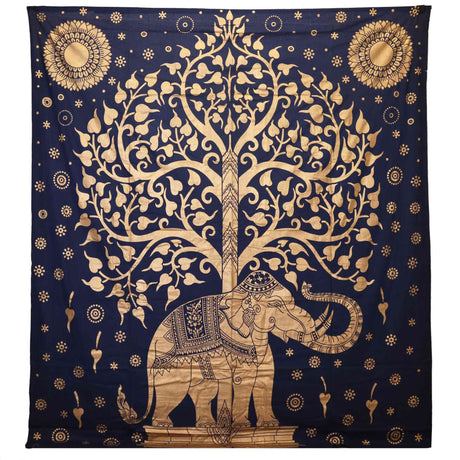
There is a moment, on the evenings that go well, when the day sets itself down before you do. Coat off, keys in the dish, the kettle finding its note. The last light comes through the window at a slant and catches the branches of the Tree of Life that hangs opposite the door — and for a half-second the room is only that: warm plaster, soft wood, the slow spread of a carved crown of branches reaching upward. You do not look for it. Your eye simply lands there, the way it has learned to land there, and the day has a place to be set down. This piece is about that moment — the threshold a wall becomes when the image on it is one your eye returns to — and about the long, many-named shape that keeps finding its way onto walls like yours.
Why this image, of all images
Why does this particular shape — a tree with roots below and branches above — keep finding its way onto walls, textiles, altars and doorways across the world? It is one of the oldest shapes a human hand has drawn. Not the oldest mark, but one of the oldest that clearly means something, that arrives already pointing somewhere. A line scratched in ochre could be a line. A tree with roots in the earth and branches in the sky is already a small cosmology: above and below joined by a single trunk, the visible and the less-visible held in one figure. You half-know this already. The image has been turning up in rooms for so long that it reads as familiar before it reads as anything else — which is, perhaps, why it keeps being chosen. Among the spiritual symbols for the home that people live with longest, the tree is the one that asks the least and holds the most.
What the Tree of Life has always meant

The Tree of Life is not the property of one tradition. It is a shape that has arrived, independently and repeatedly, across mythological, religious and philosophical traditions — generally standing for the interconnectedness of all life, the joining of divine and earthly realms, and the cycle of life, death and renewal. The image a wall holds today carries a very long memory, and it is worth knowing a little of what that memory contains.
In Norse cosmology, the tree is Yggdrasil — an immense sacred ash, Fraxinus excelsior, around which the nine worlds are arranged. The Prose Edda, compiled in the thirteenth century by the Icelandic scholar Snorri Sturluson, describes it plainly: It is the ash Yggdrasil. Beneath one of its roots lies the well Urðarbrunnr, where the gods hold their daily court, and where three Norns — Urðr, Verðandi and Skuld — pour water and mud over the tree to keep it from rotting. The name itself is generally read as Odin's horse, a kenning for the gallows, linking the world-tree to the Hávamál episode of Odin hanging from a tree to win the runes.
In Hindu tradition, the tree is the Kalpavriksha — the wish-fulfilling aeon-tree, Sanskrit कल्पवृक्ष — said to have emerged during the Samudra Manthana, the churning of the ocean of milk, and carried to Indra's heaven. It appears in Vedic scripture, in the Harivansha Purana, in Hemadri's Caturvargacintamani and in Kalidasa's Meghaduta, and it is shared by Hindu, Jain and Buddhist traditions alike.
In Buddhism, the tree is the Bodhi — a Ficus religiosa, the sacred fig with its heart-shaped leaves, under which Siddhartha Gautama is said to have sat toward awakening at Bodh Gaya in Bihar, around the fifth century BCE. The Mahabodhi Temple that marks the site is a UNESCO World Heritage Site. A sapling carried to Sri Lanka in 288 BCE by Ashoka's daughter Sanghamitta still grows at Anuradhapura as the Jaya Sri Maha Bodhi — regarded as the oldest living human-planted tree with a known planting date.
In Jewish mystical tradition, the Tree of Life is a diagram of ten sefirot — Keter, Hokhmah, Binah, Hesed, Gevurah, Tiferet, Netsah, Hod, Yesod and Malkuth — the divine emanations, sometimes joined by an eleventh, Da'at. Kabbalah's roots reach into the Middle Ages; the now-iconic tree diagram emerged in the fourteenth century, was first printed in 1516, and the familiar twenty-two-path version with Hebrew letters was set out by Athanasius Kircher around 1652.
Further back still: in ancient Mesopotamia, the Assyrian sacred tree was carved into palace reliefs as nodes and crisscrossing lines, attended by winged figures — though no surviving text explains it, and Tree of Life is a modern scholarly name rather than an ancient one. In ancient Persia, the Gaokerena was a sacred white haoma tree planted by Ahura Mazda and guarded against the destructive spirit Ahriman; the haoma plant-drink is cognate with the Sanskrit soma, a shared Indo-Iranian root. In the Hebrew Bible, Etz Chaim — tree of life — appears in Genesis, distinct from the tree of knowledge, and in Proverbs wisdom itself is called a tree of life; in Christian tradition the tree returns in Revelation, its leaves for the healing of the nations. The Celtic world venerated sacred trees and groves — the word druid may come from the Proto-Celtic *dru-wid, oak-wise or tree-knower — and sacred groves, nemeta, are attested on Anglesey until the Roman destruction in 60 CE.
The point is not the list. The point is that everywhere a culture sat down to picture how the worlds join, it drew a tree. The shape on your wall is one leaf on a very large branch.
The wall as a place of return
Back to the room. A Tree of Life on the wall becomes, over the weeks, a fixed point — not because anyone decided it would be, but because the eye is a creature of habit, and the image is patient. At the start of the day you pass it with a question forming. At the end of the day you pass it with the day's residue. Over time the image begins to hold whatever you bring to it, the way a well-trodden path holds the shape of footsteps.
The practice — if there is one — is the returning. The image keeps the note; you do the work of attention. This is the difference between a symbol you live with and a symbol you look up. A symbol you look up has an entry and an exit: you read it, you know it, you close the tab. A symbol you live with has no exit. It simply stays, and the meaning it carries is the meaning your days give it. The traditions above are the inheritance. What the image holds for you, in your room, is something you build by showing up.
How to bring a Tree of Life onto your wall

Choosing a Tree of Life for a wall is best done by feeling rather than by meaning — by the quality you want to return to, not by a fixed correspondence someone else has assigned. The image is generous enough to hold whatever you bring to it; the question is only which rendering of it your eye will not tire of in a year.
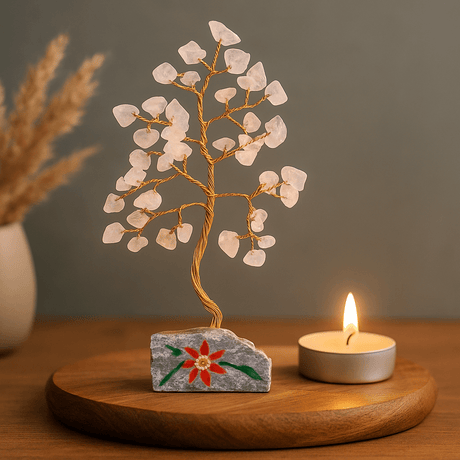
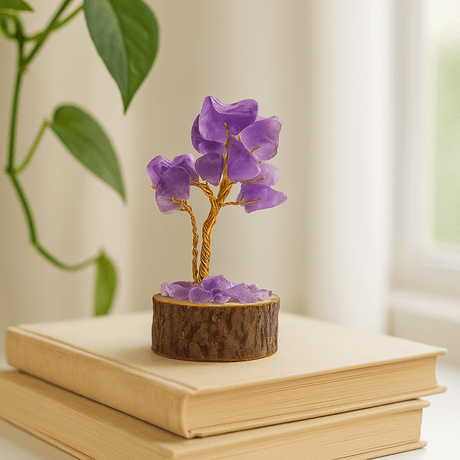
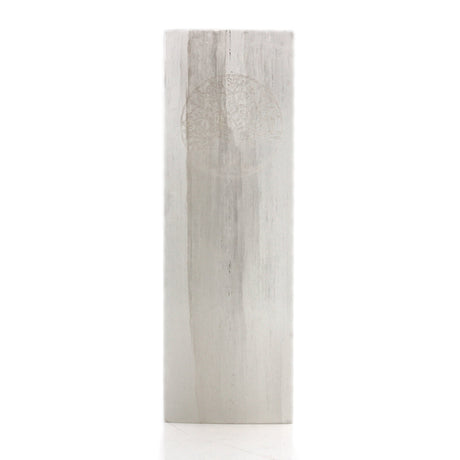
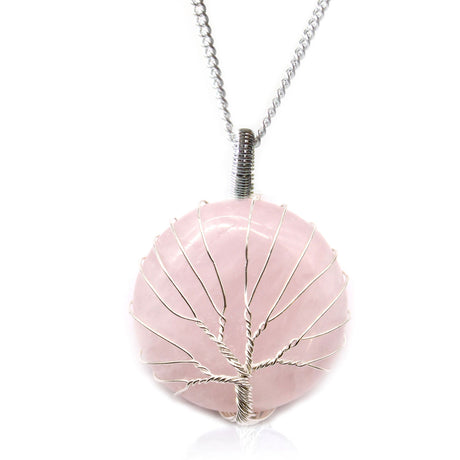
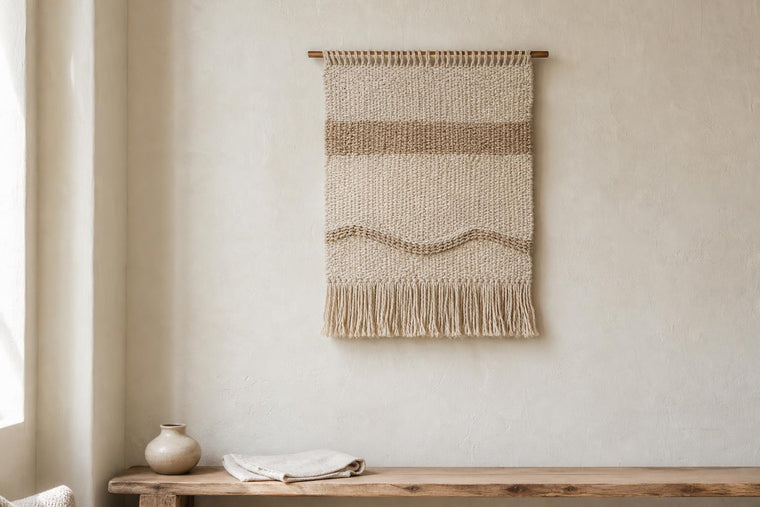
The most direct way in is Tree of Life wall décor that is already shaped for the wall — carved panels, printed textiles, framed prints. A hand-carved wooden panel brings weight and warmth; it asks for a plain wall where the chisel marks can be felt. A cotton tapestry softens a larger, brighter space and diffuses hard light. A smaller framed piece or a wire-worked gemstone tree works where a full panel would overwhelm. Among Balinese wood carvings, the Tree of Life is one of the oldest motifs — Suar wood, the roots and branches cut from a single piece, so the unity the image stands for is literally material, not just depicted.
Wood, cotton, or metal: choosing your piece

The material changes the mood more than the motif does. A carved wood panel is the most ancient reading — the tree rendered in the medium that is itself a tree. It carries weight, grain, the warmth of the workshop; it wants a quiet wall and a low light. Cotton tapestries and wall hangings are the softer answer — the same image draped in textile, the branches printed in earthy tones, the weave catching the light differently through the day. They suit a bedroom, a reading corner, a wall that takes the morning sun. A wire-worked gemstone tree is the symbol in miniature — leaves of polished stone on a metal frame, set on a shelf or a desk beneath the wall piece, so the image echoes without repeating. And for a room that already leans into boho home décor, a Tree of Life tapestry sits naturally among the plants and the linen, asking nothing extra of the space.
Where it lives best
Placement is part of the practice, not a styling tip. The wall opposite the bed is the classic choice — the first thing the eye finds on waking, the last thing it finds before sleep. The corner by the reading chair is quieter and more private; the image becomes a companion to the book rather than a statement. The entry you pass each evening is the most practical — it catches you at the exact moment of return, coat still on, before the day has been set down.
Let it rest at eye level rather than near the ceiling, so it reads as part of the room rather than signage. Give it light, but not direct sun — a carved wood panel will dry and crack under a daily blast of midday light, and a cotton tapestry will fade. The daily sightline is what matters: the angle from which you actually see it, not the angle from which it photographs best. Place it where your eye already goes, and it will do the rest.
A small ritual of return
One concrete practice, if you want one. Each evening, at the image, do three small things:
- One breath. A slow breath in, a slow breath out, standing or sitting before it. Not a meditation — a single breath, the length of one return.
- One named intention. Something you want to hold steady tomorrow. Patience with the work. Attention to the child. Kindness with yourself when the afternoon thins out. Say it inwardly, and let the image keep the note.
- One letting-go. One thing from today that is finished, released at the foot of the tree, so to speak — set down rather than carried.
The object holds the place. You do the returning. The shape of a habit, over time, becomes the texture of a life.
The image at the far end of the evening
Back to the room. The light has gone; the branches are still there. The kettle is quiet, the coat is on its hook, the day is set down. The Tree of Life on the wall holds nothing you did not bring to it — and that is the whole of it. You came back. You stopped for a breath. You named one thing to carry and one thing to release. And the image, patient as it has always been, was simply there — the way a tree is there, rooted and reaching, through every season of the people who walk beneath it.
Tomorrow you will pass it again. It will still be there.