
Piatră prețioasă
Garnet
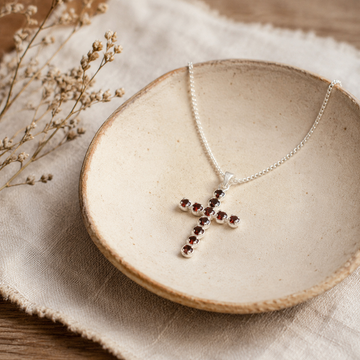
Deep red pyrope garnet: born in the earth's fire, known for five thousand years. The tradition links it with the root and sacral, with vitality, love and the work of beginning.
Deep red
Cumpără de la Garnet
 India
India
 China
China
Ce este Garnet?
Garnet is a silicate mineral (aluminium silicate, specifically) that forms in metamorphic rock and some volcanic magma. The deep red pyrope variety, the one most people picture, gets its colour from magnesium. There are green, orange, pink and even colourless varieties, but red has always dominated the conversation. The name comes from the Latin granatus, from granum, a seed, the Romans thought rough garnets looked like pomegranate seeds, which is a precise description if you've ever held one.
The tradition has kept garnet close for a long time. Egyptian jewellery from four thousand years ago contained it. Medieval travellers carried it as a talisman against harm on the road. Victorian mourning jewellery used it. Roman signet rings bore family crests cut in garnet. The tradition holds it with the root and sacral chakras, the body's two most physical centres, and with the element of fire. Capricorn and Aquarius are its zodiac companions.
What the tradition seems to reach for in garnet is the quality of embers: something already burning, waiting to be noticed. The associations follow from there: energy, vitality, love, courage. The invitation is the same as for any stone in the catalogue: give it a role in a practice. Choose a piece, set an intention in plain words (energy, presence, begin) and let it be the object that marks where the intention lives. A garnet in the pocket, a ring on the finger, a small cluster on the desk. The practice is yours; the stone keeps it in view.
Below: garnet in its deepest reds. Faceted stones, tumbled pieces, jewellery, and objects for the body and the room.