Ingyenes szállítás £33 felett · feladás az Egyesült Királyságból · adókkal együtt

Felfedezés › Szimbólumok és oltár

Mandala

A mandala, from the Sanskrit for circle, is a sacred diagram of Hindu and Buddhist tradition: a picture of the universe arranged around a centre. Monks use it as a map for meditation, moving in thought from the outer rings towards the middle. Today many people also draw or colour mandalas as a slow, focused practice.

Word
Sanskrit for circle
Traditions
Hinduism, Buddhism
Used for
meditation and ritual
Mandala

Vásárolj itt: Mandala

4 termék

What it means

A mandala is a whole world in one circle. In Hindu and Buddhist tantric practice it is a consecrated space with a deity or a buddha at its centre, and the person meditating travels inward, ring by ring, towards that centre. The outer rings guard the way; the centre is what the practice is for.

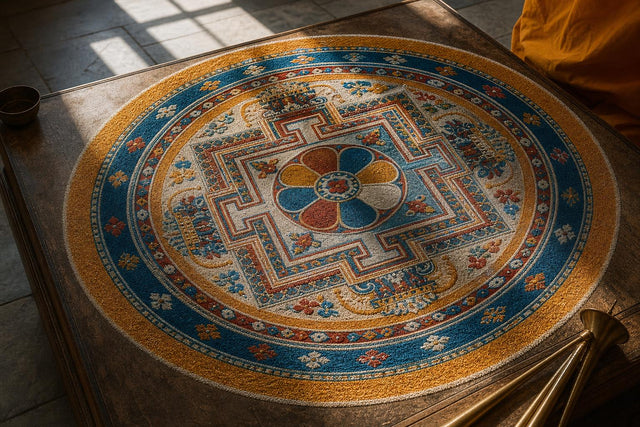
Most traditional mandalas show a square palace inside a circle, with four gates facing the four directions. The square holds the order of the world, the circle around it holds the whole, and in meditation you enter, in thought, through one of the gates.

How it is made

Mandalas are painted on cloth or paper, cast in bronze, built in stone or laid out on prepared ground with coloured threads and powders. Tibetan monks make them from coloured sand over many days, then sweep the sand away: a lesson in impermanence.

In the twentieth century the psychologist Carl Jung drew mandalas himself and helped bring the word into Western thought, which is why it now also means any circular design with a strong centre.

At home

People hang a mandala where the eye can rest: above a meditation corner, opposite a reading chair, in a hallway passed several times a day. Others keep a notebook of their own, drawn with a compass and filled in slowly over an evening.

Choosing one

A traditional mandala holds the figures and symbols of one particular practice; a decorative one keeps the circle and the centre without them. Both give the eye a place to return to. Keep printed and painted pieces out of strong sun.

Gyakran ismételt kérdések

What is the purpose of a mandala?

In Hindu and Buddhist practice it supports meditation and ritual: a map of the universe with a sacred centre. At home many people use it simply as a point of focus.

Why do monks destroy sand mandalas?

Sweeping away days of careful work is part of the teaching: everything that is made will change. The sand is often poured into flowing water.

Is colouring a mandala a form of meditation?

It is not the traditional practice, but slow, repetitive colouring keeps attention in one place, and many people find it restful at the end of a day.

Where should I hang a mandala?

Where you sit still: above a meditation cushion, beside a reading chair or in a hallway you pass often, at about eye level.