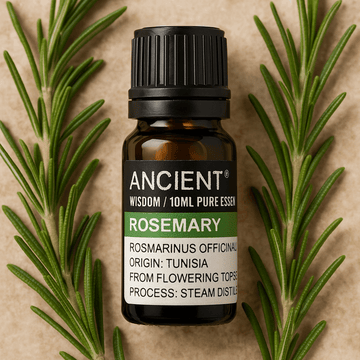
Rosemary, Rosmarinus officinalis, is a Mediterranean shrub whose name means 'dew of the sea', a reference to its preference for coastal, rocky ground and the pale mist its blue flowers make on cliff edges.
The scent opens sharp and clean, almost camphoraceous: a cold clarity that wakes the nose immediately. Within a minute it softens into something greener, more herbal, with a faint warmth underneath. It does not linger softly; it announces and then settles into a dry, clean finish.
Tradition has kept rosemary for memory and clarity since at least Roman times: scholars burned it while studying, servants wore it to sharpen recall. The herbalist tradition files it under 'stimulating' and pairs it with the morning, with spring, with the work that needs a clear head and steady hands. It is the scent of starting something.
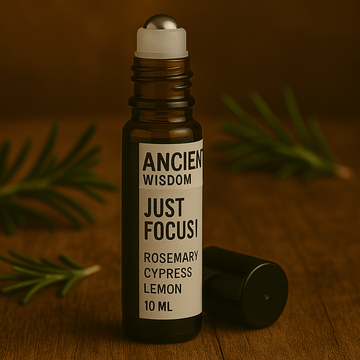
In our intention vocabulary, rosemary carries Focus and Clarity: the morning register, when the day is still taking shape. It keeps company with Protection too: the idea that a clear mind sees what's coming. In mood, it belongs to Focus and Energy: the working hours, not the evening.
The tradition's quiet suggestion: choose the stone or the scent, give it a morning intention in plain words, and let it be the first object you turn to when you sit down to work. The repetition is the practice. The object is the cue that keeps the intention in the room.
Below: the catalogue's gathering for the spring and morning register, rosemary in essential oil, candles, incense and smudge, alongside stones the tradition places with clarity and protection.
Часто задаваемые вопросы
What is rosemary essential oil traditionally used for?
The tradition pairs rosemary with memory, focus and mental clarity. It has been burned by scholars and worn by servants to sharpen recall since Roman times. Herbalists file it under stimulating scents and reach for it in the morning register, when clear-headedness and concentration are wanted, and at the start of new work.
How can I use rosemary essential oil?
Dilute a few drops in a carrier oil for topical use, add to a diffuser or oil burner to scent a room, or place a drop on a tissue to inhale during study or focus work. The tradition suggests pairing it with a morning intention (spoken plainly, repeated daily) to anchor the practice and keep clarity present in the working day.
Is there a difference between rosemary essential oil and rosemary oil?
Yes. Rosemary essential oil is steam-distilled from the leaves and highly concentrated: a few drops carry the full scent. Rosemary oil usually means the essential oil already diluted in a carrier, gentler for direct use. Always check the label: if it lists only Rosmarinus officinalis, it is the pure essential oil and must be diluted before skin contact.
Who should not use rosemary essential oil?
Avoid during pregnancy, if epileptic, or if you have high blood pressure, as rosemary is a stimulating oil in the herbal tradition. Always dilute before skin contact: neat essential oil can irritate. If diffusing around children or pets, keep the room ventilated and the session short. When in doubt, consult a qualified aromatherapist before use.
Why should I not apply undiluted rosemary oil to my scalp?
Undiluted essential oil is too concentrated for skin and can cause irritation, redness or sensitivity. The safe practice is to dilute a few drops in a carrier oil, such as jojoba or sweet almond, before massaging into the scalp. This gives you the scent and the ritual without overwhelming the skin, which needs gentleness even in a stimulating tradition.