Elämän kukka
Elämänkukka on päällekkäisten ympyröiden kuvio, jossa kuusi terälehteä avautuu jokaisen keskipisteen ympärille. Kuvio on ikivanha: se näkyy assyrialaisella kynnyksellä 700- tai 600-luvulta eaa., roomalaisilla lattioilla ja keskiajan taiteessa. Nimi Elämänkukka on moderni, peräisin 1900-luvun lopun New Age -kirjoituksista.
- Vanhin tunnettu
- assyrialainen kynnys, 700- ja 600-luku eaa.
- Nimi
- moderni, New Age -kirjoituksista
- Tutkija
- Leonardo da Vinci

Lahjaksi

Osta Elämän kukka
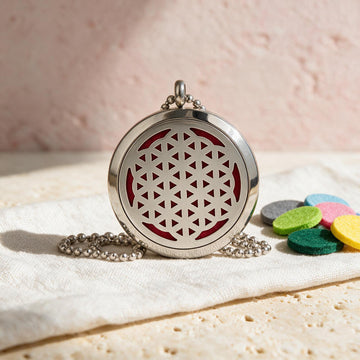
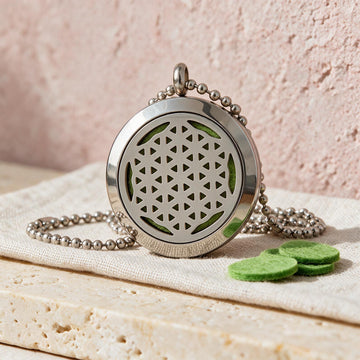
- Eteerisen öljyn diffuuseri kaulakoru Elämän kukka 30mm Ruostumaton teräs 5,0 (1)£16.95Jäsenille: +£0.95 takaisin
- Eteerisen öljyn diffuuseri kaulakoru Elämän kukka 25mm Ruostumaton teräs 4,5 (2)£15.95Jäsenille: +£0.90 takaisin
Kirjastossa


Usein kysytyt kysymykset
What does the flower of life symbolise?
Today it is read as the unity of life: many circles from one rule, each joined to the next. Historically it was mostly ornament, and in some old buildings it may have been a protective mark.
Is the flower of life a religious symbol?
It belongs to no single religion. It appears in Assyrian, Roman, Islamic and Gothic art and in folk carving, and modern spiritual movements gave it its name.
How old is the flower of life?
The overlapping-circle pattern goes back at least to the 7th century BCE. The name Flower of Life is much newer, from the late twentieth century.
What is the seed of life?
The smaller figure at the heart of the pattern: seven circles, one in the centre and six around it. It is the first step when you draw the full flower.