Ръката на Фатима
The hamsa is an open hand, often with an eye in the palm, kept across North Africa and the Middle East as a sign of protection and blessing. Its name comes from the Arabic word for five, and Jewish families also call it hamesh. Muslims know it as the hand of Fatima, many Jews as the hand of Miriam.
- Name
- Arabic khamsa, five
- Also called
- hand of Fatima, hand of Miriam
- Hung traditionally
- by the front door

Пазарувайте в Ръката на Фатима
- Малък ароматен конус за обратно горене, мангово дърво, хамса Backflow конуси · Мангово дърво 5,0 (1)£17.95Членове: +£0.40 обратно
- Голям ароматен конус за обратно горене, мангово дърво, хамса Backflow конуси · Мангово дърво £29.95Членове: +£1.10 обратно
- Кадилница с обратен поток от мангово дърво с хамса Backflow конуси · Мангово дърво £24.95Членове: +£0.80 обратно
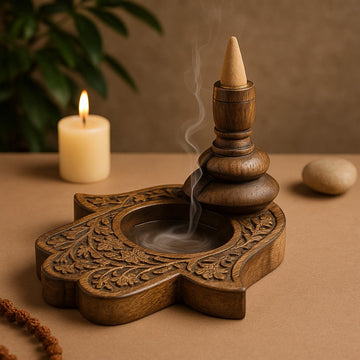
- Държач за тамян за пръчици и конуси, дървен Хамса Пръчици · Мангово дърво £6.95Членове: +£0.20 обратно
- Поставка за тамян от сапунен камък Хамса, слон и палма 9x6см Пръчици · Сапунен камък 4,0 (1)£8.99Членове: +£0.40 обратно
- Купа за пречистване Дървена Хамса Олтарни предложения 11x7cm 11 × 7 см · Дърво манго £11.99Членове: +£0.70 обратно



В библиотеката

Често задавани въпроси
What does a hamsa hand mean?
It is a sign of protection and blessing. Tradition holds that it turns away the evil eye and brings good fortune to a home and the people in it.
Should a hamsa face up or down?
Both are traditional. Fingers up is usually read as warding off harm, fingers down as an open blessing and welcome.
Is the hamsa Jewish or Muslim?
Both, and older than either. Muslims call it the hand of Fatima, many Jews the hand of Miriam, and Christians in the region keep it as well.
Can anyone wear a hamsa?
Yes. It is a shared folk symbol of the region rather than the sign of one faith, and wearing it with an understanding of where it comes from is welcome.