Doprava zdarma od £33 · odesíláno z Velké Británie · včetně daní

Objevujte › Symboly & oltář

Buddha

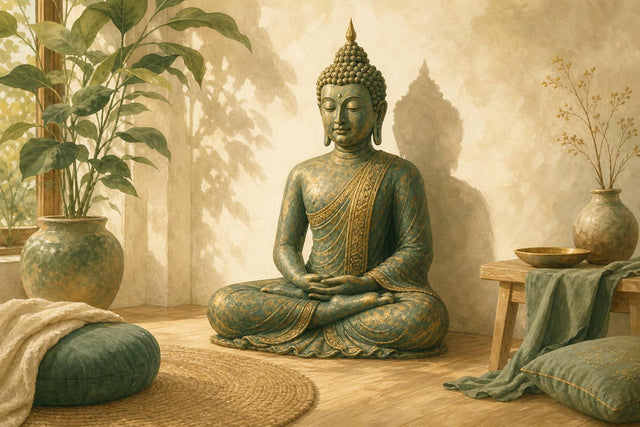
A Buddha figure portrays Siddhartha Gautama, the teacher who lived in northern India around the fifth century BCE and whose teaching became Buddhism. Each pose and hand gesture recalls a moment of his life: meditation, teaching, the night of his awakening. For Buddhists the figure is an object of respect and a reminder of the path he showed.

Tradition
Buddhism, from northern India
First figures
around the 1st century CE
Traditional place
raised and clean, never on the floor
Buddha

V knihovně

Nakupujte v Buddha

6 produktů

What the figure means

Buddha means the awakened one. It is the title given to Siddhartha Gautama, who taught in the Ganges plain some two and a half thousand years ago. A figure of him is a reminder of a person and of a path: that attention, kindness and patience can be practised, day by day.

For several centuries early Buddhist art showed him only through signs, such as a footprint, an empty seat or a tree. Figures in human form appeared around the first century CE, in Gandhara and Mathura in the north of the subcontinent.

Postures and hand gestures

A seated Buddha usually meditates. A standing one teaches or walks among people. A reclining Buddha, lying on his right side, shows his final passing, the parinirvana, and in Buddhist art it is a calm image of completion.

The hands, called mudras, tell the rest. Hands resting in the lap, palms up, mean meditation. A right hand reaching down to touch the earth recalls the night of his awakening, when he called the earth as his witness. A raised open palm is the gesture of fearlessness, and fingers joined at the chest mean teaching.

Placing a Buddha at home

Buddhist custom asks for a clean, raised place: a shelf, a low table or a home altar, never the floor and never the bathroom. Many people set the figure facing into the room or towards the door, with a little space around it for a candle, a flower or incense.

Choosing a figure

Choose the gesture you want to come back to: meditation for a reading corner, the earth-touching hand for a desk where decisions are made. The round, laughing figure with a sack is Budai, a monk of Chinese folklore, a different figure from the Buddha himself. Dust with a soft dry cloth.

Často kladené otázky

Is it disrespectful to have a Buddha statue if I am not Buddhist?

Most Buddhist teachers welcome it when the figure is kept with respect: raised, clean, and away from the floor and the bathroom. Avoid using it as a doorstop, a lamp base or a garden joke.

Which way should a Buddha statue face?

Custom varies from country to country. A common choice is facing into the room or towards the main door, at or above eye level when you sit. A clean, calm place matters more than the direction.

What does a reclining Buddha mean?

It shows the Buddha at the end of his life, lying on his right side as he passed into final nirvana. In Buddhist art it is a peaceful image of completion, not a sad one.

Is the laughing Buddha the same as the Buddha?

No. The laughing figure is Budai, a Chinese monk of folklore later linked with Maitreya, the Buddha to come. Siddhartha Gautama is usually shown slender and calm.