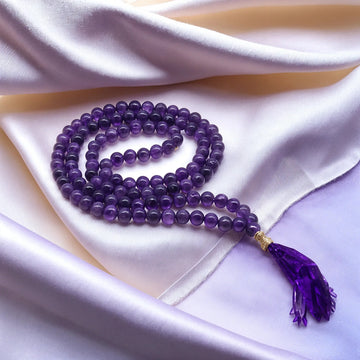
Intuition is not mystical. It is simply the part of thinking that works without showing its workings. You recognise it when it arrives: a sense of rightness before the logic has finished unpacking, a flicker of knowing that arrives faster than the evidence could explain. The tradition has always taken it seriously, in some cultures it is the most trusted form of knowing, the kind that walks ahead of the reasoning mind.
In the yogic map the third eye sits at the brow, the seat of inner sight, the bridge between evidence and instinct. In the zodiac it belongs to water (to Pisces, Cancer, Scorpio) and to the Moon, which has no logic either and has never needed it.
Stones the tradition gathers here: lapis lazuli, its deep blue mined for five thousand years; iolite, which shifts colour as you turn it, named for the violet light of the hour before full dark; sodalite, calm and clear; amethyst for the still hours when the noise quiets. Scents follow the water register: jasmine after dark, clary sage, a little frankincense for the ceremonial hours.
The objects do nothing alone, and that is true of every object. But they do something alongside you. A stone held in the palm while you ask a question is a physical anchor for a practice that might otherwise dissolve before the day is out. A candle lit while you sit with a decision signals the body that the thinking is changing register. Cues, repeated, become practice.
Below: our catalogue's gathering for intuition: stones for the third eye, scents for the water signs, and objects whose only job is to keep the listening on.
Συχνές ερωτήσεις
What are the best crystals for intuition?
The tradition gathers lapis lazuli for inner sight, amethyst for stillness, iolite for clarity between states, sodalite for calm focus, and labradorite for the liminal hours. Each is paired with the third eye or water element. Hold one while you ask a question, or keep it on your desk where decisions happen. The stone does nothing alone. It anchors the practice of listening.
How do I unblock my intuition?
Treat it as a muscle that strengthens with use, not a channel that gets cleared. Sit quietly and ask a simple question, something low-stakes, then notice the answer that arrives before logic does. Write it down. Repeat daily. A stone held in the palm or a candle lit beforehand signals the body that the thinking is changing register, and the cue becomes practice.
What are the four clairs of intuition?
The tradition names clairvoyance (inner seeing), clairaudience (inner hearing), clairsentience (inner feeling) and claircognizance (inner knowing). Each describes a different route the quiet knowing takes: some people see images, others feel certainty in the body, others simply know without evidence. Your own route becomes clear with repeated listening, and most people rely on more than one.
What crystal is good for self-belief?
Carnelian is traditionally reached for: a warm orange stone associated with courage, the solar plexus, and the part of you that stands its ground. Citrine also appears here, bright and gold, paired with confidence and the decision to act. Carry one in a pocket during a difficult conversation, or keep it where you see it when doubt arrives. Belief built slowly tends to last.
What crystals can I wear every day?
Any stone that does not scratch easily and suits the rhythm of your day. Clear quartz and amethyst both sit at hardness seven, durable enough for daily wear. Rose quartz and sodalite are slightly softer but still practical. Avoid very soft stones like selenite or malachite against keys or zips. The tradition values consistency: a single stone worn often builds more than a drawer full left untouched.