Livraison offerte dès £33 · expédié depuis le Royaume-Uni · taxes incluses

Pierre précieuse

Jade

Jade is two minerals wearing the same name, nephrite and jadeite, carved for eight thousand years. Green is most common but it comes in lavender, white and black too.

Green

Achetez Jade

33 produits

Qu'est-ce que Jade ?

Jade is two minerals wearing the same name. Nephrite, a fibrous tremolite-actinolite, has been carved in China and New Zealand for eight thousand years. Jadeite, the denser of the two, is the material that travels under the name imperial jade: vivid, translucent, almost luminous. The word comes from the Spanish piedra de la ijada, stone of the flank, which tells you the Romans valued it for something more urgent than ornament.

The Chinese tradition placed jade above all other stones. It called jade the principle of heaven, associated it with virtue, and buried it with the dead as a guarantee of safe passage. The Mesoamerican cultures (Olmec, Maya, Aztec) worked jadeite with obsessive precision, chiselling masks and pectorals for kings who would never be seen without it. Neither tradition had any notion of the other's existence. They arrived at jade independently, which is worth sitting with.

The crystal tradition places jade at the heart chakra: green, cool, open. Taurus and Libra are its zodiac companions; earth is its element. It is the stone the tradition reaches for alongside abundance, calm and the quieter kinds of wellbeing.

The honest invitation is a simple one: jade rewards attention. No two pieces share the same depth of green, and the surface (cool, slightly waxy, yielding slowly to the thumb) feels unlike quartz or feldspar. If you are drawn to it, let it keep a corner of a practice: a stone on the desk, a knot in a handkerchief, a physical place to return to when the intention needs its weight restored.

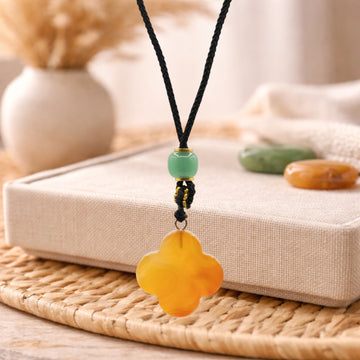
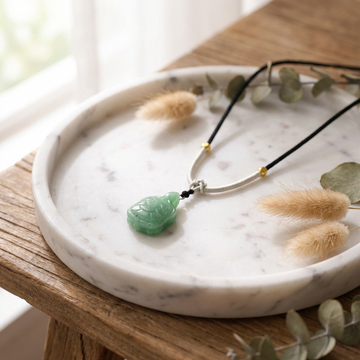
Below you'll find what the catalogue holds in jade: tumbled stones, pendulums, jewellery and carved objects in both nephrite and jadeite.

Foire aux questions

What does jade mean spiritually?

The Chinese tradition calls jade the principle of heaven and associates it with virtue, while the crystal tradition places it at the heart chakra and pairs it with abundance, calm and the quieter kinds of wellbeing. Both nephrite and jadeite have been carved for eight thousand years across unconnected cultures, each arriving at jade independently.

How can you tell if jade is real?

Real jade feels cool and slightly waxy to the touch, is surprisingly dense for its size, and warms slowly when held. Nephrite and jadeite both have a fibrous or interlocking crystal structure visible under magnification, and neither will scratch easily with a steel blade, though this risks damaging the stone and is not recommended.

Is jade expensive?

Nephrite is generally affordable and widely available, while jadeite (especially the vivid, translucent material called imperial jade) can command very high prices. Colour, translucency and carving quality all affect cost, and no two pieces share the same depth of green or internal character, so price varies dramatically across the material.

What stone is often mistaken for jade?

Serpentine, aventurine, chrysoprase and dyed quartzite are all sold as jade, sometimes deliberately and sometimes through confusion. True jade is either nephrite or jadeite, both denser and cooler to the touch than most imitations, and neither will feel glassy or scratch as easily as quartz-family stones.

What are the traditional rules for wearing jade bracelets?

The Chinese tradition holds that jade should be worn on the left wrist, close to the heart, and that it should not be removed casually once chosen. Some practitioners believe jade absorbs the wearer's energy over time and should not be passed between people, though this is interpretive rather than doctrinal.