Fri frakt över £33 · skickas från Storbritannien · skatter ingår

Ädelsten

Petrified Wood

Ancient wood turned to stone over millions of years, silica replaced the cells, leaving banded brown growth rings and a weight that speaks for itself.

Brown banded

Handla från Petrified Wood

7 produkter

Vad är Petrified Wood?

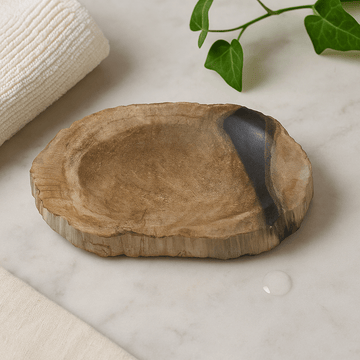
Petrified wood is wood turned to stone, not metaphorically, but literally. Where a fallen trunk lay in silica-rich water, the organic cells were replaced molecule by molecule over millions of years, until nothing remained but the shape of the wood, cast in quartz. The name comes from the Greek petros, stone.

The brown banding is the original growth rings, preserved in agate-like layers: each ring a year, each inch of stone a small eternity. The colours depend on the minerals that did the replacing: iron brings rust and amber, manganese makes grey and pink. The finest specimens come from Arizona's Petrified Forest, and from deposits in Indonesia, Madagascar and Australia.

As a material for objects and jewellery, it has been gathered for centuries. The Romans cut it into seals; Victorians set it into writing desks. It is heavy in the hand in a way that wood never is, and warm in a way that stone rarely is: a material that sits between two worlds.

The tradition places it at the root chakra, with the earth element, and gives it to Leo and Virgo: the signs that work and build. Its intentions are grounding, calm and the kind of steadiness that grows slowly.

The suggestion for working with it is simple: hold it in the morning, name what you are building, and let the weight of it be the whole instruction. It is a reminder, not a guarantee: a weight in the hand, not a force in the mind.

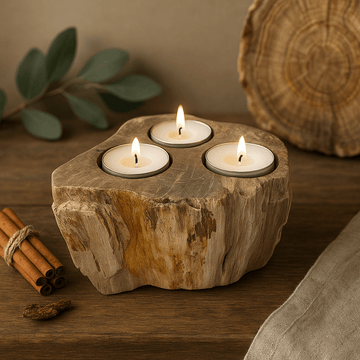
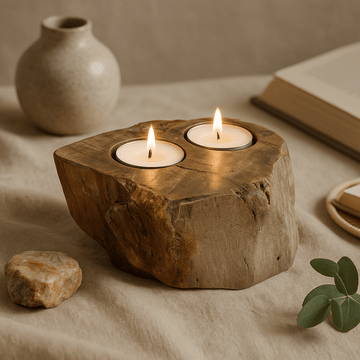
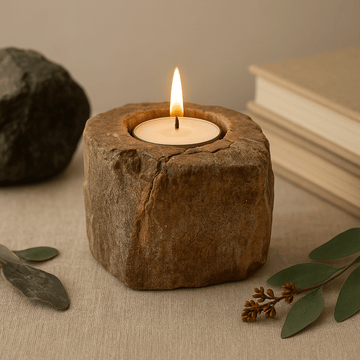
Below you'll find what the catalogue holds in its register: rough slabs, polished slices, rings and pendants, each one a different piece of ancient forest, now stone.

Vanliga frågor

Is petrified wood a gemstone?

Petrified wood is classified as a gemstone, specifically a fossilised organic material that has been replaced by quartz and other minerals over millions of years. Like amber or jet, it sits between the mineral and biological worlds, cut and polished for jewellery, carvings and decorative objects. Its hardness, around 7 on the Mohs scale, makes it durable enough for rings and daily wear.

What does petrified wood mean spiritually?

The tradition associates petrified wood with grounding, patience and the kind of steadiness that accumulates slowly over time. It is placed at the root chakra and linked to the earth element, often reached for when building something lasting or when needing the weight of deep time to anchor restless thought. The stone itself, ancient wood transformed, is read as a symbol of endurance and slow becoming.

Why is petrified wood so special?

Petrified wood is wood that has become stone, molecule by molecule, over millions of years, a complete cellular replacement by silica that preserves the original growth rings, knots and grain. Each piece holds a record of an ancient forest, now extinct, in banded brown layers that feel warm to touch despite being quartz. It is both fossil and gemstone, heavy as stone yet shaped like timber.

What is the rarest colour of petrified wood?

The rarest colours in petrified wood are vivid reds, deep purples and true blues, caused by trace minerals like cobalt, chromium or copper replacing the wood during fossilisation. Most specimens are brown, amber or grey: iron and manganese being far more common. The famous Rainbow Forest in Arizona occasionally yields multicoloured pieces, but these are uncommon and prized by collectors worldwide.

Is it bad luck to have petrified wood?

There is no widespread tradition holding petrified wood to be unlucky, in fact, it is generally associated with grounding and stability rather than misfortune. A localised belief discourages removing pieces from certain protected sites like Arizona's Petrified Forest, more out of respect for conservation law than superstition. As a material in the home or worn as jewellery, it carries no taboo in ritual practice.