The body already knows how to sleep. It has done it every night of your life. The tradition around it is really about the cues: the signals that tell a busy mind the day is finished.
The practice is ancient and particular. Greeks kept amethyst near the bed for a quiet head. Romans washed with lavender; the name is simply lavare, to wash, and it has meant clean linen and easier nights for two thousand years. Chamomile came from the kitchen garden to the bedside. Moonstone followed the moon. The suggestions are always unhurried: the same hour, the same scent, the same stone held for a moment before the light goes out.
These objects work alongside your practice, not instead of it. A few drops of lavender at the same hour each evening. A stone kept on the bedside table as a physical bookmark for an intention that would otherwise dissolve by ten o'clock. The tradition's quiet advice is to let the repetition do the deepening. Ritual, at its plainest, is memory with props.
The honest invitation is this: choose one thing, give it a small role in your evening, and trust the body to learn the signal. Sleep built this way is unglamorous and slow, and it stays.
Below: the catalogue's evening register. Stones the tradition links with rest, aromas for the last hour of the day, and objects whose only job is to make the transition a little gentler.
Preguntas frecuentes
What is the best crystal for sleep?
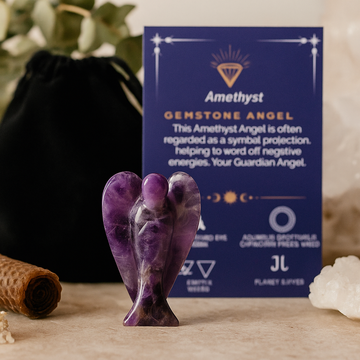
Amethyst is the stone most consistently paired with sleep in Western tradition, kept on the bedside table or under the pillow to quiet a busy mind. Moonstone, lepidolite and howlite are also traditionally reached for at bedtime. The practice works best when the same stone is used each night, building repetition into a signal the body learns to recognise.
What crystal can you sleep with?
Amethyst, moonstone, lepidolite, howlite and selenite are all traditionally kept in the bedroom and slept with. The usual advice is to hold the stone briefly before sleep, or place it under the pillow or on the bedside table. Choose a smooth tumbled piece rather than a raw or pointed formation, and use the same stone nightly so the ritual becomes familiar.
What crystals are best to keep by your bed?
Tradition places amethyst, moonstone, lepidolite and selenite near the bed for their associations with rest and quiet. They are usually kept on the bedside table or tucked beneath the pillow. The practice values consistency over variety: one stone used each evening becomes a cue, a small physical bookmark that signals the day is finished and sleep may begin.
Where to put crystals in your bedroom?
The bedside table is the traditional spot, close enough to touch before sleep but out of the way during the night. Some practitioners tuck a smooth tumbled stone beneath the pillow or place a larger piece on the windowsill to catch moonlight. The placement matters less than the repetition: returning the stone to the same place each evening builds the signal.
What crystals should I not keep in my bedroom?
Stimulating stones such as carnelian, clear quartz and citrine are often avoided in the bedroom by those who find them too activating before sleep. Tradition tends to favour the cooler, quieter palette for evening: amethyst, moonstone, lepidolite. If a stone keeps you wakeful or dreams too vivid, simply move it to another room and notice the difference.


 India





 China


