Choosing a gift for a father is rarely difficult because he is hard to please. It is difficult because he has usually stopped asking for anything at all. This guide is built around that fact, not around what he grills, golfs or collects. It sorts gifts by the ordinary moments already inside his day, and by what actually gets used rather than unwrapped once and left on a shelf.
The day itself has a short, specific history: in 1909 Sonora Smart Dodd, sitting through a Mother's Day sermon in Spokane, Washington, thought of her own father, a widowed Civil War veteran who had raised six children alone, and petitioned for a day to honour fathers too. Spokane held the first one on 19 June 1910; it became a fixed national holiday in the United States only in 1972, and today falls, in both the US and the UK, on the third Sunday of June. That is the history in full. The more useful question is what you actually put in his hands now.
How to Choose, Without a Hobby in Mind
Ask a father what he wants and "nothing" is often not a deflection to be cracked like a code. Many men past a certain point genuinely have what they need, and most gift guides answer this by suggesting more of it: another gadget, another tool, something that requires assembly, a chosen setting or an occasion to justify. A different approach is to stop trying to out-smart the reply and instead look at where his attention already goes, quietly, every day, without needing a special day to prompt it. Set the hobby-type sorting aside and ask three plainer questions instead.
- What does he already do with his hands most days, without thinking about it: turn keys, sort papers, carry the same small things through his pockets?
- Where does he mark the line between the working day and the evening, even if he has never named it as a ritual: a door, a chair, a first cup of something?
- What would he never buy for himself, because it feels like an indulgence rather than a necessity, however small the actual cost?
Answer those three and the gift tends to suggest itself. It is rarely the most expensive object on any list.
Something to Carry or Wear
A stone small enough to sit in a coat pocket or beside a keyboard asks nothing of the man who owns it: no batteries, no manual, nothing to assemble on Sunday morning. In crystal traditions, tiger's eye is associated with steadiness and focus, and black tourmaline with grounding, associations worth offering lightly as tradition rather than promise. Tiger's eye is also a genuinely interesting object in its own right: its golden shimmer, known as chatoyancy, comes from a parallel fibrous structure inside the mineral that catches the light differently as the stone turns in the hand, which is reason enough to give it. Our tiger's eye and grounding stones sit in the crystals collection for exactly this kind of quiet, pocketable gift.

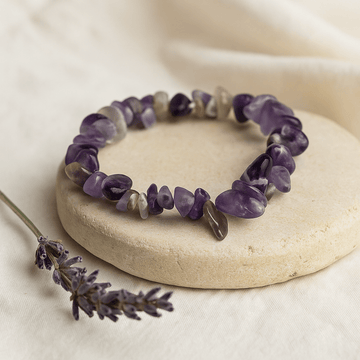
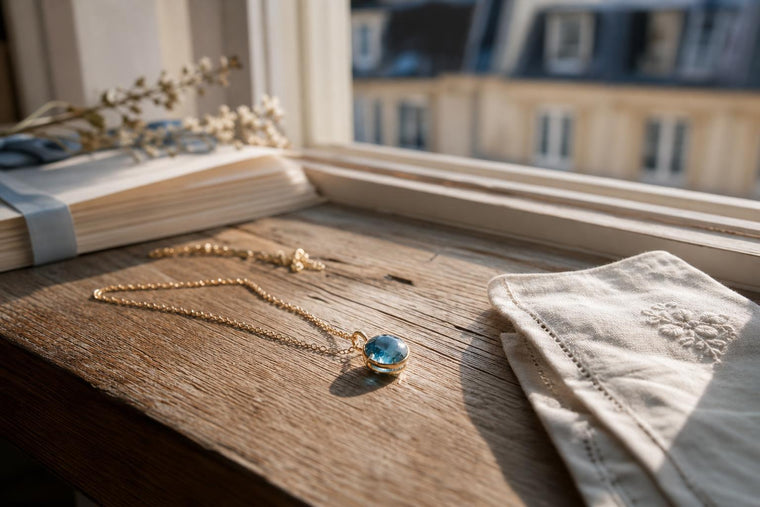
A father who dislikes fuss is often better served by one object worn daily than by a drawer of things used once. A single ring, bracelet or pendant set with stone has an advantage a gadget doesn't: it needs no charging, no app, no second decision each morning about whether to wear it. It simply sits on him until it becomes part of how he looks, a different kind of gift from something displayed and photographed once. The mineral jewellery collection carries pieces built for daily wear rather than for a shelf.
Incense: The Line Between Work and Home
I keep a small incense practice of my own, lighting a stick most evenings, and the value of it has never been in the scent alone. It is in the two or three minutes the smoke takes to settle, which mark a boundary between one part of the day and the next without requiring a single word to explain it. For a father who comes home from work and struggles to leave it at the door, one stick lit in the same spot each evening can do that quietly, with no assembly and no explanation needed, only a small, repeatable act he chooses to keep. The incense collection holds a few scents suited to exactly that kind of daily marker.

Gift Sets: When Neither of You Knows
Sometimes the honest position is that neither of you has a clear answer, and that is fine. A small curated set, a stone alongside a stick of incense, or a pendant paired with something for the desk, removes the guesswork from both sides: he is not asked to choose, and you are not asked to guess correctly on the first try. The gift sets collection is built for this exact situation, where the point is not variety for its own sake but a handful of things that belong together and ask little of the person opening them.
The Gift Is the Two Minutes He Stops
None of these objects do anything on their own. A stone in a pocket does not steady a mind by itself, and a stick of incense does not draw a line between work and home without someone choosing, deliberately, to strike the match. What each of them offers is a small, repeatable reason to stop for a moment inside an ordinary day, the kind of moment a father who says he wants nothing rarely gives himself permission to take. That pause, more than the object that prompts it, is the actual gift. Everything else on this list is simply there to make the pause a little easier to reach for tomorrow, and the day after, long after the wrapping paper is gone.


 Brazil
 India
India
 South Africa
 Morocco
 China
China