Somewhere beneath the Chihuahuan desert, in a chamber no visitor will likely enter again, beams of crystal the length of a bus lie in the dark, waiting out a flood. They are made of the same mineral as the small bowl on a shelf at home, and knowing that changes what the bowl is for.
The cave that holds the same stone at an impossible scale
In the Naica Mine in Chihuahua, Mexico, miners working far below the surface found a chamber lined with crystal beams, some growing to around 11.4 metres and weighing in the region of 12 tonnes. The Cave of the Crystals, as it became known, held some of the largest natural crystals ever documented. The heat and humidity down there made it barely survivable for long visits even with protective gear, and in October 2015 the mining company Peñoles announced it was suspending operations because of flooding it could no longer control. The pumps that had kept the chamber dry were switched off, and the cave has sat underwater since, its giant beams undisturbed and almost certainly unreachable for years to come.
A bowl carved to sit in your hand and a beam too large to fit through most doors are, mineralogically, cousins. Nothing in a shop replicates the scale or the geology of Naica, and no bowl was ever cut from that flooded chamber. But the link is real enough to be worth knowing before the bowl is asked to do anything at all.
What the stone actually is, and what most bowls really are
Selenite is a transparent to translucent form of gypsum, chemically calcium sulfate dihydrate. It takes its name from Selene, the Greek goddess of the moon, a fitting choice for a mineral that can catch light in pale, almost liquid sheets. The name was given formal use in 1747 by the Swedish mineralogist J. G. Wallerius, at a time when naturalists across Europe were busy sorting the mineral world into families and giving its members names that stuck. What makes it recognisable isn't colour so much as structure: it grows in flat, bladed crystals that can be almost glass-clear when pure, which is part of why the giant beams at Naica photograph the way they do, like something poured rather than grown.
Most objects sold as selenite today, including the bowls, wands and plates found in home and gift shops, are not cut from clear crystal blades at all. They are carved from satin spar, a fibrous, silky variety of the same mineral, which forms in softer, more workable veins and is far more abundant than the clear crystal form. Satin spar is routinely sold under the selenite name, and there is nothing dishonest in that: both are gypsum, both share the chemistry, and the trade has simply settled on one word for a family of related material. It explains why a bowl has that warm, fibrous sheen rather than the glassy clarity of a Naica photograph. One is theatre at a scale nature rarely repeats; the other is the quieter, everyday form of the same stone, shaped by hand into something you can hold.

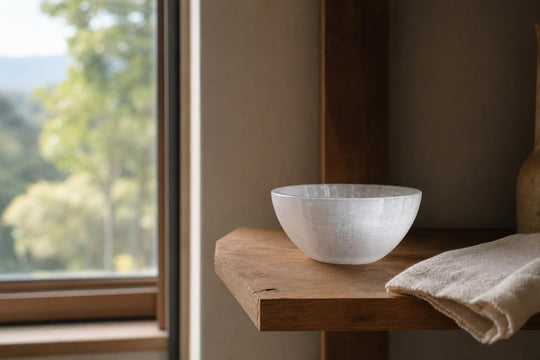
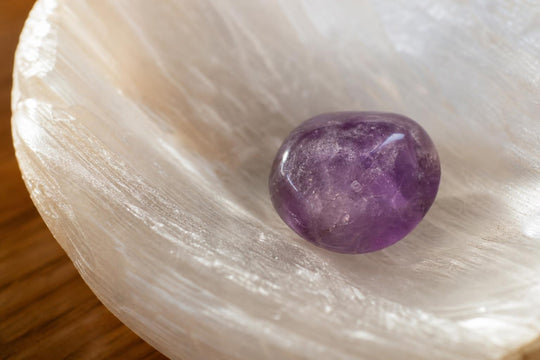
A well-made selenite bowl carries that fibrous character honestly, its surface catching light in long pale streaks rather than a single clean reflection, and that texture is part of what makes it worth having on a shelf rather than tucked in a drawer.
Where a bowl like this actually comes from
Much of the selenite sold in the decorative and mineral-specimen trade, including a good deal of what reaches Europe from Morocco, is associated with the Tafilalt region, particularly the area around the towns of Erfoud and Ouarzazate. Selenite of various origins, Mexican, Moroccan, Madagascan among others, moves through the same specimen and decor trade, and a bowl rarely carries a single, traceable birthplace the way a bottle of wine might. What can be said honestly is the region, not a guaranteed single quarry, and that honesty is worth more than a tidier-sounding claim.
Living with the bowl
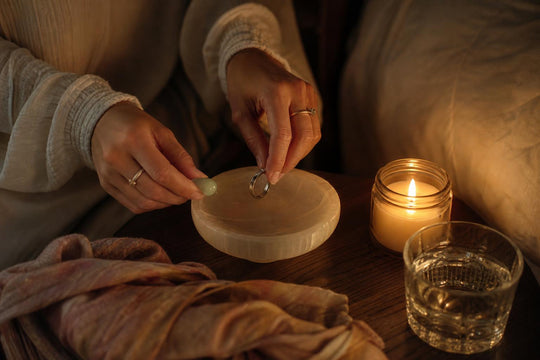
The simplest use for a selenite bowl has nothing to do with any claim about energy and everything to do with repetition. Jewellery comes off at the end of the day and goes somewhere specific, rather than onto whatever surface is nearest. Tumbled stones that spend the day in a pocket or on a desk get a place to rest overnight instead of rolling to the back of a drawer. The bowl becomes the fixed point in a small, repeatable act: here, and not elsewhere. Some people like to rest other stones against the bowl overnight, treating the pale surface as a kind of base note beneath whatever else sits there; others use a flatter selenite piece for the same purpose when a tray suits the stones better. None of this asks the bowl to perform a mechanism no one can verify. It asks the person to return to the same small gesture often enough that it becomes a habit worth keeping, which is a different and more useful kind of magic than the one usually advertised.

Caring for a soft stone
Selenite sits at 2 on the Mohs hardness scale, which puts it only just above talc and means it marks easily, sometimes with nothing more than a fingernail dragged across the surface. This matters far more for daily handling than any claim printed on a listing. A bowl left on a windowsill in strong, direct sun can dull or discolour over time, and because gypsum dissolves slowly in water, a bowl that gets properly wet, left in a damp bathroom, wiped with a soaked cloth, soaked to "cleanse" it, risks a soft, chalky surface rather than a cleaner one. The sensible handling is almost the opposite of dramatic: keep it dry, keep it out of hard sunlight, dust it with a soft cloth, and set it down rather than letting rings and stones scrape across it as they're added or removed.
None of this makes the bowl less worth having. If anything, knowing what it is, gypsum rather than myth, satin spar rather than glass-clear crystal, a region rather than a single storied mine, makes the evening habit it supports more honest. The bowl doesn't do anything to the stones placed in it overnight, and nothing here claims that it does. What it does is mark a spot, small and specific, where a ring or a tumbled stone is returned rather than abandoned, where a day's small clutter has one place to land before the next one starts. That is a modest thing to ask of an object, and a modest thing is usually the kind that lasts on a shelf for years rather than weeks.

 Morocco