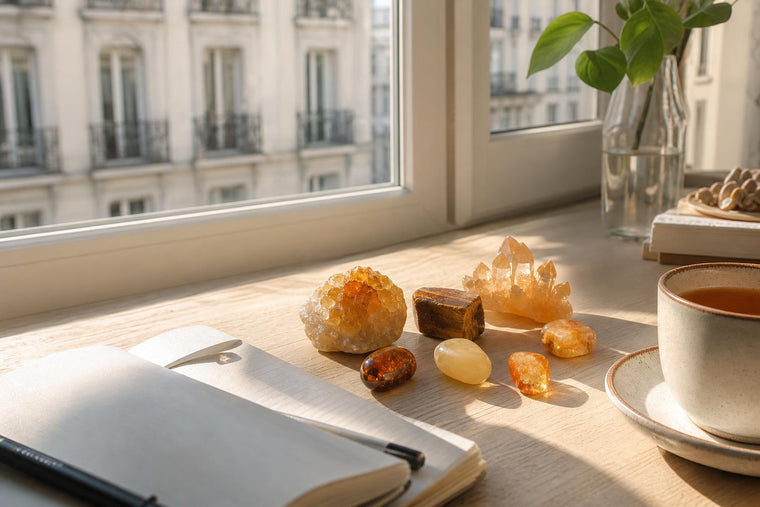
A friend asks you this over tea, or you type it into a search bar at eleven at night: can someone just give me a list of healing crystals? Here it is, plainly, before anything else.
Can You Give Me a List of Healing Crystals?
Yes. The stones that come up again and again, across most shops and most teachers, are these: clear quartz, amethyst, rose quartz, black tourmaline, citrine, tiger's eye, hematite, lapis lazuli and green aventurine. Each one carries a traditional association rather than a guarantee, and that distinction matters more than the list itself.
Clear quartz is often called the master healer: not because it does one thing, but because it is widely held to amplify intention and to work alongside whatever other stone sits near it. Amethyst is reached for when a mind won't settle. Rose quartz is tied to the heart and to self-compassion. Black tourmaline is carried for grounding, a kind of quiet buffer against a noisy day. Citrine is associated with confidence and abundance. Tiger's eye is linked to steadiness and courage under pressure. Hematite, heavy and metallic, is another grounding stone. Lapis lazuli is known as the stone of truth, useful for anyone who finds speaking up hard. Green aventurine sits alongside rose quartz as a gentler, everyday heart stone. You can see the fuller range, including several of these, within our full range of crystals and gemstones, and most new collectors do well starting from a shelf like Healing & Wellbeing rather than chasing every name at once.
Which Crystals Match Each Chakra?
Chakra pairings are one of the oldest ways people sort their crystals, and they are worth knowing, with one honest caveat first: the pairings vary. Different teachers, different books and different shops will give you slightly different stones for the same chakra, and no single list is the final word.
That said, some pairings are widely repeated. The root chakra, associated with safety and grounding, is commonly matched with hematite and black tourmaline; if you want to start there, crystals for the root chakra gathers stones chosen with that grounding quality in mind. The heart chakra is usually paired with rose quartz and green aventurine, both reached for softness rather than force. The third eye and crown chakras, concerned with clarity and a quieter mind, are most often linked to amethyst, and sometimes to lapis lazuli for the throat just below them. Treat these as a starting vocabulary, not a locked system. A stone can mean one thing in one tradition and something adjacent in another, and both can be true at once.
Which Crystal Is Best for Calm or Anxiety, and What Does "Working" Actually Mean?
Of the whole list, two stones are reached for most often when a mind is racing: amethyst and rose quartz. Amethyst is the one people describe holding at a desk, or keeping by a bed, when the thoughts won't slow down on their own. Rose quartz tends to be chosen when the unsettled feeling is softer, something closer to needing comfort than needing quiet.
Neither is a treatment. What they offer, honestly, is a focal point: something small and real in the hand that gives restless attention somewhere to go. The stone doesn't do the settling. You do, and the stone gives you a place to put your hand while you do it. That's the whole mechanism, for these two and for every other name on the list above, and it's worth saying once, plainly, rather than dressing it up stone by stone: a crystal left in a drawer, however correctly chosen, is just a small rock. The same stone picked up and held with attention, even for a minute, is doing the only work it was ever going to do, which is giving your attention a place to land.

How Do You Choose and Care for a Healing Crystal?
This is the part most lists skip, and it's the part that actually matters once a stone comes home with you. Start with hardness. Crystals are rated on the Mohs scale, and stones at five or above tend to handle daily carrying, a pocket, a bag, a child's curious hands, far better than softer ones. It's a practical reason quartz, amethyst and citrine show up so often in beginner sets: they're pretty, but they're also durable.
Sunlight is the other detail almost nobody mentions. Several widely loved stones, including amethyst, citrine, fluorite, aquamarine and some quartz, can fade or lose colour with long exposure to direct sun. A windowsill looks lovely in a photograph; it is quietly the worst place for these particular stones to live for months on end. A shelf out of direct light, or a drawer you open with attention rather than habit, keeps the colour as it was when you chose it.
As for choosing itself: resist turning it into a checklist. The same quiet attention I bring to lighting incense before japa, or choosing which mala to use on a given morning, is worth bringing here. Pick the stone up. Hold it for a minute before you decide where it lives, on a shelf, by a bed, on a small home altar. That minute of attention is the practice; the stone is just what you're paying attention with. If you want something to begin that minute with today, a set of tumbled carnelian stones is small enough to hold properly and inexpensive enough to not feel precious about it.
Are Jaspers, Hematite and Lapis Lazuli Different From "Healing Crystals"?
No, and this confuses more people than you'd expect. Jaspers, hematite, lapis lazuli, tiger's eye: these are specific named stones, each with its own mineral identity and its own history of use, sitting inside the broader category that gets called "healing crystals" as a shorthand. The category isn't a separate thing from the stones; it's simply the umbrella term for all of them considered together.

Jaspers are a family of opaque, often richly patterned stones, commonly linked with steadiness and nourishment depending on their colour and type. Hematite, with its dark metallic sheen, is grounding in both senses: heavy in the hand, and traditionally tied to the root chakra. Lapis lazuli, deep blue and often flecked with gold-toned pyrite, carries its old reputation as the stone of truth. None of these needs to be approached as a separate discipline from "crystals" in general. They're simply the specific names behind the general word, the way "rose" is one answer to the general word "flower".
Living With the List
A drawer full of stones bought in a hurry and never touched again is not a practice; it's clutter with better lighting. One stone, chosen slowly and handled often, held for a minute before a busy morning or kept near you on a hard day, earns its place in a way the longest list never will.
So treat the names above as a vocabulary, not a shopping list to complete. Learn which one speaks to what you're actually reaching for this season, root, heart, clarity, calm, and let the rest wait. A collection built that way, one considered stone at a time, tends to mean more than one assembled all at once.


 Uruguay

 South Africa

 Zimbabwe

 China
 India


 Morocco