In the winter of 1848, the Illustrated London News published an engraving of Queen Victoria, Prince Albert and their children standing around a decorated tree at Windsor. It was a small, domestic image: candles clipped to branches, children in their best clothes, a fir tree indoors in the middle of December. Within a few years, that private household custom, already old in Germany, had become something close to a British habit. One picture did more to spread the Christmas tree than any sermon or decree.
A Trick of Light
The engraving worked because it landed at exactly the right moment of the year. The winter solstice falls around 21 or 22 December, the shortest day in the Northern Hemisphere, when daylight is at its thinnest and the nights press in from both ends. Christmas Day, on 25 December, sits only a few days after that turning point. A festival built around light, candles, a lit tree, a fire kept going, arrives just as the actual daylight has begun, almost imperceptibly, to lengthen again. Many argue the placement still does this work, quietly, engraving or no engraving, whatever else the date carries.
The Borrowed Midwinter
Rome already had a festival at this time of year before Christianity did. Saturnalia honoured Saturn, the god of agriculture, and was marked with feasting and a loosening of ordinary rules. Further north, Germanic and Scandinavian communities kept Yule, a midwinter observance with its own fires and feasting, long before Christian missionaries arrived. The earliest surviving record of 25 December as the date for Christmas comes from 336 CE, under the reign of Constantine. One theory, sometimes traced to the third-century historian Sextus Julius Africanus, held that Jesus's conception fell on 25 March; nine months later lands precisely on 25 December. Whether the date was chosen to answer these older midwinter festivals, or arrived at that point by its own separate reckoning and simply came to sit alongside them, is still argued over by historians. Both things may be partly true. What is clear is that a light festival at the year's darkest point did not begin in the nineteenth century, or even in the fourth.

The Twelve Days, Properly Counted
Most people now treat Christmas as a single day, with the tree down and the cards recycled by 27 December. But Christmastide, in the older reckoning, runs from 25 December to 5 January inclusive: twelve days, ending on Twelfth Night, the eve of Epiphany. Epiphany itself, on 6 January, marks the visit of the Magi in Christian tradition, the point at which the gift-bringers finally arrive. Advent, the weeks of waiting before 25 December, is a separate season that comes first; Christmastide is what follows it, not a repeat of it. Frankincense is remembered as one of the three gifts the Magi are said to have carried, and belongs properly to this later stretch of the calendar, not to Christmas Eve alone. Somewhere along the way, the twelve days shrank to one, and a season became a single, exhausted afternoon. It's worth saying plainly that this shrinking is not simply carelessness: school terms, work calendars and the cost of keeping a household lit and fed for twelve straight days all push most people back to ordinary life well before 5 January, whatever the older calendar asks for.
The Carol That Wasn't a Code
The song most people know as marking those twelve days first appeared in print in 1780, in an English children's book called Mirth Without Mischief. The tune sung today is not that old; it was arranged by the English composer Frederic Austin in 1909, and it is his version, not any older one, that everyone now hums without thinking. A popular theory holds that the twelve gifts secretly encode a catechism for English Catholics under persecution, a partridge for Christ, a set of pipers for something doctrinal. It is a good story. It is also, as fact-checkers including Snopes have found, unsupported by any documented evidence; folklorists treat it as invented legend rather than history. The carol can still be sung, and enjoyed, for what it plainly is: a counting song about a very generous, very impractical lover, without needing a secret code to make it interesting.

Keeping It Slowly

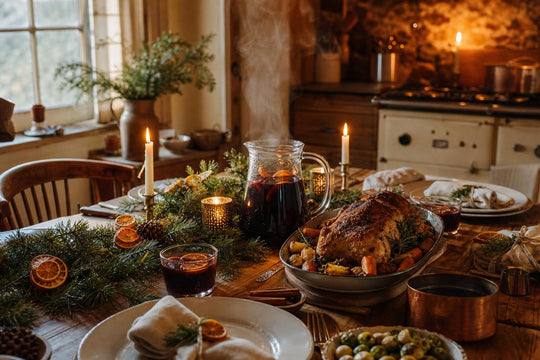
Taken properly, the Twelve Days invite something different from the usual rush: put the tree up, take it down, move on. A season kept across twelve days asks for less intensity and more repetition, though for many households a full twelve-day observance simply isn't practical, and a shorter, more compressed Christmas is the honest, sensible shape their year allows. Where there is room for it, the scent of pine through the house on the first evening need not vanish by the third; it can be a thread that runs through the whole stretch, refreshed rather than replaced. A candle lit each evening, at the same hour, turns the season into a small daily practice rather than one loud event. Not every household marks the day the same way: in parts of India, where fir and pine are not native, some Christian communities decorate a mango tree, or a frame of banana leaves and bamboo, and the custom carries the same intention in different materials. Mulled wine on a shared table, offered once or twice across the season rather than only on the day itself, does the same work: it gives the twelve days a shape, evenings that people actually look forward to rather than a single dinner that has to hold everything at once.
Into January, Not a Crash
Ending the season on Twelfth Night, rather than the day after Christmas, changes how January begins. The season is allowed to finish, properly, rather than being switched off. There is something to be said for choosing your own twelve scents of the season and letting each one mark a different evening, so the tree comes down not as an afterthought but as the last, deliberate act of a season that was kept the whole way through. What the season loses when it is compressed into one day is not the presents or the food, but the slow return of light it was built to mark. Twelve days, taken at something like their own pace, give the darkest weeks of the year room to turn, gently, back towards spring.

 United Kingdom





 China


 Austria


 India