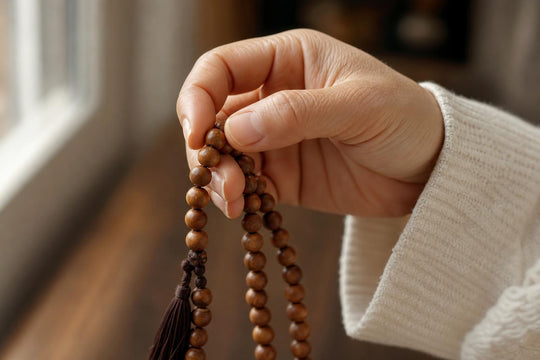
Count the beads on a japa mala and you will reach 108, then find a 109th that is never counted at all. It sits slightly apart, often larger, sometimes with a small tassel, and a practitioner moving through the strand does not cross it. On reaching it, the hand turns and works back the way it came. This bead has a name: the guru bead, or meru. It marks the one place on the entire object where you are asked to stop, not to continue.
I keep a mala within reach of the bed, and that small design choice, a counted circle with one deliberately uncounted bead, tells you more about what makes a gift worth giving than anything printed on a box.
The real test for a gift under £30
Most gifts in this price range are judged on arrival: does it look good unwrapped, does the recipient smile in the moment. That test is easy to pass and almost meaningless. The better question is what happens a week later, when the novelty has gone and the object is still sitting somewhere in the house. Does it get picked up again, or does it get moved to a drawer and quietly forgotten.
Stack a scented candle, a small tube of bath salts, a mug and a biscuit under one lid and you have assembled a pleasant hour, not a habit. Each item in a bundle like that has a shelf life measured in a single use: the bath happens once, the candle burns down, the mug joins twelve others in the cupboard. None of them ask to be returned to, because none of them are built around return.
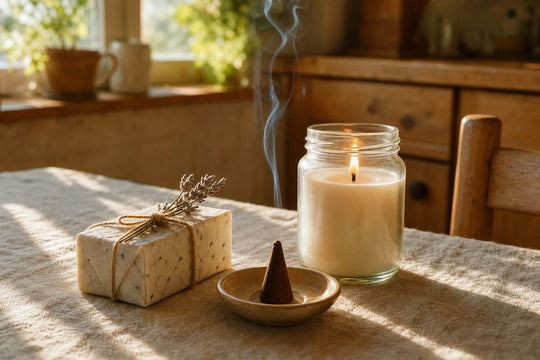
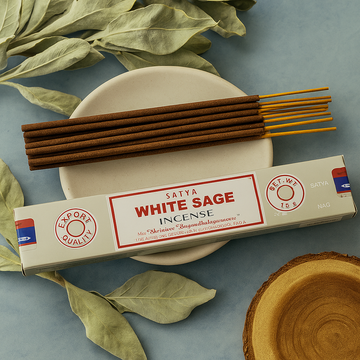
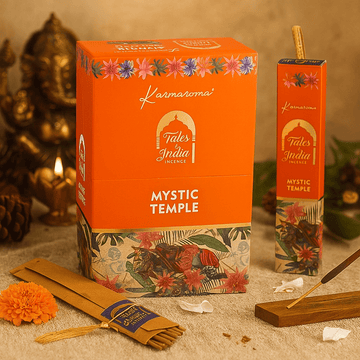
A Rudraksha Buddha Mala Bracelet works on the opposite principle: a small loop of beads, each one meant for a single breath, repeated. It has one job, done again tomorrow, and the guru bead sitting apart from the other 108 is the clearest version of that idea in a single object. It is the one bead built to be skipped rather than counted, which is another way of saying the object itself marks where a habit pauses and where it begins again. The same logic holds for a bar of natural soap, a cone of incense, or a single well-made candle kept for the specific moment of marking a day's end: none of them need to be part of a set to matter, and chosen on their own, for repeat use rather than quantity, they ask more of a person and give back more in return. The same test extends to a spiritual bracelet worn daily rather than set aside after the first week.
The honest variance the gift guides skip
A mala is a counting strand with roots in Indian religious tradition reaching back to the middle of the first millennium BCE, and the word itself, mala, is simply Sanskrit for garland. Hindu and Buddhist practitioners both use it, and the tradition does not reduce to one neat rule about what it is made from or how many beads it carries.
Within Hindu practice alone, the material varies with the devotion: Vaishnava practitioners commonly chant on tulsi, the beads taken from holy basil, while Shaivite practitioners more often use rudraksha, a seed associated with Shiva. Neither tradition claims the other's material is wrong; they are simply different practices, carried on different seeds.
The number 108 carries the same honest uncertainty. It is treated as significant across several Dharmic traditions, and multiple explanations exist: astronomical counts, numerological readings, symbolic ones, but no single account is agreed to be the origin. Tibetan Buddhist malas also run to 108 beads, where a full circuit counts as 100 repetitions, with the remaining eight set aside as a dedication to all sentient beings rather than tallied for the self. Shorter forms exist too: wrist malas of 27 or 18 beads, told twice or four times over to complete a full count of 108, are common enough that the number itself seems to matter more than any single length of string.
Why it stays by the bed, and how to use it
My own japa practice is a small, daily thing, not a performance. A mala by the bed means the first and last deliberate minutes of a day have somewhere to go that is not a phone screen. There is a particular point at which a person buying one of these for someone else understands what they are actually choosing: not an object that will be unwrapped and praised once, but a small, repeatable discipline they are quietly handing over.
The practice itself is simple enough to start the same day it arrives. Hold the mala in one hand, away from the guru bead, and move to the first counting bead with the thumb. Each bead gets one breath, or one word, or one repetition of a chosen phrase, whichever form of japa you are drawn to. Work steadily round the strand, one bead per repetition, until the hand reaches the guru bead again. At that point the rule is firm and simple: you do not cross it. You pause, and if you want to continue, you turn the mala round and work back the way you came. It is a small, physical reminder built into the object itself that even a practice meant to be repeated has a natural stopping point, and noticing the stop is as much a part of the discipline as the counting.
A rarer thing to give
A gift worth giving twice is not one that impresses in the unwrapping. It is one you find yourself buying again for somebody else entirely, because you have watched what it did the first time: not a single bright afternoon, but a small habit that kept returning on its own. That asks the giver to trust that a single well-made object, used daily, outlasts a basket of things used once, and it asks the receiver to do nothing more than pick it up again tomorrow.


 India

 Mexico


 United Kingdom