In 1792, Tipu Sultan declared sandalwood a "royal tree" of Mysore. From that year, every sandalwood tree in his territory belonged to the state, regardless of whose land it stood on: a farmer could own the soil and still own nothing of the tree growing out of it. The law held, in one form or another, for more than two centuries. No one in Mysore has ever lit a sandalwood stick the way you might light one tonight, absent-mindedly, between emails. The wood carried a government's interest before it carried a scent.
Incense sits close to daily practice for a great many people, alongside a mala or a few quiet minutes before the day properly starts, and the three sticks most reach for, without quite knowing why one differs from another, are nag champa, sandalwood, and rose. They are usually sold as interchangeable moods: pick the one that matches how you want to feel. It is more useful to know what each one actually is, because the honest answer changes how you choose, and it is more interesting than a scent wheel. It also brings you back to that stick you might light tonight without thinking about it at all, and what two hundred years of law, trade and craft put into your hand before you struck the match.
What nag champa actually is
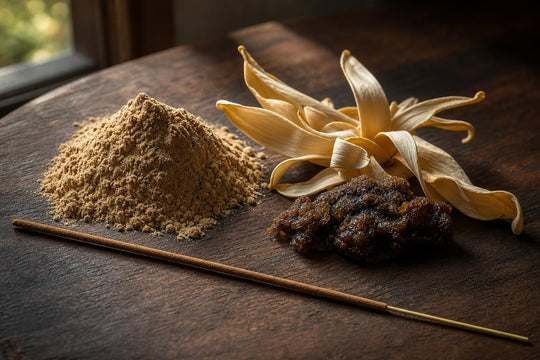
Nag champa is a masala incense, which means a paste rather than a scented stick. Traditionally, this paste combines champaca flowers, sandalwood, and a resin called halmaddi, worked together and hand-rolled onto a bamboo core, rather than a fragrance oil dipped onto plain wood. Champaca itself (Michelia or Magnolia champaca) is a golden flower related to magnolia, not to be confused with frangipani, which is sometimes used in its place; when frangipani stands in for champaca, the result is usually sold simply as "champa". The confusion between the two flowers is old and genuinely widespread, not a modern shortcut.
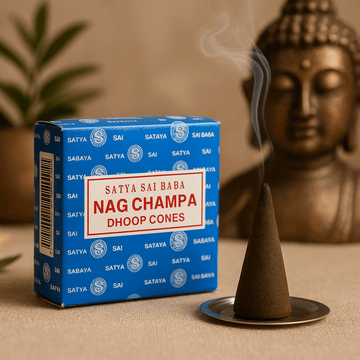
Halmaddi is the part of the recipe most people have never heard named. It comes from Ailanthus triphysa, and it gives traditional nag champa its particular character: damp, a little honeyed, slightly resinous underneath the floral top note. The resin draws moisture from the air, which is part of why an older stick of nag champa can feel soft and slightly sticky to the touch in a way a drier incense never does. Halmaddi has grown scarce and restricted in harvest over recent years, and incense makers have had to adapt: some substitute, some reduce the proportion, some rework the recipe entirely. This means a given brand's nag champa today may smell noticeably different from one made a generation ago, and different brands of nag champa can smell different from each other for reasons that have nothing to do with quality and everything to do with what each maker had available. If you have ever bought two packets labelled the same and found them unlike each other, this is usually why. When you want the fuller, rounder profile this paste tradition is known for, a stick like Nag Champa Incense 250g Satya sits closer to that older style than the thin, oil-dipped versions found on many shelves, though the recipe itself has shifted with its ingredients, as all living crafts do.
Sandalwood on its own
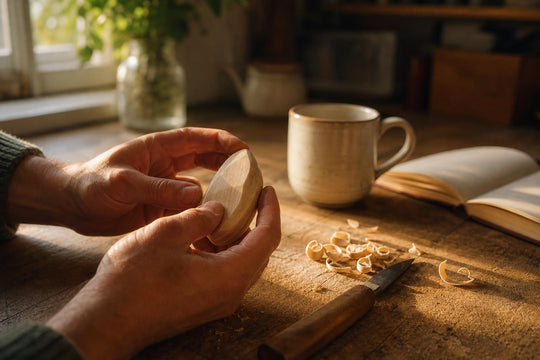
Strip the champaca and halmaddi away and you are left with sandalwood by itself, and here the 1792 edict matters again. Tipu Sultan's declaration was adopted and continued by the governments that followed him in the region, and for a long stretch of time afterward, landowners in large parts of southern India held no ownership rights over sandalwood trees growing on their own soil. A person could plant one and never be allowed to cut it down. That changed only recently, as Karnataka and other states relaxed the state monopoly in the early 2000s, and for the first time in generations, private individuals could grow and legally own sandalwood again. Karnataka still holds a large share of India's remaining natural sandalwood, which says something about how long and how thoroughly that single law shaped where the tree survives today.

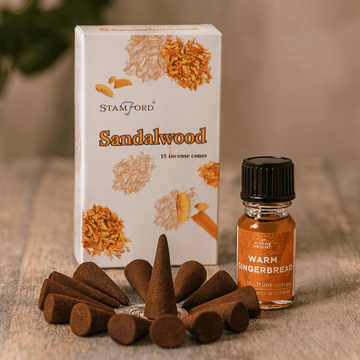
The species behind all of this, Santalum album, is listed as Vulnerable by the IUCN. That status, and the regulation built around it, is part of why genuine sandalwood incense, done honestly, tends to cost what it costs: a slow-grown heartwood, taken under licence, from a tree that cannot simply be replanted and harvested on a short cycle. When you burn it on its own, without a flower paste around it, you get the plain thing: a smooth, milky, woody note with very little sweetness, grounding rather than lifting. It is the base note that holds up the floral top in nag champa, and on its own it reads quieter, more austere, the kind of scent that asks for stillness rather than mood. A simple way into that register, without the ritual weight of a full stick, is a set like Sandalwood Incense Cones 15 Pack With Holder, or for daily use, a packet from the wider range of pure sandalwood incense.
Rose incense, the odd one out
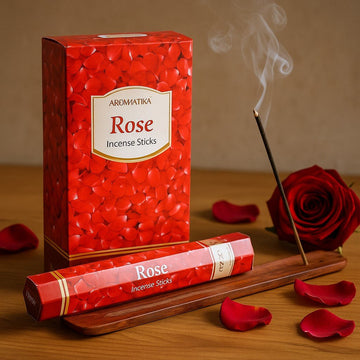
Rose is where the comparison tables mislead people most, because a stick labelled "rose incense" is, in many cases, not holding real rose at all. Natural rose oil is made through slow, traditional distillation of the petals, and it takes a genuinely large quantity of them to produce a small amount of oil, which makes it among the costlier materials in perfumery and expensive to use honestly in a mass-market stick. Much of what is sold as rose incense instead carries a synthetic or semi-synthetic approximation of the scent, built to read as "rose" without the plant behind it. This is not a scandal and it is not a reason to avoid the category; a well-made synthetic rose note can still be pleasant and still mark a moment of the day. But it is worth knowing, if you are choosing rose for its association with the actual flower, with Lakshmi's traditional iconography, with the softness that rose carries across so many cultures, that the stick in your hand is more often an idea of rose than the flower itself. Buy it for what it is rather than for what the label implies, and look at the range of rose incense with that distinction in mind rather than against it.

Choosing by character and timing, not mood
Once you know what each one actually is, the choice stops being about mood and starts being about character and timing. Nag champa, with its honeyed resin underneath the floral note, tends to suit a room where people will sit together, or the hour when a day is winding down rather than beginning: it has weight to it, something that lingers. Sandalwood on its own suits the start of something, a seated practice, a desk before the first task, because it asks for very little and offers a plain, steady note rather than a complicated one. Rose, real or approximated, tends to work best as a light accent, somewhere soft is wanted rather than somewhere grounded, a room meant for rest rather than concentration. None of this is a rule. It is closer to how you might choose tea by the hour rather than by a mood board: certain things simply sit better at certain points in a day, and your own sense of this, built up stick by stick, will outlast any guide.
What the smoke actually does, each time, is mark that something has started or something has ended. That is older than any comparison chart, and it stays true whichever of the three happens to be in your hand tonight, lit between one task and the next.

 India

 United Kingdom