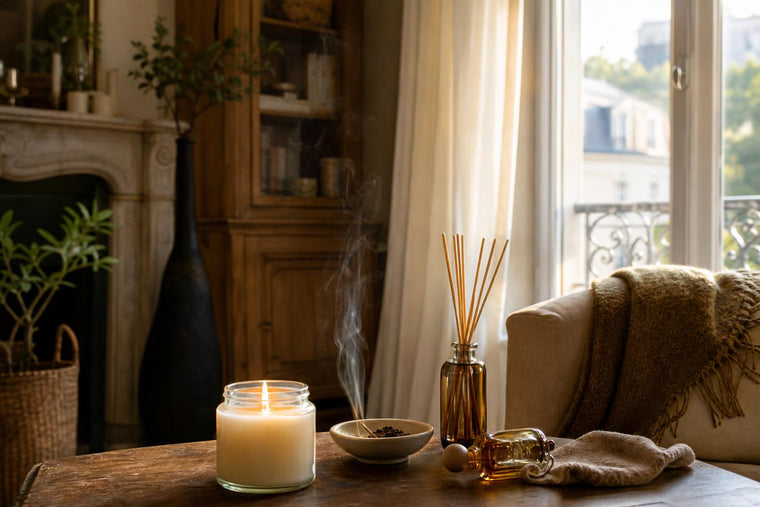
A guide kept by the King Abdulaziz Foundation for Research and Archives, the body Saudis call Darah, preserves a particular detail about King Abdulaziz: when he received guests, he moved between different bottles of perfume himself, applying scent until the room was filled with fragrance. He favoured incense, oud oil and rose oil, and the record is careful to note that he perfumed his guests as well as his rooms. Hospitality, in that account, extended to the people in the room, not only its walls and cushions, and oud itself has reportedly long carried a price that made it a gift for an occasion rather than a routine household habit.
That detail is worth sitting with, because most writing on Gulf home fragrance treats it as a finishing touch: a burner mentioned in passing after the cushions and the calligraphy, a line about "adding a welcoming scent" to an already-decorated room. The majlis tradition suggests something closer to the opposite. Scent is not decoration applied to a finished room. It is part of how the room receives people, carried by hand, timed to the moment, and planned with the same attention as where someone will sit.
The room built for sitting, and for smelling
The word majlis means, literally, a place of sitting. It names the reception room at the centre of a traditional Gulf home, the space where seating runs along the walls facing inward, where guests are received and where much of a household's social life happens. In that room the burner, the mabkhara, traditionally has its own fixed place, not tucked into a cupboard between uses but set out as a permanent fixture of the room itself, the way a hearth might anchor a different kind of sitting room in another culture.

That permanence matters. It tells you scent was never an afterthought reached for when a guest's car pulled up. It was built into the room's furniture of attention, there to be used whenever the room was used for its purpose: receiving people properly.
Why the burner walks
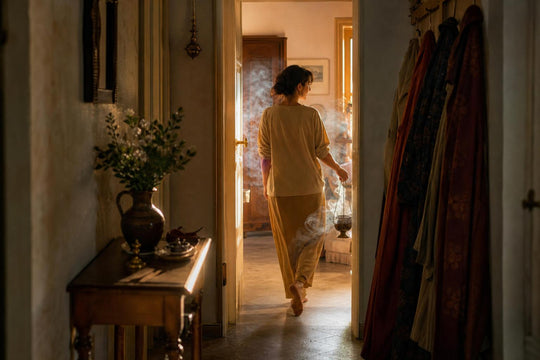
In many Khaleeji households it is common to carry bakhoor or agarwood smoke through several rounds rather than leave a burner smouldering in one spot. The mabkhara moves at the entrance, so a guest meets the scent before they meet the room. It moves through the majlis itself, where people gather and stay. It moves along the passageways connecting rooms, so the house is scented as a whole rather than scented in patches. The room is prepared before guests arrive, not perfumed while they watch; by the time anyone crosses the threshold, the work is already finished.
Traditional Gulf architecture once did a version of this work without anyone carrying anything. The barjeel, the wind tower found in many older homes across the region, draws air down through the building and pushes it back out, and in doing so it helps circulate fragrance through a house the way it circulates cooler air. A home built with a barjeel did not need a person to walk scent from room to room quite so often: the building itself kept the air, and whatever was burning in it, moving. The hand-carried mabkhara is, in a sense, a portable version of what the architecture used to manage for free. Where the wind tower is gone, the walk through the house is how that same logic survives.
None of this depends on having a wind tower or a formal reception room. It depends mostly on sequence and restraint. Air the room first, so the scent you introduce is the only one in it. Choose a burner that can travel comfortably from hand to hand: a small ceramic burner works at the entrance and then again by the seating, where guests will actually linger. Keep the material itself modest, a chip or two rather than a fistful, whether that is a resin or a stick of oud incense, and let it burn only long enough to reach the room, not to fill it. For the gap between spaces, where smoke doesn't reach as easily, a few measures of a room spray for the passage between rooms can do a version of the same walking work the mabkhara once did unaided.

Why air forgets and fabric remembers

There is a practical reason the burner lingers near the cushions and the rugs rather than simply perfuming the open air of a room. Air holds a scent for a matter of hours. Textiles hold it for days. A rug that has had smoke pass close to it, a curtain that has had a few minutes near the mabkhara, carries the fragrance long after the room has been aired out and the smoke itself has gone. This is why the traditional sequence pauses near fabric rather than treating the whole room as one undifferentiated space: a cushion is a kind of memory for a scent that the air cannot keep.
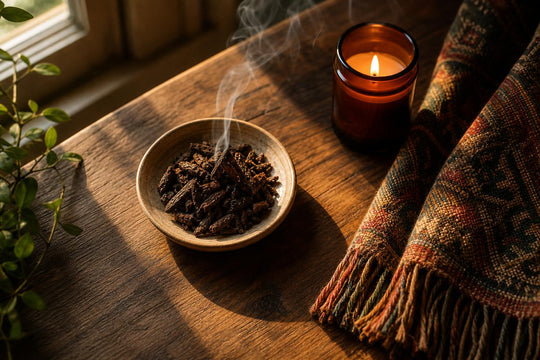
The traditional method given for this kind of scenting is unhurried rather than heavy-handed: ventilate the room first, prepare the burner with ashed-over charcoal or an electric plate on a low setting, and use only two or three chips of bakhoor or a small piece of resin, never a handful. The burner is carried slowly, not held in one place, and the whole process stops well before the room feels smoky, because the fragrance keeps developing in the fabric after the burning itself has ended. Restraint, in the accounts that describe this practice, reads less like a modern correction and more like the habit itself.
Carry the burner, don't park it: a short pass through the hallway, a pause near a cushion or curtain so the fabric has a chance to hold what the air cannot, and then let the room be. Backflow incense cones, whose smoke pools low and visible, suit a room where you want the occasion to be seen as well as smelled, a small theatre of arrival rather than a scent nobody notices until it's already fading.
Oud, the wood with a wound in it
Oud itself is worth knowing a little about, since it is named so often in this tradition without much explanation. It is the Arabic name for agarwood, the resin-dense heartwood that forms inside certain Aquilaria trees after they become infected by a particular mould. Before that infection, the wood is pale, light and largely without scent; the tree's resinous defence against the infection is what eventually produces the dark, dense material. The incenses and perfumes made from agarwood have been valued for centuries and used by many cultures for spiritual, opulent and what one research review on the trade describes as aphrodisiac purposes, with a documented history of international trade in the wood, whether as the material itself, as oud oil, or as the attars and reconstructed perfume accords built to resemble it. What looks like a single raw material is really the record of a tree fighting something off, and the slowness of that infection, which can take years, is a large part of why genuine agarwood has always carried a price to match its scarcity, and why much of what is sold today leans on cultivated trees and synthetic accords to meet demand the wild resin alone could never satisfy.
An occasion, not a constant
What stands out, reading these accounts together, is how episodic the practice is. The room is scented for something: a guest arriving, a gathering beginning, an occasion that deserves marking. It is not left running in the background the way a diffuser might run through an ordinary afternoon. The scent announces that something is happening here now, and then it recedes, living on quietly in the cushions until the next occasion calls for it again.
I keep returning to this distinction, because it runs against the instinct a lot of home fragrance habits fall into: scent as wallpaper, something switched on in the morning and left to hum along unnoticed by evening. A fragrance kept for certain moments, carried room to room with some attention, asks you to notice the moment it marks, and asks your guests to notice it too. The cushions will hold the trace long after the smoke has cleared, which means the room keeps a kind of memory of the occasion even once it is over, a trace a guest might only notice on their own coat the next morning. A house that scents for every occasion equally has simply traded one kind of constancy for another; the version worth keeping is the one where the scent still has something to announce. The question is not "how do I keep this room smelling nice", but "what is this scent for, today".

 India


 Peru


 China