In 1833 a French chemist wrote to a colleague about something strange happening in his own hand. Michel Eugène Chevreul held a pendulum quite still, and it would not stay still. What he set down afterwards has outlasted almost every wilder claim later made in the pendulum's name.
A Letter to Ampère
Chevreul, known for his work on colour and on fats, wrote an open letter to the physicist André-Marie Ampère describing a small experiment he had run on himself. He held a pendulum by its cord, kept his hand as still as he could manage, and watched the weight begin to swing regardless. It did not swing randomly. It seemed to answer his own attention.
His explanation was careful rather than mystical: tiny, involuntary muscle contractions in the hand, too small to feel, large enough over time to set a hanging weight in motion. The account was precise enough that psychology still uses his name for it. The Chevreul pendulum, or Chevreul pendulum illusion, describes exactly this: a still object moved by a hand that believes it is holding still.
Popular writing on pendulums likes to reach back to "ancient Egypt, China and Rome" in one breath, folding the pendulum into a single unbroken story of dowsing. The actual record is less tidy. The forked rod is the older, better documented tool: Georgius Agricola's De Re Metallica, published in 1556, describes miners in the Erzgebirge, the Ore Mountains of Saxony, using forked hazel rods to search out veins of ore underground, though Agricola himself was sceptical of the method and argued against relying on it. The hand-held pendulum, held loosely over a question rather than swept over ground, is a separate and later thread, running through Chevreul's 1833 letter rather than back through Saxon mining. The two are related in spirit, both objects that seem to answer a question, but they are not one tool with two names.
What the Object Actually Is
Strip away the questions people ask of it, and a pendulum is a plain thing: a weighted point hung from a cord or a chain, free to swing. It can be a faceted crystal, a bead, a key on a string, a ring on a thread. Nothing magnetic is required, and nothing in the material makes the weight move on its own.
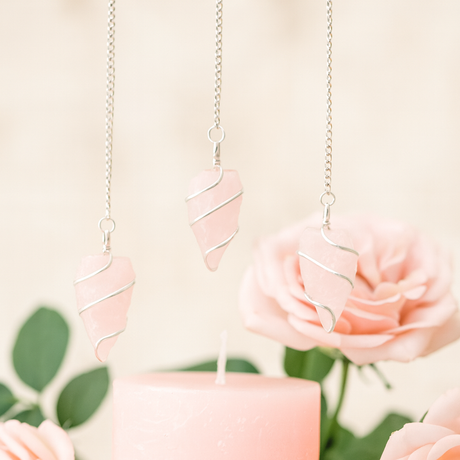
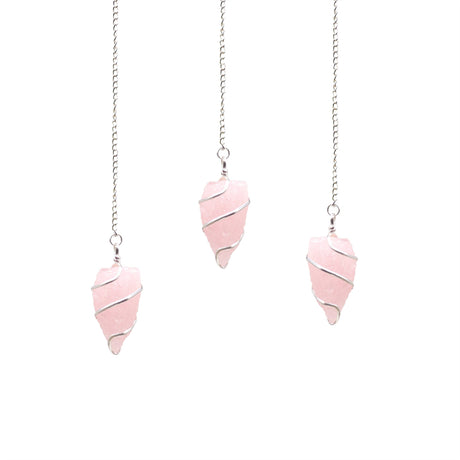
What varies is only what someone chooses to hold. A person drawn to the traditional associations of rose quartz might reach for a rose quartz pendulum for that reason alone; the swing itself works the same way whatever hangs from the chain.
Why It Actually Moves

In 1852 the English physiologist William Benjamin Carpenter gave this general pattern a name: the ideomotor effect, an idea producing a small muscle movement without the person intending it or noticing it happen. A pendulum's swing, on this account, is not a message arriving from somewhere outside the hand. It is the hand's own faint decision, made visible by a weight sensitive enough to show it.
That is a small claim, and it is the honest one. The pendulum is reading the hand back to itself.
How to Begin

Choose something light enough to move freely and heavy enough to hold a clean line rather than wobble, on a chain of roughly six inches. An amethyst pendulum, a faceted point on a chain of about that length, works well for exactly this reason: enough weight to settle, enough length to swing without your hand having to do anything deliberate.
Sit somewhere steady. Rest your elbow, and hold the chain between thumb and forefinger so the point hangs just above the flat of your other, open hand. Let your hand go quiet rather than trying to hold it perfectly still, which tends to produce more movement, not less.
Start with a question whose answer you already know: your own name, a fact that is plainly true. Watch which way the pendulum begins to swing, forward and back, side to side, or in a circle. Whatever pattern appears is your own "yes" for that session. Ask a second question, one you already know is false, and note the different pattern that answers it. Only once both are established do you ask the real question, once, and read the swing you already recognise.
Holding the Practice Honestly
A pendulum session is worth treating the way I treat a string of mala beads or a lit stick of incense: as an object that gives the hand and the attention something to do, not as an authority handing down a verdict. The person doing the noticing is still the one doing the work.
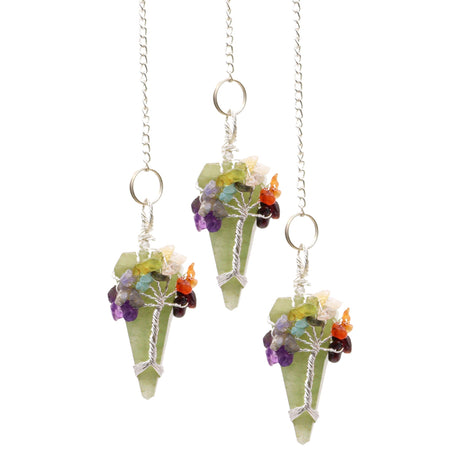
Some people run a pendulum over the seven chakra points during a body scan, and a seven-chakra pendulum is made with that particular use in mind, one bead of colour for each point along the spine. Traditionally this is held as a way of directing attention along the body, not as a diagnosis, and it asks nothing of the reader beyond a few quiet minutes of paying attention to where a swing changes.
None of this stands in for medical advice, and no pendulum session should be read as a prediction about health, a relationship, or a decision still to be made.
Ask anyone who uses a pendulum regularly what happens after the first few sessions, and they will tell you the same thing: the "yes" swing stops needing to be worked out each time. It arrives faster, more cleanly, often in exactly the same direction it took the very first time it was calibrated. That is not the pendulum remembering anything; chains and crystal points hold no memory. It is the hand that has learned a habit, the way a hand learns any small, repeated motion, and Chevreul, writing in 1833, was describing the very first instance of that habit ever set down on paper.