A deck of oracle cards sits on the table, face down, waiting to be shuffled. It looks old, or wants to look old: gilt edges, a moon on the box, a word borrowed from a temple that closed down a very long time ago. The word is oracle, and it comes from the Latin oraculum, itself from orare, to speak or to pray. It named a divine pronouncement, and the person or place through which it came. In ancient Greece that person was, for centuries, the Pythia: the priestess who delivered oracles at the Temple of Apollo at Delphi, traditionally described as speaking from a tripod, consulted by ordinary people and by whole cities.
A word older than the cards
The oracle decks sold today did not inherit her seat, her temple, or any single unbroken practice reaching back to it. What travelled across that distance was the word, not the object. It is worth saying plainly, because the fact is more interesting than the myth it sometimes gets dressed up as: a modern oracle deck is a distinctly younger thing, a format that grew mostly through the twentieth century as artists and authors began publishing decks of their own design, each one free to choose its own imagery, its own themes, its own number of cards. Some of the best-known angel-themed decks, the ones people now search for by name, came out of exactly that period of independent publishing rather than any older lineage.
Tarot took a different road. It settled, in the twentieth century, into a fixed and widely recognised structure: seventy-eight cards, split between the twenty-two of the Major Arcana and the fifty-six of the Minor Arcana across four suits, a structure fixed in the public imagination by decks such as the Rider-Waite-Smith, illustrated by Pamela Colman Smith and designed with A.E. Waite, published by Rider in 1909. Learn that deck and you are learning a shared grammar that thousands of other readers already know. Oracle cards offer no such promise. There is no fixed count to master, no universal key that opens every deck; each one is its own small, self-contained world, and that changes what "learning to read them" actually means.
Choosing a first deck

Because there is no common grammar underneath oracle cards, choosing a first one is less a mystical decision than a design decision, and a fairly ordinary one at that. Two questions do most of the work. Can you read the image at a glance, without squinting at symbolism that only the artist understands? And is the accompanying booklet actually worth keeping, offering a real sentence to sit with rather than a single adjective? A deck under fifty cards is easier to hold in the head as you start; eighty or more is a fine ambition for later, once a handful of cards have already become familiar faces rather than strangers you have to look up every time.
None of this needs the idea that the right deck will somehow find you, or call out from a shelf. It is closer to buying a cookbook: some are written for people who already know what they are doing, and some actually teach you as you go. Start with the second kind.
The mechanics of a first reading
The reading itself is simpler than the packaging around it suggests. Shuffle until it feels sufficiently mixed, not by any ritual count but by your own sense of it. Draw a single card. Read the booklet entry before reaching for your own instinct, since the writer has usually thought about that image longer than you have in the first thirty seconds. Then sit with the picture itself for a minute before deciding what, if anything, it has to say about the actual day ahead of you. That last step is the one most checklists skip, and it is the one that turns a card from a slogan into a genuine prompt for a small piece of noticing.
The practice that actually works
A single pulled card, taken as a yes or a no, tends to be forgotten by evening. What holds up over time is smaller and far less dramatic: a dated line in a notebook, the name of the card and one honest sentence about the day, written down and then left alone. Read back after a few weeks, that short log does something a single pull never can. It lets you check the cards against your own memory rather than against a booklet, and it is where any real pattern, if one exists, would actually show itself, rather than in the drama of any single draw.
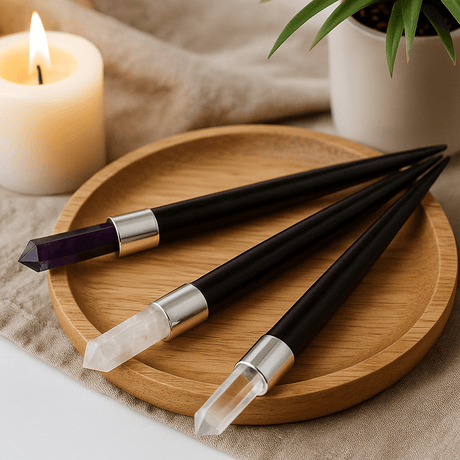
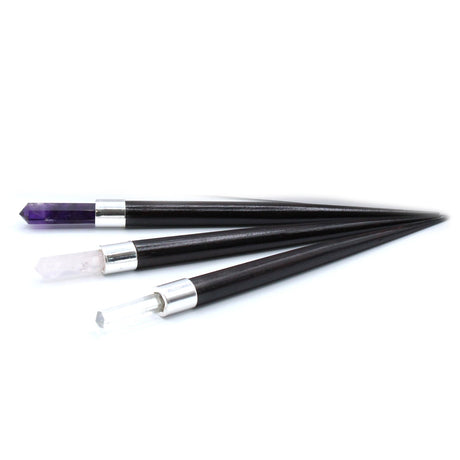
Some readers keep a small stone in reach while they do this, a piece of amethyst among the more common choices, a stone the Greeks associated with sobriety and a clear head. It does not change what a card means, and nobody needs it to. What it does is closer to lighting a lamp before opening a book: a small, specific object that marks these fifteen minutes as separate from the ones either side of them, in the same quiet way an Amethyst Crystal Pendulum for Dowsing and Divination earns its place on a table not by predicting anything but by being the thing a person reaches for when they mean to sit down and pay attention.
What the log is for
The Pythia's authority came from her seat, her temple, and a role she held for a very long time within a system built entirely around her. A person keeping a shuffled deck and a notebook at home has none of that, and does not need to borrow it. What they have instead is a habit small enough to actually keep and honest enough to check: not a claim about the future, but a record of a person's own attention, written down often enough that its shape, if it has one, becomes visible to the person who wrote it. That is a much smaller thing than an oracle in the old sense. It is also, unlike the old sense, something you can go back and read.
Keeping that record does not need much. A page will do it, or, for anyone who likes their small rituals to have their own container, a dated line in a notebook kept somewhere it will actually be opened again is worth more than any elaborate deck left unshuffled on a shelf.