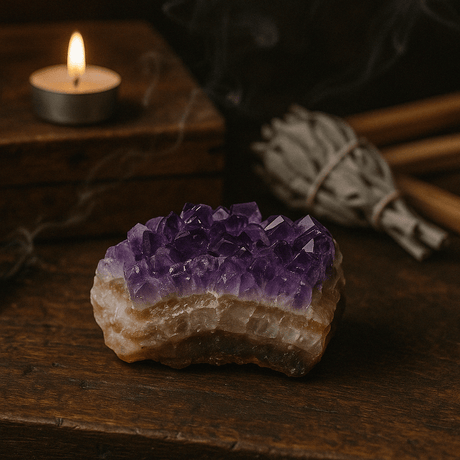
Slow living asks small, specific questions of ordinary objects, and amethyst rewards the asking better than most stones on a shelf. Before it is a colour or a mood, it is a very particular piece of geological history: a cavity in old lava, filled slowly by water, cut open by someone's hands. Knowing that story changes what you are actually choosing when you choose one.
One Stone, Two Rooms
A large geode arrives at a cutting shed as a single, dull grey boulder. It is sawn straight through the middle, and the two halves it produces are, structurally, the same object: matching crystal faces, matching growth lines, a matching record of however many millions of years it took to fill. From there the two halves usually part ways. One might stay in a shop in South America; the other travels, often to a different continent entirely, sold to a buyer who will never see, or think to ask about, its twin. This is not a rare or dramatic event in the amethyst trade. It is the ordinary, everyday way most large geodes are sold.
What both halves are made of is straightforward. Amethyst is quartz, coloured purple by a trace of iron in the silica combined with natural irradiation deep underground, over a very long time, at no drama at all. It sits at 7 on the Mohs hardness scale, which is why it survives daily handling and jewellery-setting far better than softer stones. The colour and the durability come from the same slow chemistry, which is worth holding onto, because most of what follows is really an extension of that one fact.
The Ground Before the Gem
Every amethyst cavity began its life as a gas bubble, trapped inside lava as it cooled and solidified into basalt. The bubble left a hollow space behind, sealed inside rock, and it is that hollow, not some vague "ancient formation", that eventually became a geode. Today's principal amethyst-producing ground is the Paraná flood basalt province, a vast stretch of old lava spanning southern Brazil and Uruguay. Two localities within it have actually been studied and named: Ametista do Sul in Rio Grande do Sul, Brazil, and Artigas in northern Uruguay.
A 2009 study published in the International Journal of Earth Sciences traced what happened inside those trapped bubbles. Warm water, linked to the Guaraní aquifer and estimated at roughly 50 to 120 degrees Celsius, moved through the basalt and lined the cavities in stages: first a skin of agate, then quartz, then finally the amethyst layer that ends up in a cutting shed. The same research dated this slow infilling to somewhere between about 65 and 133 million years ago. It is not a metaphor to say a piece of amethyst took that long to become itself; it is closer to a literal description of the mineral in your hand.
The scale of extraction varies enormously. The giant "cathedral" geodes associated with the Artigas region can weigh from hundreds of kilograms to several tons, and are mined by carving a protective shell of surrounding rock around the cavity before lifting the whole thing out with cranes or loaders. Smaller geodes, by contrast, can be removed intact by hand. A cluster small enough to sit on a desk and a cathedral geode taller than a person began the same way, in the same kind of hollow; they simply grew, and were found, at different scales.
A Gem That Lost Its Rank
For much of its history in the West, amethyst was ranked among the five cardinal gemstones, set alongside diamond, ruby, sapphire and emerald, and valued accordingly. That standing shifted decisively in the 18th century, when large deposits were found in Brazil. Supply that had once been genuinely scarce became, relatively speaking, abundant, and amethyst's rarity, and with it its price, never fully recovered its old position. This is worth knowing because it means the modest cost of amethyst today has almost nothing to do with how it is made, which is still a slow and specific geological process, and almost everything to do with how much of it geologists eventually found in one part of the world.
Reading the Stone Instead of Testing It
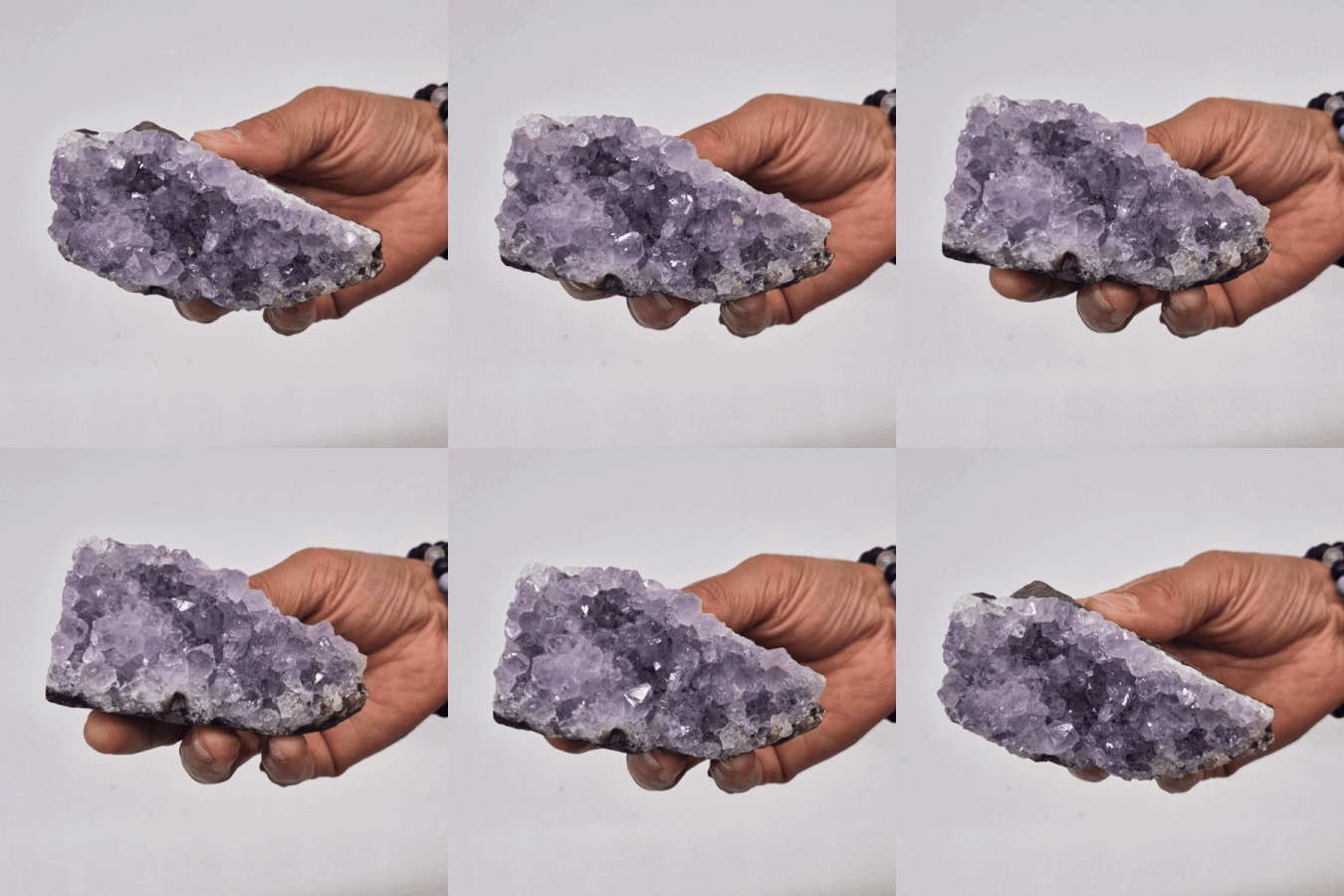
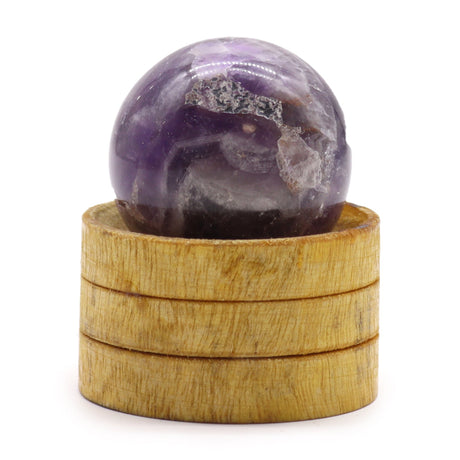
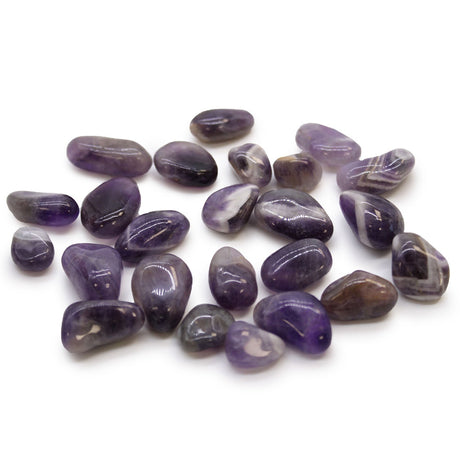
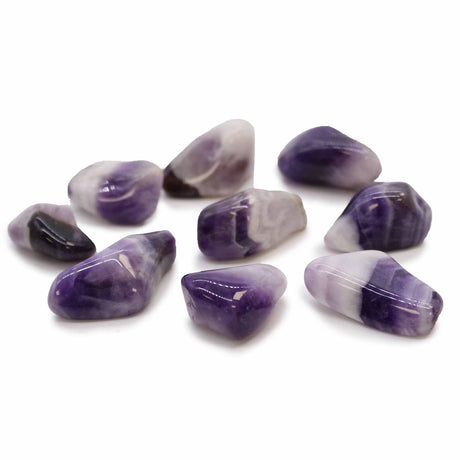
Buying advice for amethyst tends to arrive as a checklist: grade the colour, check the clarity, look for certification. There is a simpler way in, and it starts from the geology rather than from a grading sheet. Colour zoning, those uneven bands of lighter and darker purple running through a piece, is not a flaw to be graded down. It is a growth line, a record of how the mineral-rich water inside the cavity changed slightly as it worked. A stone with visible zoning has simply kept a more legible diary of its own formation than one that looks perfectly uniform.
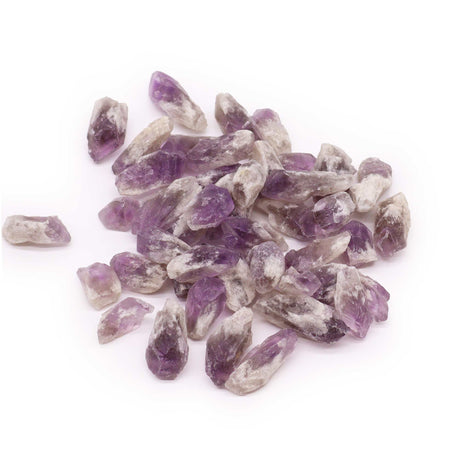
Weight and crystal size tell a related story: where in the cavity a piece grew, closer to the outer wall or nearer the open centre, tends to show in how large and how dense its crystals are. And the difference between a single pointed crystal and a clustered piece is not a difference in quality so much as a difference in which part of the same slow process you are holding: a point often grew with more room to extend outward; a cluster grew crowded, alongside its neighbours, and kept that closeness visible.
None of this replaces basic care with a significant purchase. Natural amethyst typically feels cool against the skin and warms slowly, while glass or synthetic imitations tend to warm quickly and can hide round gas bubbles or pooled dye along their fractures. The GIA is also clear that origin alone does not set an amethyst's value: the old term "Siberian quality" no longer refers to Siberia at all, but describes stones showing red and blue flashes over a deep violet, wherever they were actually mined. For anything costly, their own advice still stands: work with a jeweller who knows the material, and ask for an independent report where it genuinely matters. But for most amethyst that will sit on a shelf or in the hand, the more useful skill is simply learning to see the growth record already in front of you.
How to Live With One
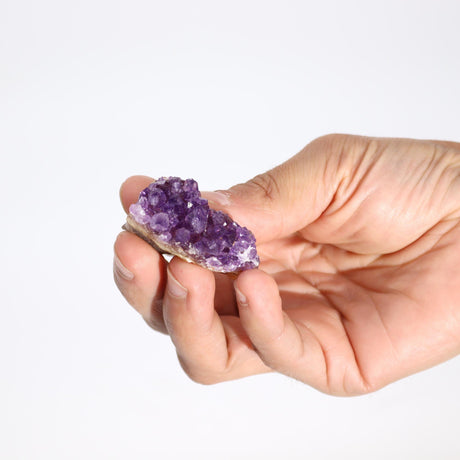
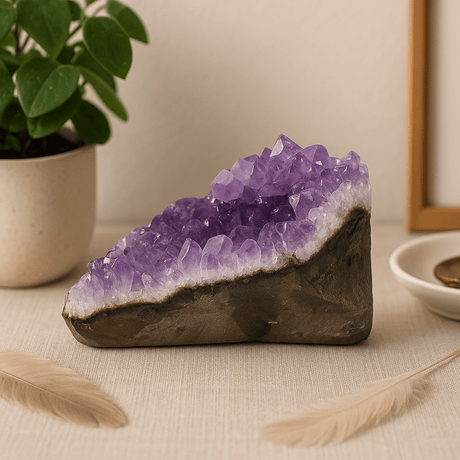
Amethyst has long been reached for as a stone of calm attention, associated in various traditions with clarity of mind and, in some systems, with the crown chakra; what it actually does in a room is quieter and depends entirely on what you bring to it. Scale still guides the practical choice more than any grading criterion. A small cluster for a desk sits within easy reach through a working day. A standing cluster for a room holds its own at a larger scale, somewhere it will actually be looked at. A rough point for the hand suits meditation precisely because it has not been shaped smooth, keeping its own uneven growth under your thumb. Whichever you choose, the stone offers itself; what you make of the time you give it is yours to decide.
The Other Half
Go back to the geode split cleanly down the middle. Most amethyst that reaches a shop arrived that way, as one half of a pair, and almost no one who buys it stops to ask where its twin went. That is not a loss worth mourning; it is simply the ordinary shape of the trade, and a useful thing to remember the next time a piece of amethyst catches your eye. You are not choosing a graded gemstone so much as taking custody of one half of something that was, until fairly recently, still whole rock in the ground.