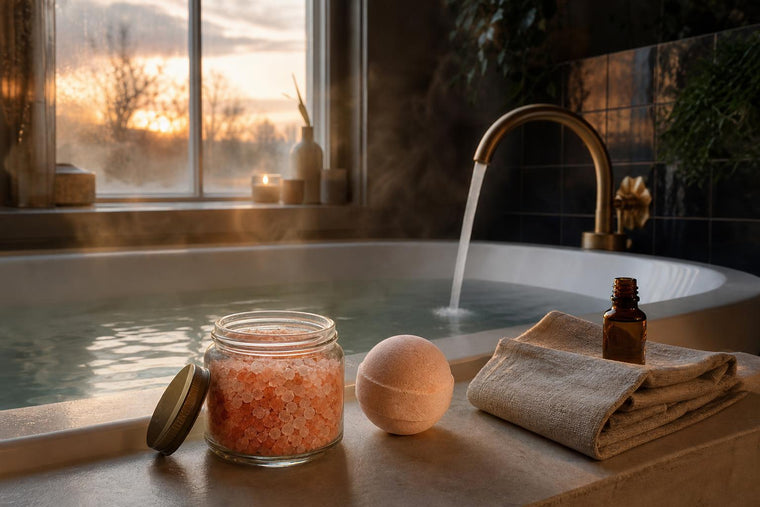
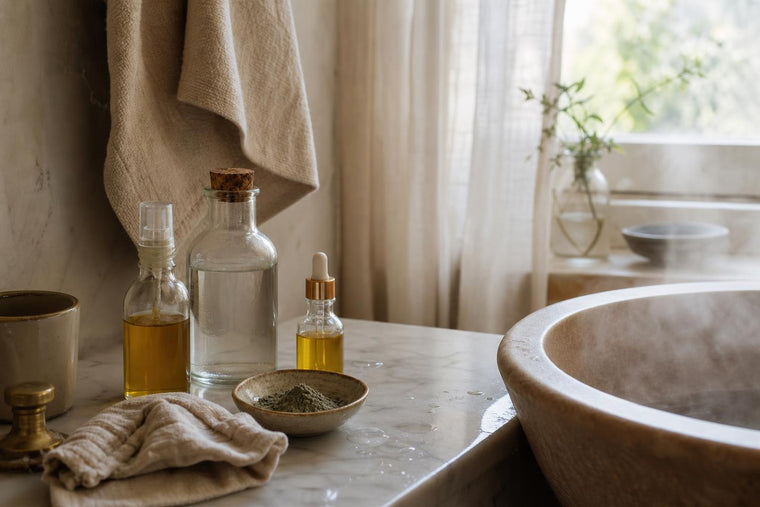
In one tradition of self-care, the oil goes on first. Not after the shower, not massaged into damp skin as the last step before dressing, but before any water touches the body at all. In Ayurveda this is abhyanga, a word built from the Sanskrit abhi (into, or towards) and anga (limb): oil worked into the limbs, then left to sit, and only afterwards washed off. Nearly every modern tip about body oil runs in the opposite direction. The reversal is worth sitting with, because it changes the question the reader is actually answering: not just what the skin needs, but how much of the next while is theirs to give it.
Three textures, plainly
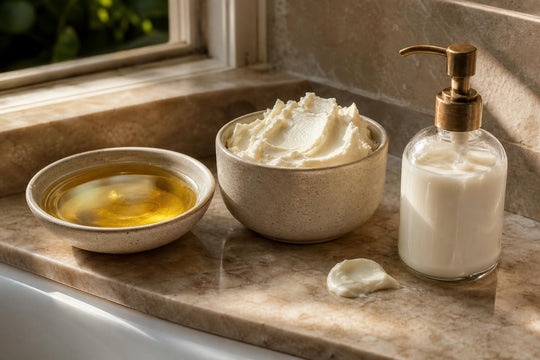
Oil, butter and lotion are often sold as interchangeable, differing mainly in scent or packaging. They are not. The difference is water.
Lotion is an oil-in-water emulsion, and the water is usually the larger share. That is why it feels light on the skin and disappears quickly: it is mostly liquid, carrying a smaller amount of oil to slow down evaporation. Body butter runs the other way. It is built chiefly from plant butters and oils with little or no water in the mix, which makes it denser, slower to work in, and longer-lasting once it has. Pure body oil goes further still: no water at all. An oil does not add hydration so much as seal in whatever moisture is already sitting on the skin, acting as a barrier rather than a source.

That single fact, water content, explains almost everything else people say about the three. It is why a standard piece of advice tells you to apply oil within a few minutes of stepping out of the shower, while skin is still damp: the oil has nothing to hydrate with on its own, so it needs water already there to hold in place.
The modern shorthand, and what it leaves out
Most current advice sorts the choice by skin type and season. Dry skin and winter point towards butter, heavier and slower to use up. Normal or combination skin and warmer months point towards lotion, which sinks in without a residue. Oil sits at the end of a shower routine, sealing what the water has just given the skin.
This is useful, and none of it is wrong. But it answers only half the question, because it assumes the only variable is the skin itself: how dry it is, what month it is. It says nothing about the person doing the applying, or about how much time and attention they actually have in that particular moment. A skin-type chart cannot tell you whether tonight is a fifteen-minute night or a ninety-second one.
An older sorting system: oil by constitution, not by skin type
Abhyanga offers a different logic entirely, and it predates the water-content chart by a long way. It is recorded among the oldest documented forms of self-care, named in the Charaka Samhita and also described in Vagbhata's Ashtanga Hridaya, two of Ayurveda's classical texts. The practice is traditionally done before bathing, most often in the morning, though an evening version is also recognised, usually framed around settling the body for rest rather than preparing it for the day.
What makes the system genuinely different is how the oil itself gets chosen. Rather than matching oil to a skin-type label, Ayurveda matches it to constitution, the three doshas: sesame oil is associated with Vata, coconut oil with Pitta, mustard oil with Kapha. Three oils, three temperaments, and not one of them asks whether your T-zone shines by midday. Sesame runs warm and grounding, suited to a constitution reads as dry and restless. Coconut runs cool, suited to one that already runs hot. Mustard runs sharp and stimulating, suited to one that tends towards heaviness and slow mornings. Practices and exact pairings vary between lineages and households, and this is not the only scheme in use, but the underlying idea, oil as something chosen for the person rather than only for the surface of the skin, is a genuinely old one.
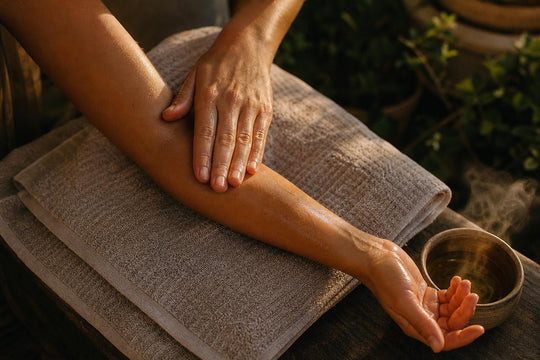
After the massage, the oil is traditionally left on the skin for ten to thirty minutes before washing, giving it time to work in rather than simply sitting on top. A full daily self-massage is generally described as a ten-to-twenty-minute morning practice, considerably shorter than a therapist-given treatment, which commonly runs forty-five minutes to an hour.
What the time actually buys
Abhyanga is not really a case for using more oil, or using it at a different hour. It is a case for attention as the actual ingredient, separate from whatever is in the bottle. Ten minutes of unhurried, deliberate contact with one's own skin, oil or no oil, is a different act from a thirty-second smear while thinking about something else entirely. The texture a person reaches for, oil, butter or lotion, often follows from how much of that attention is available, more than from what the label on a skin-type card says. A heavy winter night with nowhere to be suits a butter worked in slowly, under a jumper. A rushed morning before work suits a lotion, in and done before the kettle has boiled. Neither is the better choice. They are answers to different questions about the same ten minutes of a day.

A shorter way in, and where products actually fit
A full self-massage routine can feel like one more task on a day that already has too many. Abhyanga has its own answer to that: padabhyanga, a foot-focused version, is often suggested as the easiest way to begin, precisely because it needs so little. A few minutes with oil and the soles of the feet, before bed or before a bath, is not a diminished version of the practice. It is the same idea, scaled to whatever time is genuinely on offer that day.
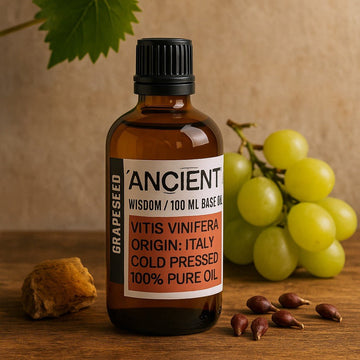
The same logic travels well into an ordinary bathroom cabinet. A Grapeseed Carrier Oil, thin and quick to work in, suits the ninety-second morning. A denser Shea Body Butter Argan earns its place on nights when there is real time to let it sit under a jumper. A light mist of Rose Water Hydrosol beforehand gives the skin the dampness that oil was always meant to seal in, closer to the damp-skin logic most advice already recommends than to a separate ritual of its own. None of the three is the better bottle. Each answers a different amount of time.
The one ingredient no bottle supplies
The real question behind "oil, butter or lotion" was never only about dryness. It is about where, in a given day, a person is willing to put ten unhurried minutes rather than ten distracted seconds. Abhyanga simply makes that choice explicit, by putting the oil before the water instead of after it, and by asking what the body needs rather than only what season it is. The product on the shelf rarely decides the outcome on its own. The time given to it does the greater part of the work.

 United Kingdom


 Netherlands
 India
 Madagascar

 South Sudan

 Poland
 Malaysia
 Spain