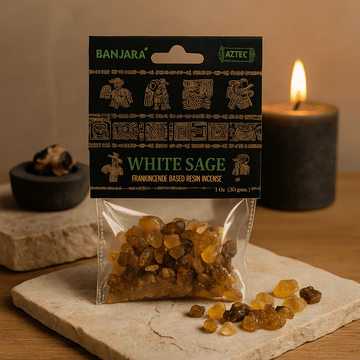
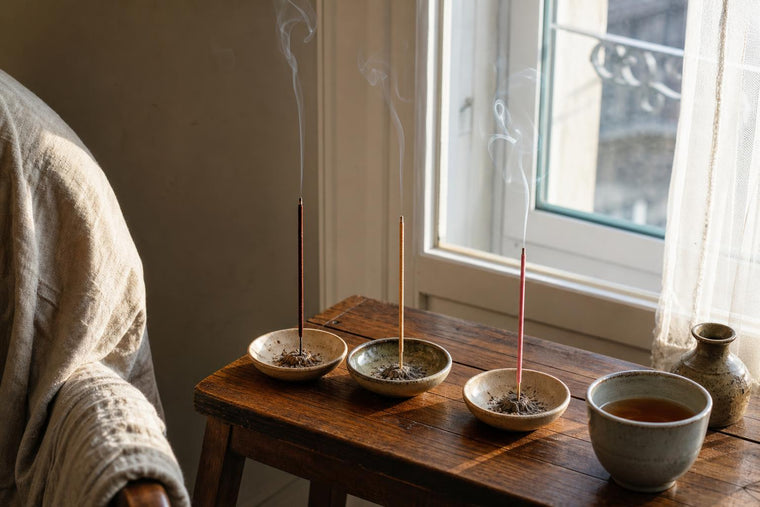
A branch of palo santo does not become fragrant the day it falls. It lies on the forest floor in the dry coastal stretches of Peru, half buried in leaf litter, and it waits. Years pass before anyone comes near it with a saw. This is not neglect. It is the entire method: the tree dies on its own, and the wood rests before it is worth cutting into sticks.
Two trees share one name
Most of what reaches a shelf as palo santo comes from a single species, Bursera graveolens, a small tree native to Mexico, Central America, the Galápagos, and the drier stretches of northwestern South America down through Peru. It belongs to Burseraceae, a family sometimes called the incense trees, which should tell you something about how long humans have been drawn to what this wood does when it burns.
But "palo santo" is a common name, not a scientific one, and common names travel loosely. A second, unrelated tree, Bulnesia sarmientoi, carries the same Spanish label in parts of South America. It grows mainly in the Gran Chaco, the dry forest spanning Argentina, Bolivia and Paraguay, a long way from the coastal forests where Bursera graveolens is found. The two trees are not close relatives, and their conservation situations are not remotely similar, which is exactly where a great deal of online confusion about palo santo begins. One name, two species, two very different stories.
The resting years

For Bursera graveolens, the wait on the forest floor is not incidental. Reports from growers and suppliers in the region put the resting period at a minimum of three to four years after the tree dies naturally, left where it fell. During that time the wood's essential oils concentrate and its resinous compounds mature, slowly, with no one hurrying them along.
Cut the wood too soon and you can see the difference before you even strike a match: the timber looks paler and burns through quickly, carrying a thinner version of the scent the wood is known for. The years of lying still are doing real chemical work. A stick that reaches you already represents a small, patient transformation that happened long before anyone thought to sell it.
There is something worth sitting with in that, for anyone who keeps a daily practice of incense or quiet ritual at home. A stick of incense usually asks for nothing more than a moment's attention rather than being left to burn as background. Palo santo asks something similar, but earlier, long before it was ever a stick: that nobody rush a dead tree into becoming useful.
Who enforces the waiting
In Peru, this is not left to goodwill alone. The harvesting of palo santo is regulated by the national government specifically so that trees are not cut down for their wood. The body responsible is SERFOR, Peru's National Forest and Wildlife Service, which maintains rules against felling a living Bursera graveolens tree. Only wood that has already died and fallen is meant to be collected and taken to market.

Ecuador has taken a further, more active step: reforestation programmes there use a transplant method, lifting overcrowded saplings from dense patches of forest and resettling them in areas with no trees at all, spreading the species rather than simply protecting what already stands. Between Peru's restriction on live felling and Ecuador's replanting work, the supply chain for genuine Bursera graveolens palo santo is built, at least in principle, around letting the tree die on its own schedule.
What the conservation status actually says
This is the point where many articles blur the two trees together and alarm the reader unnecessarily, or else wave the question away entirely. Neither is accurate. Bursera graveolens is assessed by the IUCN Red List as Least Concern, and it is not listed under CITES, the international agreement that restricts trade in threatened species. The tree used in the vast majority of palo santo sticks sold for incense is not, by the current record, in danger.
Bulnesia sarmientoi is a different matter. That tree, also called "palo santo" in parts of South America, is listed on CITES Appendix II, a status tied to its much smaller range in the Gran Chaco and the pressures on that particular forest. The two trees' fortunes have nothing to do with one another, which is precisely why it matters to know which one you are holding. Buying a stick of genuine Bursera graveolens, naturally fallen and legally harvested under Peru's rules, is not the same question as the pressures facing a tree from an entirely different forest three countries away.

Reading the years in the wood
None of this requires a reader to become a botanist before lighting incense, and none of it has to turn a five-second ritual into ceremony. But it can change what the moment is made of, because the wait leaves marks a person can actually perceive, not just ones they are told to believe in. The colour of the wood gives an early clue: timber that rested the full three to four years tends to look deeper and more amber than wood cut in haste, which stays pale. The scent is the other clue. Well-rested palo santo is described, even before it is lit, as sweet, resinous and surprisingly citric, something like frankincense crossed with lime peel. A stick with almost no scent at rest, or a sharp, green note once lit, usually came from wood cut too young. A seller willing to say plainly that the wood was gathered from fallen timber, rather than staying vague about sourcing altogether, is often a good sign.
Lighting a stick is not lighting a manufactured object. It is lighting the end point of a tree that died on its own ground, lay there through several seasons while nobody touched it, and was then judged ready, by colour and scent a person could check with their own hands. For a home altar or a quiet shelf kept for incense and small daily rituals, palo santo incense sticks sit well alongside a plain smudge bowl for catching ash, and for anyone who prefers the scent without smoke at all, palo santo essential oil carries the same resinous note in a different form.
What that changes about the moment
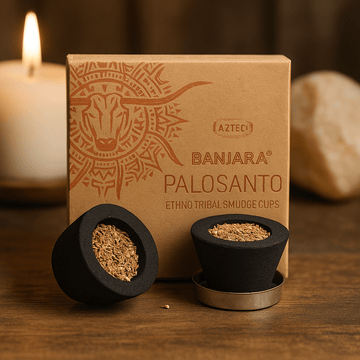
This is, in the end, what a conscious relationship with any object asks of a person: not more rules, not more worry, just a willingness to know what you are actually using. Whether that stick arrives as a single length lit by hand, or as part of palo santo and sage smudge cups already prepared, or alongside other smudge sticks and resins on the same shelf, the wood's own history does not change. A dead tree, a long patience, and then, briefly, smoke.


 India

 Peru


 Mexico