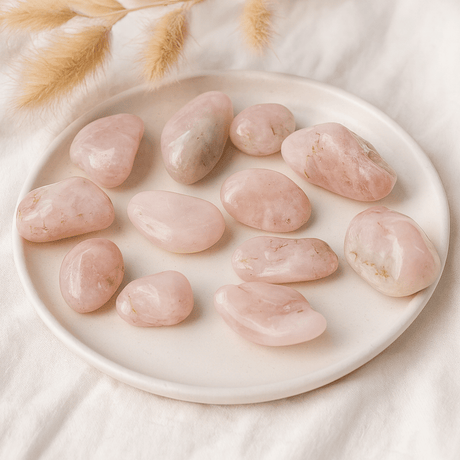
For most of the twentieth century, nobody actually knew what turned quartz pink. It seemed a small enough puzzle: iron gives emerald its green, chromium its red in ruby, so surely rose quartz had its own trace element quietly staining the crystal from within. That answer sat unchallenged in mineral guides for decades. Then, in the late 1990s, three mineralogists working out of Caltech decided to stop guessing and start dissolving. George Rossman, Julia Goreva and Chi Ma took samples of rose quartz from several localities and dissolved them in hot hydrofluoric acid, strong enough to eat through the silicon dioxide itself. Their idea was simple: dissolve away the quartz, and whatever is left behind is the actual cause of the colour. Their findings, published in the journal American Mineralogist in the early 2000s, did not just confirm a guess. They replaced one.
The Century-Old Guess
The old explanation was not foolish. Titanium, iron and manganese genuinely occur in trace amounts in many quartz specimens, and the idea that one of them tinted the crystal lattice directly, the way a dye tints water, fitted a pattern seen elsewhere in gemmology. It is still the line repeated on most shelf labels today. What it never quite explained was the second, equally consistent fact about rose quartz: that it is almost never properly transparent. If a stray metal ion were simply colouring clear crystal, there is no obvious reason the stone should also come out cloudy, again and again, wherever it was mined.
What Survived the Acid

When the quartz itself was gone, something remained in every sample: a tangle of extremely thin pink fibres, far too fine to see with the naked eye. Rossman, Goreva and Ma examined them under a scanning electron microscope, tested them by infrared, Raman and optical absorption spectroscopy, and confirmed the identification by X-ray diffraction. The fibres matched a mineral related to dumortierite, a borosilicate. This is the detail most explanations skip past: the pink colour of common rose quartz worldwide comes from these fibres, not from a scattering of individual atoms spread evenly through otherwise clear crystal. Because the same fibres also scatter the light passing through the stone, they are the reason it rarely clears; the haze is not a separate flaw sitting alongside the colour, it is the same structure doing both jobs at once. Titanium and iron do play a part, through an iron-titanium interaction that produces an absorption band near 500 nanometres, but that happens inside the chemistry of the fibres themselves, not as a simple tint dissolved through the quartz. Later analyses of samples from other localities have found the fibres are not perfectly identical from one deposit to the next, a reminder that even a well-solved mineralogical question rarely settles into one tidy rule wherever the stone is found.
Cut correctly, that same structure can turn into something worth seeking out rather than working around. Shaped as a rounded cabochon instead of faceted flat, cloudy rose quartz can throw a six-rayed star across its surface as it catches the light, an effect called asterism, caused by the fine, oriented fibres reflecting light along consistent internal directions rather than scattering it evenly.
A Rarer Cousin, and Where the Common Stone Comes From
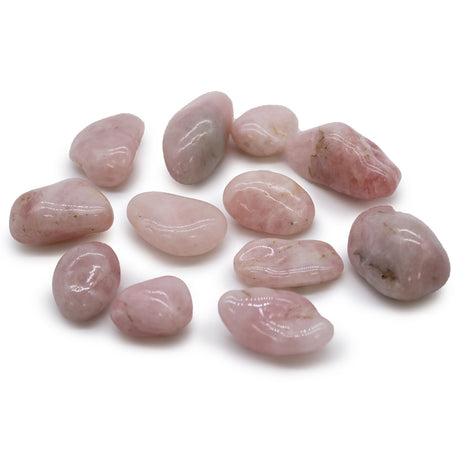
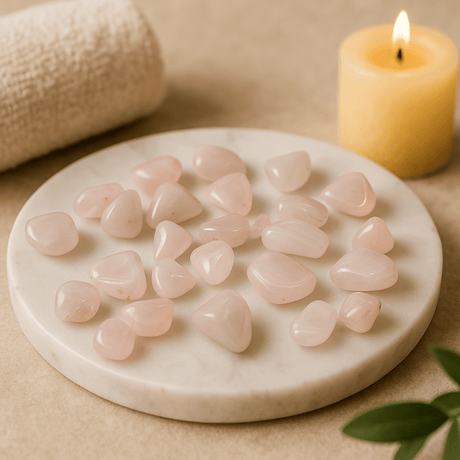
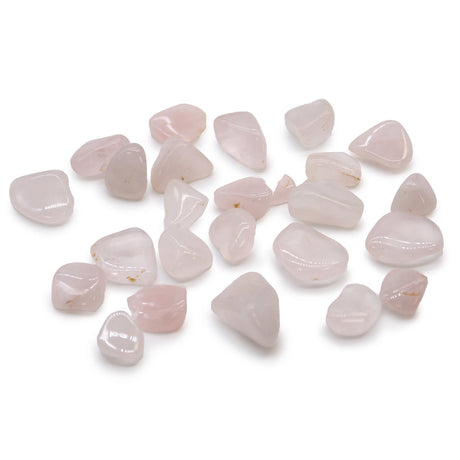
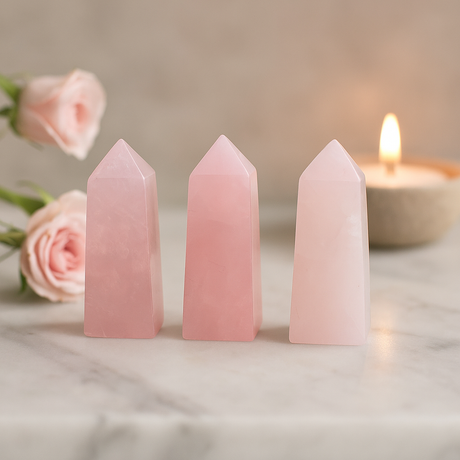
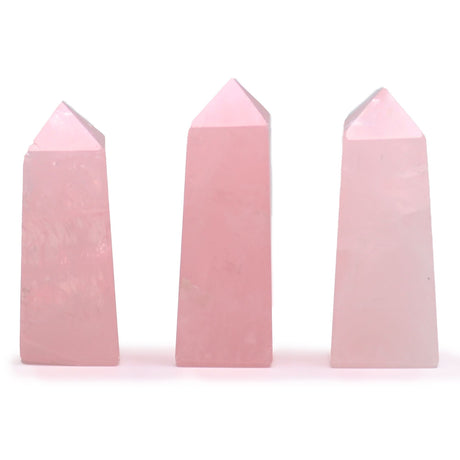
Occasionally a different kind of pink quartz turns up: small, well-formed, genuinely transparent crystals, rather than the massive, intergrown lumps most rose quartz forms as. These occur in late-stage pegmatite pockets, and their colour has nothing to do with fibres at all; it comes from irradiation-induced colour centres involving aluminium or phosphorus within the crystal structure, a different mechanism entirely, and one that is notably unstable, since exposure to heat or strong light makes that pink fade. The fibre-based colour of the rose quartz people actually own, whether carried as a tumbled rose quartz stone or cut into an object for a shelf, is comparatively stable by contrast, because it is built into a mineral inclusion rather than a temporary defect in the lattice.
That common material has been described as coming from Brazil, Madagascar and half a dozen other places, which is true but not especially useful. Most of it is mined as massive deposits rather than isolated crystals, and one of the better-documented sources sits in the southern Black Hills of South Dakota, near Custer, where rose quartz has been worked since the late nineteenth century and remains a recognised state mineral of South Dakota today. Unlike amethyst, which typically grows as pointed individual crystals lining a cavity, rose quartz here forms as massive, intergrown material without distinct crystal faces of its own, exactly the habit that suits the dumortierite fibres running through it in every direction at once.
Living With a Hazy Stone
Once you know why the cloudiness is there, buying a rose quartz that is a little uneven in tone, or slightly milky in one corner, stops reading as a compromise. Real rose quartz varies piece to piece and rarely comes without some internal texture, since the fibres are never evenly distributed and no two stones haze in quite the same way. A stone that looks perfectly clear and perfectly, evenly pink throughout is, more often than not, dyed glass rather than quartz; glass imitations tend to give themselves away under closer inspection through round trapped air bubbles that real quartz, at a Mohs hardness of 7, simply does not contain. Set a polished piece beside smoky quartz, whose brown colour comes from a completely different event, natural irradiation acting on trace aluminium in the lattice, and the pattern becomes obvious: with quartz, colour is almost always a story about something lodged inside the stone, not something applied to its surface. A raw, uncut piece kept as a raw mineral specimen shows this more plainly than any polished object can, since nothing has been smoothed away to hide where the haze sits.
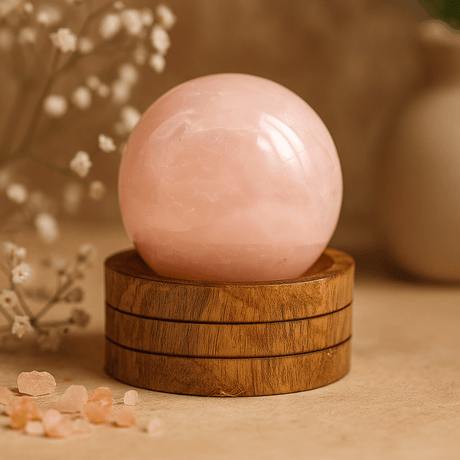
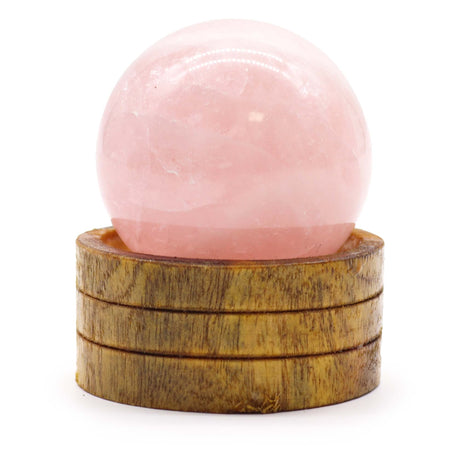
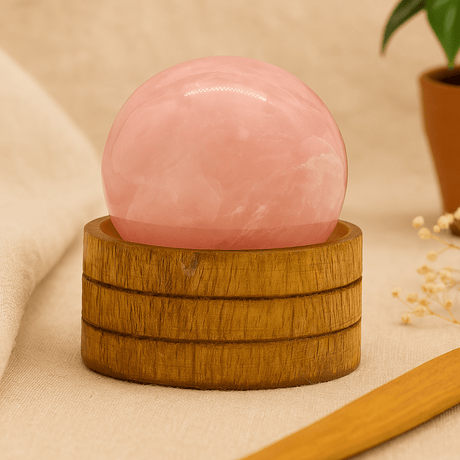
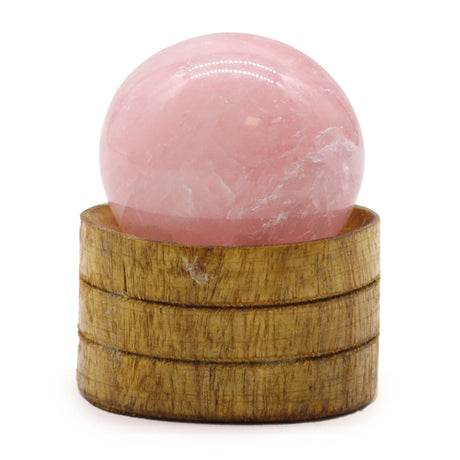
Rose quartz has long been kept close for the gentleness people read into it, associated with the heart and with an ease of feeling rather than sharp clarity of thought, and that reading sits comfortably with what the mineralogy shows. A specimen shaped into a polished sphere makes the mechanism visible: turn it slowly and the haze thickens and thins as the light moves around its curve, the same dumortierite fibres doing, in miniature, what they do in most rose quartz mined, colouring the stone and clouding it in one and the same motion.