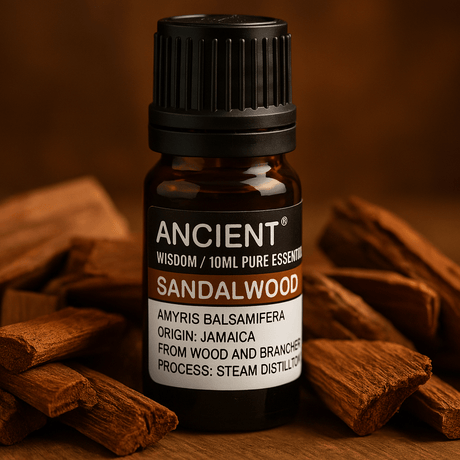
Most advice on scent treats a body and a room as the same surface, just built at different sizes. It isn't true, and the mistake costs people fragrance they've paid good money for. A perfume held against warm skin and a dhoop stick filling a sitting room are answering to two different kinds of physics, and the moment you know which one you're doing, half the guesswork disappears.
Two crafts, one instinct
On skin, scent depends on warmth and on the skin's own chemistry. Body heat lifts the oils, pH shifts how they read, and a perfume that smells sharp on one wrist can sit rounder on another. In a room, none of that applies. A candle, an incense stick or a diffuser is releasing scent into air that moves by convection, filling a volume rather than warming against a surface. The advice that works for one doesn't automatically transfer to the other, and most of what circulates about "layering" quietly assumes it does. Once you separate the two, the practical questions become much simpler: what am I actually doing, a wearable perfume or a scented room, and which set of rules applies here.
Where the idea of "notes" comes from
The vocabulary itself has a specific author. The English chemist George William Septimus Piesse, who lived from 1820 to 1882 and co-founded the London perfume house Piesse & Lubin in the 1850s, published a book in 1857 called The Art of Perfumery. It's the book often credited with giving perfumery the language of "notes" that is still used today, top, heart and base, and Piesse went further than a metaphor. He proposed an "odophone", an octave of odours arranged against musical pitch, as if a scent could be read the way a chord is read. The idea didn't survive as a literal scale, but the practical reading underneath it did: lighter molecules reach the nose first and fade fastest, heavier ones arrive later and linger. That's why a citrus top note is gone within the hour while a base of wood or resin can still be there the next morning, on skin or in a room.
Building a fragrance on skin

Perfume worn on the body is usually placed at pulse points, the wrists, the neck, behind the ears, where warmth is closest to the surface and the scent has the best chance of lifting. Testing on a strip of paper tells you the shape of a fragrance; testing on skin tells you how it actually behaves once your own chemistry gets involved, which is why the two rarely smell identical. Where practitioners genuinely disagree is the order: some apply the heavier, more assertive scent first and let a lighter one sit on top, others do the reverse, building from light to heavy so the final note is the one that lingers longest. Both are defended by people who know what they're doing, which is a useful thing to know before you assume there's a single correct sequence you're getting wrong.
Layering a room, not a wrist

A room asks for a different kind of thinking, because you're not warming an oil against skin, you're filling air. A steady base held in a diffuser or in the slow burn of incense gives the space its floor, and a lighter layer moved through with a spray or a second, brighter stick can shift the mood without erasing what's already there. This is where a stick of dhoop earns its place, not as a replacement for a candle but as a different register of the same idea: resin-based incense that fills a room more insistently than a lighter agarbatti would, useful when you want the base note to actually hold. A candle burning does something gentler, closer to ambient warmth than a scent statement, which is exactly why the two are worth understanding separately rather than as interchangeable ways to "make a room smell nice."
Choosing what to pair
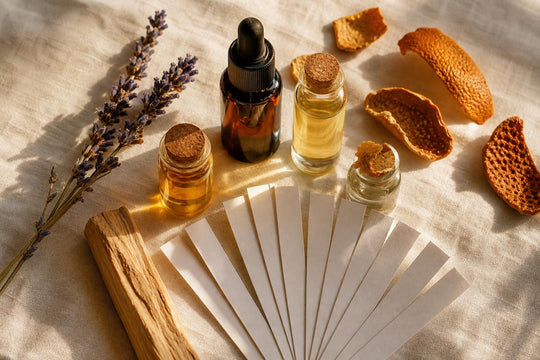
Perfumers and retailers often work from the Fragrance Wheel, a circular classification put together by the Australian-born fragrance writer and consultant Michael Edwards, first published in a guide he brought out in 1992. It arranges scent families, floral, oriental, woody, fresh, in relation to one another around a ring, and the practical use of it is simple: families that sit next to each other on the wheel tend to sit easily together, citrus near green, amber near woody, while families from opposite sides of the circle can clash or need a steadier hand to reconcile. It's not a rulebook so much as one widely used map of what tends to work, built by someone who spent his career watching what customers actually reached for. Other classification schemes exist, and perfumers don't always draw the family lines in the same place, so it's worth treating the wheel as a useful lens rather than the final word. Knowing it exists is more useful than any single pairing tip, because it lets you reason about a new scent instead of memorising a list.
A daily rhythm, not a single spray
I think the biggest misunderstanding in most scent advice is that it's written for a single, decisive moment, the signature scent you get right once and then defend. That's not how I actually live with fragrance. My own day tends to hold two separate layers rather than one: something worn close to the skin in the morning, and incense burned in the evening as part of puja, a rhythm I've kept for years and one that's genuinely common in households across India, where dhoop or incense sits alongside a lit lamp as one part of daily practice, alongside attar, the oil-based perfume long associated with South Asia and the Middle East and traditionally applied straight to skin rather than sprayed. Neither layer is trying to out-do the other. The morning attar has usually faded by evening, and the incense isn't correcting it, it's simply the next part of the day arriving with its own scent. Once you stop expecting a single fragrance to carry you from morning to night, layering stops being a technique to master and becomes something closer to punctuation, marking where one part of the day ends and another begins. That, more than any rule about pulse points or fragrance families, is the actual shift worth making: treat scent as something you return to across a day, not something you solve once and wear like an answer.