A room has a volume of scent the way it has a volume of sound. Walk into a house where someone has just burned frankincense and the air announces itself before you've taken off your shoes. Walk into a quieter room, one lit with a single stick of sandalwood an hour ago, and you might not notice anything at all until you stop moving. Neither is wrong. They are simply pitched differently, and learning to hear that difference is most of what this piece is about.
The Room That Taught a Country to Listen
In Japan, this distinction has a name and a long practice behind it. Monkō (聞香) is the habit of "listening" to incense rather than smelling it: practitioners use the verb kiku, "to listen," for the act of taking in a fragrance, as though the nose were an ear. It sits at the centre of kōdō (香道), literally "the way of incense," a slow, formal art built entirely around scent, one of Japan's three classical arts of refinement alongside chadō, the tea ceremony, and kadō, flower arranging. The appreciation of incense at court is generally traced to the Heian period, when aristocrats blended and compared fragrances as a courtly pastime, and it was shaped into this more formal art during the Muromachi period that followed. Incense itself had arrived in Japan earlier, carried in with Buddhist ritual from the Asian mainland, and its slow turn from ritual object to refined pastime is its own kind of history.
What I take from monkō, keeping my own daily incense practice at home, is not a technique but a question: how loud does this room want to be? Some spaces are built for company and movement. Others are built for stillness. A scent that suits one will feel wrong in the other, not because of any mood it claims to deliver, but because of how much of itself it puts into the air.
Loud Rooms, Quiet Rooms
The living room, the kitchen, the entryway: these are rooms where people arrive, talk, cook, come and go. They can carry a scent with real presence, something that fills the air the way conversation does. A dense resin like frankincense produces a thicker curl of smoke and a stronger presence than a fine stick, simply because it is a denser material burning more of itself at once. For a room like this, a resin or a thicker stick makes sense: it has something to compete with, and it can hold its own.
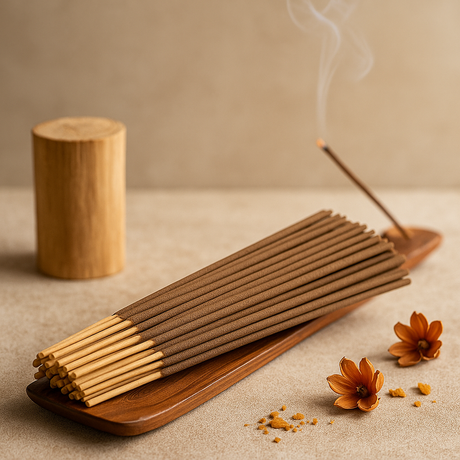
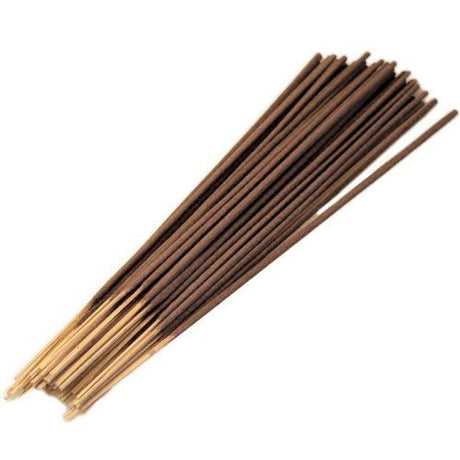
The bedroom, the bathroom, a reading corner: rooms built for stillness rather than company want the opposite. Traditional kōdō practice never lights its fragrant wood chips, agarwood, a resin-rich wood prized for its scent, or sandalwood, directly. Instead it warms them gently over hot ash, keeping the fragrance close to silent rather than filling the room with smoke. You don't need hot ash and a censer to borrow the principle. A finer stick, or a small unlit dish of something aromatic left to work on its own, sits closer to a hush than an announcement. Some incense sticks are also made without a bamboo core running through the centre, a difference in construction that tends to burn more evenly and produce less visible smoke than a corded stick, which is worth knowing if quiet is what a room is asking for.
This is a physical fact, not a claim about what the scent will do to your mood. You can watch it happen: light two sticks of different thickness side by side and one will visibly put more smoke into the room within a minute. That is presence you can see, not a promise you have to take on faith.
Test the Volume, Not the Mood
The simplest way to learn this is not to read about it but to do it. Light two different materials at the same time in the same room, a thicker stick or a piece of palo santo on one side, a fine stick on the other, and just sit with both for a few minutes. Notice which one you can still smell from across the room and which one only reaches you when you lean towards it. Notice which one asks to be heard, and which one waits until you've gone quiet enough to hear it.
That noticing is the whole practice. Once you can feel a scent's volume the way you feel a voice's, choosing what to burn where stops being a checklist and becomes something closer to kiku, the old word for listening to incense, rather than smelling it, to the room, and to what it's already telling you it needs.