Most objects on a shelf have a quiet history. A selenite stick has one with an actual date attached to it: April 2000, a mine tunnel some 300 metres below the Chihuahuan desert, near a town called Naica in northern Mexico. Two miners drilling a new passage broke through rock into a chamber they had no way to have predicted: gypsum beams as long as twelve metres, some thick as tree trunks, growing out of the walls and ceiling like frozen light. The air was so hot and so saturated with moisture that a person could survive inside for only a short time without protection. Nobody had built this. The mineral had simply been left alone, in water, in the dark, for a very long time.
The smooth pale stick sitting on a shop shelf did not come from that chamber. But it is, mineralogically, the same substance the miners found: the same chemistry, grown at a different scale, in a different setting, over a much shorter stretch of time. Knowing what that chemistry actually is changes how the stick looks in the hand.
What the Stick Is Actually Made Of
Selenite is not its own separate mineral. It is a variety of gypsum, calcium sulfate with water bound into its crystal structure (CaSO₄·2H₂O). That water in the lattice is part of why gypsum behaves the way it does: soft, cool, faintly slippery to the touch. On the Mohs hardness scale, used by mineralogists to rank how easily a material scratches, gypsum sits at 2, low enough that a fingernail alone can mark it. Left in a bowl of water, a stick will soften, cloud and pit within days; there is no ritual reason to keep it dry, only a chemical one.
Most of the wands, towers and smooth sticks sold under the name are cut from one particular habit of gypsum, satin spar: a fibrous form that grows in long parallel strands, giving it a silky, almost woven lustre when polished. It is this fibrous structure that lets satin spar be cut into the tall, tapered shapes shops favour, including the selenite tower many people keep on a windowsill or a small altar. Satin spar is only one habit among several; the flat, glass-clear plates once prized for an entirely different purpose were a different form again.
Naming, Moon and Colour
The word selenite comes from the Greek selene, the Moon, given for the stone's pearly, almost luminous sheen when light catches it at an angle, not for any documented ritual tied to the Moon itself. It describes an appearance, coined by people who thought the stone looked like moonlight caught in rock. Whatever a person now finds in that association, whether they carry the stick for a sense of clarity or simply enjoy the shine, belongs to them, not to a claim buried in the etymology.
Natural selenite is, in truth, colourless to milky white. Almost none of the strongly coloured satin spar sold commercially, the peach and orange sticks in particular, occurs that way in the ground; that saturation is typically the result of dyeing. It is a fact rarely mentioned on the shelf, and knowing it does not make the object less worth keeping, only more honestly described. A separate and genuinely natural gypsum form, the desert rose, is often confused with coloured selenite but is a different habit entirely: rosette-shaped clusters formed in arid, evaporating ground, where grains of sand become trapped inside the crystal as it grows, giving it a warm, sandy tone that comes from the desert itself rather than a dye bath.
A Roman Window, Not a Crystal Shop

Long before anyone was selling gypsum for its calm, the Romans were mining it for light. A clear, sheet-like variety known as lapis specularis was quarried in vast underground galleries near the town of Segóbriga, in what is now the Cuenca province of Spain, in workings that archaeological surveys have mapped across several kilometres of tunnels, with some estimates running considerably further. Pliny the Elder recorded that the finest lapis specularis in the Empire came from within roughly a hundred thousand paces of Segóbriga, and described how sheets of it were cut, transported to the port at Carthago Nova and shipped on to Ostia to glaze villas across Roman territory. Tiberius is associated with early forcing-frames, specularia, said to have let cucumbers grow out of their natural season behind sheets of the mineral. The mineral's first documented job, in other words, was architectural, not spiritual: light for a room, warmth for a garden, centuries before anyone thought to hold it while setting an intention.
Keeping One

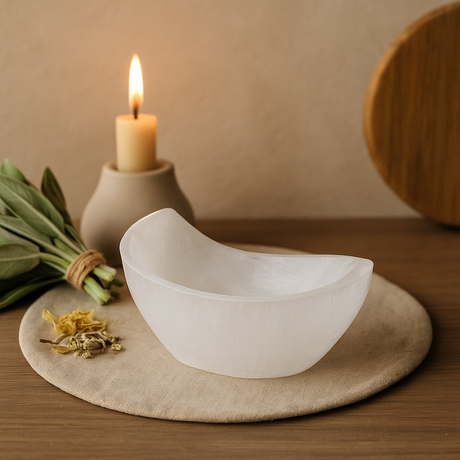
Because gypsum is so soft, the only real rule with a selenite stick is to keep it away from water and away from anywhere it might be knocked or scraped against something harder. A dry, soft cloth, drawn along the stick every so often, does something practical rather than symbolic: it lifts the fine dust that settles on any pale surface and dulls the pearly sheen the stone was named for. Some people keep one flat on a small charging plate for other stones to rest against, since the surface itself asks nothing of the objects placed on it; a selenite charging plate serves that purpose well precisely because it is broad, stable and easy to wipe clean.
Why the Naica Crystals Grew So Large
The scale of the Naica beams puzzled geologists from the moment the chamber was found, and the explanation came from a living scientist rather than an ancient one. Juan Manuel García-Ruiz, a crystallographer at the University of Granada, led research published in the journal Geology in 2007 showing that the giant crystals had grown over hundreds of thousands of years in water that stayed close to a threshold near 58 degrees Celsius, the temperature around which the mineral anhydrite converts into gypsum. Stay near that threshold for long enough, undisturbed, and the crystal has room to grow rather than dissolve and reform. García-Ruiz has called the chamber "the Sistine Chapel of crystals" and has spoken of his first walk into it as one of the most exhilarating moments of his working life; he is still working, still publishing, on a mineral most people only meet as a small pale object on a shelf.
The chamber itself has not finished its work in one further sense: once the mine's owners stopped pumping the tunnels dry, water was allowed back in, and the crystals are now submerged again, out of view, closer to the conditions that grew them in the first place. Exactly how those conditions held so steady for so long, without a single disturbance interrupting the growth, is still argued over among geologists studying the site. The stick on a shelf is not a fragment of that chamber and never claims to be. It comes from the same reaction, cut short at a human scale: gypsum quarried and shaped long before it had any chance to grow into something twelve metres long in the dark.