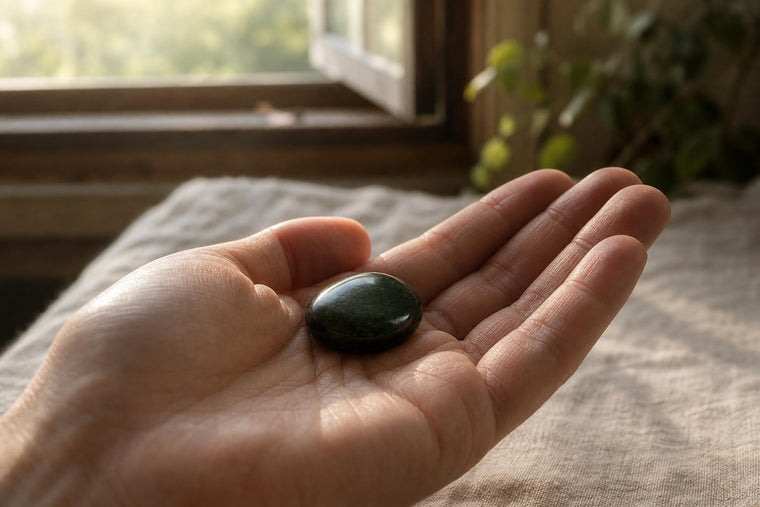
The evening bath is one of the oldest domestic crossings there is: older than the wellness industry, older than the concept of self-care, older than the word 'ritual' borrowed from Latin and pressed into lifestyle service. What follows is a practice you can run tonight, in under an hour, with very little.
The Sandhyā Hour
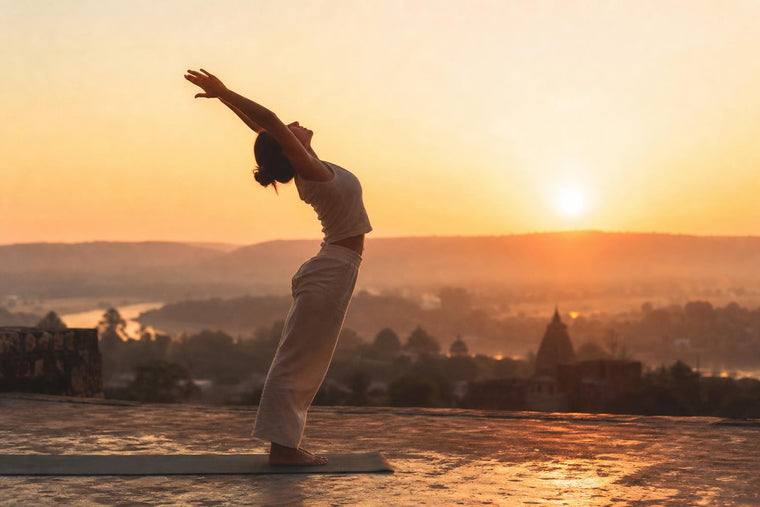
In Vedic tradition, sandhyā (Sanskrit: संध्या) names the three daily junctions — dawn, noon and dusk — when the world pauses between one state and another. The word means simply 'junction', and the evening sandhyā, the sāyam sandhyā, is the most widely observed of the three in domestic life across the Indian subcontinent. At dusk, traditionally, you wash, you light a lamp, you turn inward. Not because the day was bad, but because the day was the day, and now it is done.
The modern bath-as-self-care has no such anchor. It arrived with 1990s spa culture and the rise of aromatherapy as a consumer category: a pleasant invention, but a shallow one. The practice below borrows from something considerably older. The evening bath is not hygiene extended into leisure, but a deliberate crossing from the active world into the interior one. You are not washing the week off. You are stepping through a door.
Before You Step In

Set the bathroom before the water runs. This sequence matters: the preparation is part of the practice, not a preamble to it.
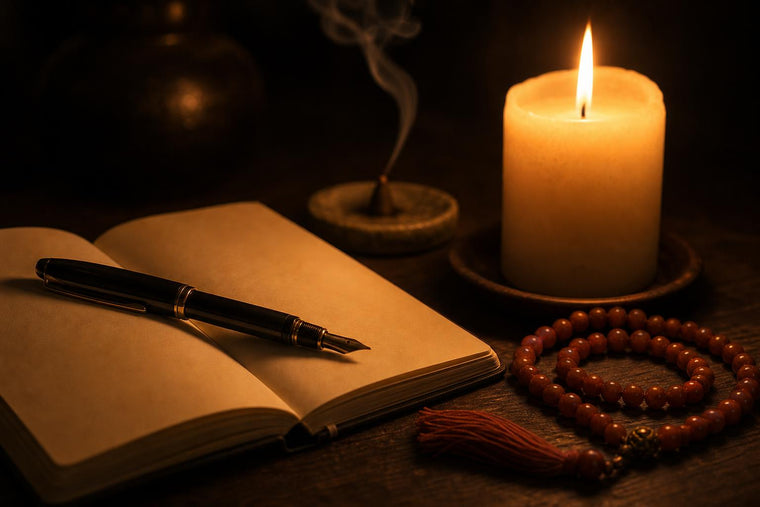
- Light the candle first. In the Indian domestic tradition, the evening lamp (the dīpa) is lit at dusk as an act of intention, not decoration. The deepa puja, the lighting of a household flame at the day's turning, appears across the Vedic, Puranic and Āgamic corpus; it is among the most continuous unbroken daily practices in the world. When you light your candle now, you are doing something recognisably similar: marking the threshold. Place it where you will see it from the water.
- Light one stick of incense. Dhūpa is one of the five traditional offerings in Hindu puja, alongside a lamp, water, food and flowers. In the home, evening incense marks the household's turn from the outer world to the inner. One stick is enough. Frankincense incense works well here; the resin has been used in contemplative contexts across traditions for a long time, and the scent is grounding without being sweet.
- Run the water warm, not hot. Sleep research consistently finds that a warm bath taken an hour or two before sleep (at around 40°C) supports the body's natural temperature drop that precedes sleep onset. You do not need to measure it; warm enough to relax into, cool enough to stay in for twenty minutes.
- Add Himalayan bath salts if you have them. A handful, dissolved. Then step away and let the room settle for a moment before you get in.
In the Water

Lie still for the first few minutes. This is harder than it sounds. The week has a momentum of its own, and it does not stop because you have closed a door.
Breathe slowly. Not a technique, just slower than you have been breathing all day. Let the weight of the water register. Notice where your body is holding tension and, without forcing anything, let the warmth do what warmth does.
When the mind quietens a little (and it will, given time) you have a choice. You can simply stay with the breath and the water. Or you can reach for a mala.
Japa is the meditative repetition of a mantra or divine name, counted on a mala of 108 beads. It requires no special posture and no performance. Rest the rose quartz mala on the edge of the bath. Draw it bead by bead through your fingers, repeating whatever name or phrase you carry in your practice. The mala keeps count so the mind need not; that is precisely its function. If you have no mantra, a simple Sanskrit syllable or even a word that carries meaning for you will do. My own japa practice began with a mala and a single name, repeated until the repetition became its own kind of quiet. It is not complicated. It is just consistent.
Stay in the water for as long as feels right: fifteen minutes, twenty, perhaps more. The candle is still burning. The incense is still moving. You are not rushing toward anything.
After the Bath: The Settling
This is the step most evening-bath guides skip entirely, and it is the one that makes the difference.
The sandhyā practice does not close when you towel off. The crossing is not complete until you have sat, briefly, in stillness. Wrap yourself, move to wherever you sit in the evenings, and pour a cup of tea. Not a task, not a screen. Just the tea and the quiet.
Herbal teas suited to the evening hour vary by tradition and by taste; in many Indian households, a light tulsi or ashwagandha blend marks the close of the day. Choose whatever you find genuinely calming. Hold the cup. Let the transition finish on its own terms.
The week is not gone. It happened, and it will still have happened tomorrow. But you have acknowledged it, set it down in the water, and stepped through to the other side of the day. That is what the sandhyā hour has always been for: not erasure, but a clean crossing.
A Note on Doing This Regularly
Some traditions survive not because they are spectacular, but because someone quietly repeats them every morning, or every evening. The value of this practice is not in any single bath. It is in the accumulation of crossings: the body learning, over weeks, that when the candle is lit and the water is warm, the day is genuinely over.
You do not need all the elements every time. On a weekday when you have twenty minutes, light the candle, run the water, sit for five minutes afterward. On a Sunday when you have an hour, add the incense, the mala, the tea. The practice scales to the evening you actually have, not the one you planned.
What it asks of you is only this: that you treat the crossing as real. The water is warm. The flame is lit. The interior world is waiting.