Picture one still image before we begin. A blue figure reclines, asleep, on the coils of an enormous serpent that floats upon an ocean of milk. His face is calm. A goddess sits at his feet. From his navel, a single lotus rises, and inside that lotus a whole new universe is being dreamed back into being. This is Vishnu between the cycles of creation, and it is the quietest picture of total responsibility you are ever likely to see. The whole of his meaning is here, in a god who carries the world and yet rests.
The reclining god
The serpent is called Shesha, also known as Ananta, the endless one, often described as having a thousand heads. The ocean is the Kshira Sagara, the cosmic sea of milk. This aspect of Vishnu, asleep upon the serpent between the great cycles of the cosmos, has its own name: Anantashayana, Vishnu reclining on the infinite. His consort Lakshmi sits with him. And from his navel the lotus unfurls, bearing Brahma, the maker, so that creation can begin again. For this reason Vishnu carries the epithet Padmanabha, the lotus-navelled one.
Hold the image a moment longer, because it is the thesis of everything that follows. The universe rests on him, and he rests too. There is no strain in the face, no clenched effort. The work of holding the world together is carried without anxiety. In a tradition with a thousand fierce and dancing forms, the central image of the preserver is one of repose. That is not an accident. It is the point.
The forgotten member of the trinity
Hinduism is a living tradition, and what follows is offered as cultural and historical context rather than as a claim about how the world is. Within it, three great deities are spoken of together as the Trimurti. Brahma is associated with creation, the bringing-forth of things. Shiva is associated with dissolution, the clearing away. And between them stands Vishnu, whose role is preservation, the maintenance of the cosmos. The Sanskrit word is sthiti: the steady holding of a thing in being.
Of the three, preservation is the one we are least equipped to celebrate. We tell stories about beginnings and endings. We mark the launch and the funeral, the first day and the last. But the long middle, the quiet years of keeping a good thing going, has almost no language of its own. Maintenance is the least romantic act there is. Nobody throws a party for the morning you simply showed up again, watered the plant again, kept the promise again. And yet that unglamorous continuity is what actually holds a life, a relationship, or a world intact. In a culture forever turning toward the new and the final, Vishnu is the one who attends to the part nobody photographs.
Reading the iconography slowly
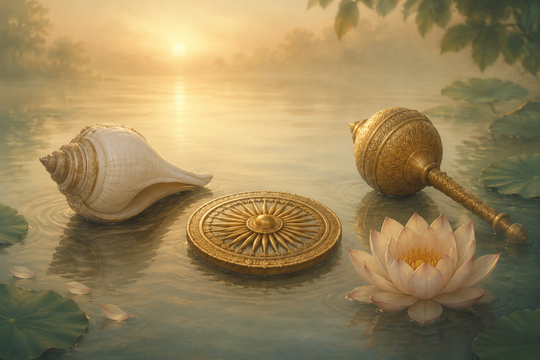
Vishnu is most often shown with skin of deep blue, the colour of the sky and the ocean, the colour of something so vast it reads as dark. He has four arms. Across many images his hands hold four attributes, though it is worth saying plainly that the placement of each object in each hand varies from tradition to tradition and image to image, so it is the meanings, not a fixed arrangement, that matter.
- The conch (shankha), named Panchajanya. When blown it sounds the first note of creation, the vibration from which form arises.
- The discus (chakra), the Sudarshana Chakra. A spinning wheel, often read as the turning of time and the clear-cutting power of an ordered mind.
- The mace (gada), named Kaumodaki. Weight, strength, the firmness that backs up gentleness.
- The lotus (padma). The flower that grows out of muddy water yet opens clean, an emblem of unfolding awareness, and the same lotus that rises from his navel.
On his chest he bears the Shrivatsa mark and the Kaustubha jewel, and he is often shown in yellow garments, the pitambara, with a garland of forest flowers, the Vanamala. Read each of these not as a costume but as a quality. The expression that ties them together is the steady, level calm of a figure who has nothing to prove and nowhere he needs to rush.
Lakshmi and Garuda, the company he keeps
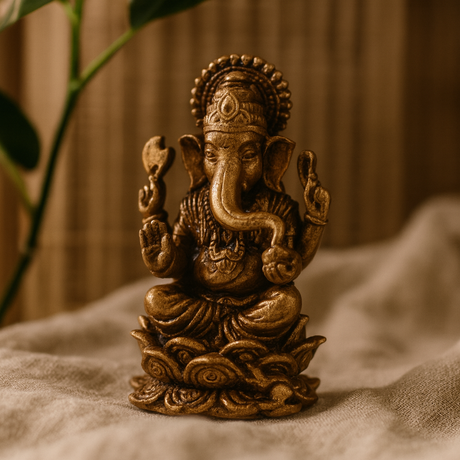
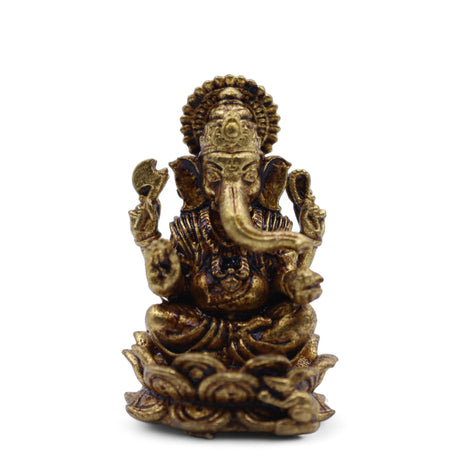
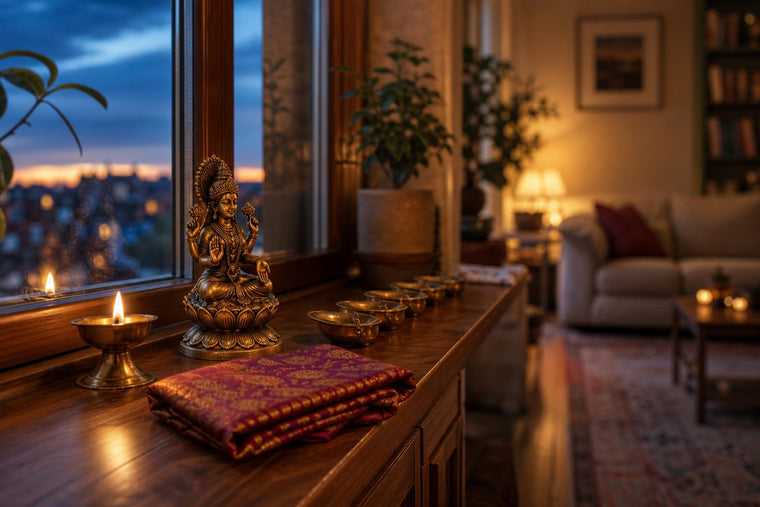
Vishnu is never quite alone, and that is part of his meaning. His consort is Lakshmi, also called Shri, the goddess associated with prosperity, abundance, fortune and beauty. In the tradition, abundance is not separate from steady stewardship; the grace of Lakshmi accompanies the one who holds things faithfully. Across Vaishnava devotion the two are honoured together, which is why a home shrine to one so often makes a place for the other. This is the natural home of a Vishnu statue at home, set beside her, where Vishnu and Lakshmi are honoured together at the home shrine.
His mount, his vahana, is Garuda, the great eagle, a swift and powerful bird-like being who carries him. Where Lakshmi speaks of the grace that attends steady care, Garuda speaks of will: the readiness to move quickly when preservation asks it. Together they say something simple. Care is relational, not solitary. The work of holding a good thing steady is rarely done by one pair of hands alone.
The ten avatars as one long story of care
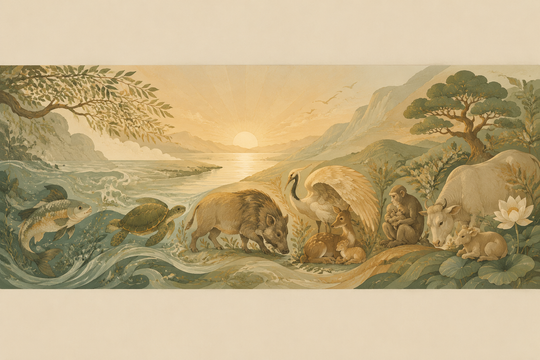
Most encyclopaedia entries reduce Vishnu's avatars to a list to be memorised. The Dashavatara, the ten principal descents, deserves better, because read in sequence it is not ten pieces of trivia but a single recurring movement. Each time the balance of the world tips toward chaos, the impulse to restore appears again, taking whatever form the moment needs.
The widely used standard list runs: Matsya, the fish, who carries the seeds of life through a flood. Kurma, the tortoise, who steadies the churning of the ocean on his back. Varaha, the boar, who lifts the drowned earth. Narasimha, the man-lion, who arrives where neither man nor beast could. Vamana, the dwarf, who reclaims the world in three modest steps. Parashurama, Rama with the axe. Rama, of the Ramayana. Krishna. Buddha. And Kalki, the avatar still awaited, expected at the close of the present age. It is worth noting that the lists vary between traditions; some replace Buddha with Balarama, and the ordering is broadly conventional rather than fixed.
Notice the shape of it. The form keeps changing, but the impulse is the same: when the good thing tips, something returns to set it right. That is a story about care, repeated, rather than a roll-call of heroes.
Why the descent happens 'when dharma declines'
The idea that the divine takes form whenever balance falters is one of the best-known themes in the Bhagavad Gita, in lines commonly cited around chapter four, where it is said that age after age the divine appears to restore dharma, the right order of things. (It is a famous scriptural theme; the exact wording varies by translation, so it is better cited as a pattern than quoted loosely.)
Read it gently and it is less a promise of rescue from outside than a description of renewal. The world is not held by one great intervention. It is held by repeated, ordinary acts of setting-right, returning again whenever things drift. And once you see it that way, the pattern is not only cosmic. It includes the small corrections each of us makes, daily, to keep our own corner of the world in true.
Preservation as a slow-living practice
Here is where the preserver god becomes a tool rather than a figure to admire from a distance, and here it is worth being honest: no object and no practice acts on your behalf. What a practice offers is attention and intention, nothing more and nothing less. With that said, the discipline is simple.
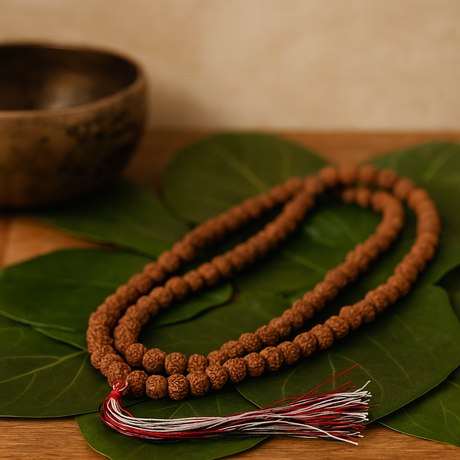
Name one thing in your life worth preserving. Not ten things, not a system, one thing: a friendship that has quietly carried you, a piece of work you believe in, your own steadiness in the mornings. Then name the one small, repeatable act that keeps it. The message back, the walk, the early hour you guard. Preservation, after all, is sthiti, the steady holding, and steadiness is built from acts so small they barely look like effort. The practice is not to grip harder. It is to return, reliably, to the same small gesture. You might mark it with keeping a still moment at dawn before the day's noise begins. A mala can hold the count if you like a rhythm to settle into, counting 108 repetitions of a Vishnu mantra on a mala. The point is never the object. The point is the returning.
The mindful home
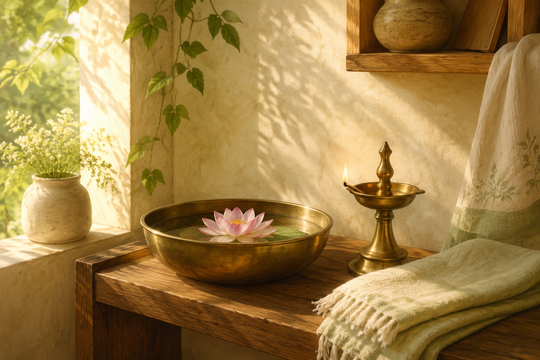
For many, the tradition lives most simply as objects: a statue of Vishnu or Lakshmi, a string of beads, a thread of incense, a small considered altar. Presented honestly, these are cultural-heritage pieces and focal points for attention. They are not charms, and they do not change health, fortune or the course of a life; they are cues to pause, anchors for a few minutes of quiet. Held that way, they earn their place.
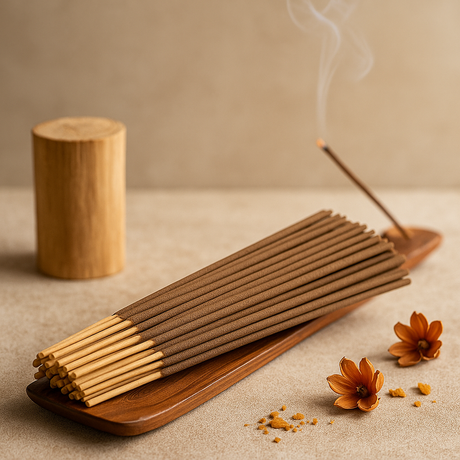
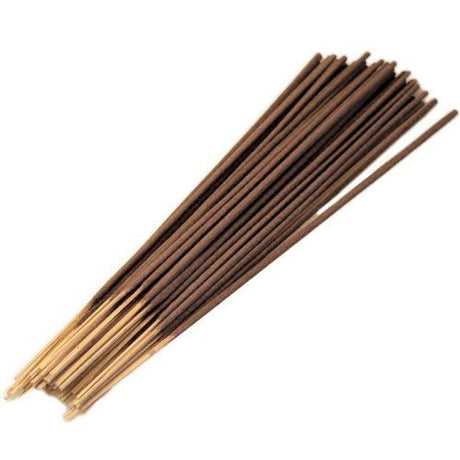
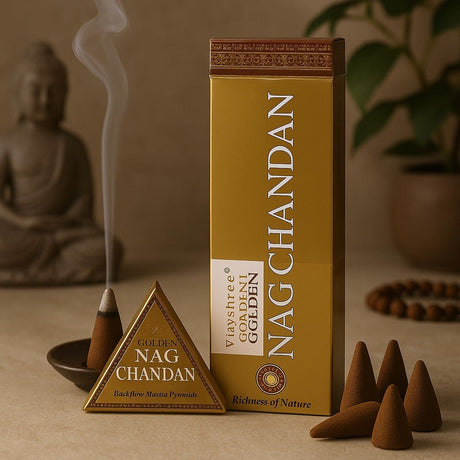
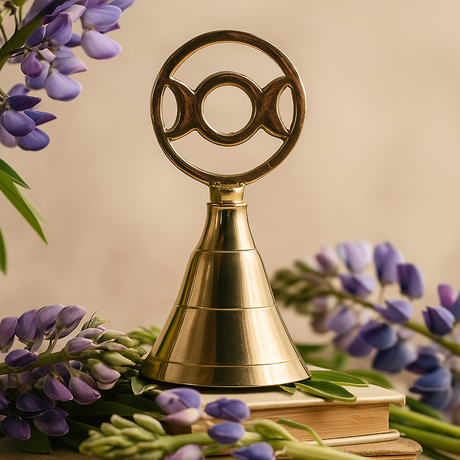
Tulsi, holy basil, is the plant most closely bound to Vishnu's worship, traditionally used above all others in his honour, which makes it a natural scent for a Vishnu-themed corner. Light an incense stick of the holy basil so closely bound to Vishnu's worship, and let it mark the start of the moment. Some prefer the slow bloom of a cone and the first thread of smoke rising from it; either wants a clean, raised place to rest, a lotus-form brass burner echoing the flower Vishnu holds. If smoke is not for you, one lit flame at dawn does the same grounding work. Give the whole arrangement a clean surface and a quiet corner rather than the floor, set the statue a little raised, and let it mean something to you. For those who like sound, a brass singing bowl can open the practice with the first sound of creation, an echo of the conch's note, before the mind has had time to wander.
Back to the reclining god
Return, at the last, to the image we began with. Vishnu asleep on the serpent, the world resting on him and he resting too, the lotus opening at his navel into a fresh universe. Everything generic about 'the preserver god' collapses into that one nameable scene, and so does the lesson. Preservation is not anxious gripping. It is steady holding. It is composure and responsibility carried in the same breath: total care, no strain. Whatever in your own life is worth keeping, keep it the way he holds the world, with a calm face and a hand that does not let go.