


Dendritic Limestone Picture Stone Arch 145x110mm

Dendritic Limestone Picture Stone Arch 145x110mm is backordered and will ship as soon as it is back in stock.
Email me when it's back in stock
One email when this piece is back. No marketing, and you can unsubscribe at any time.
Chosen by 20,000+ customers across Europe · 30 days to return
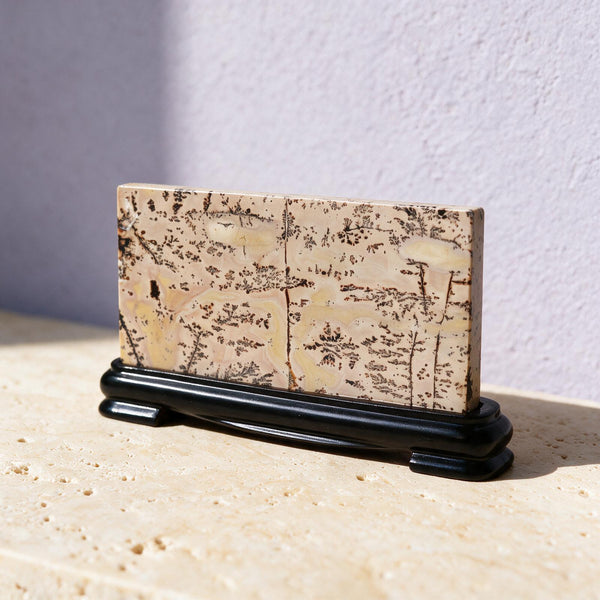
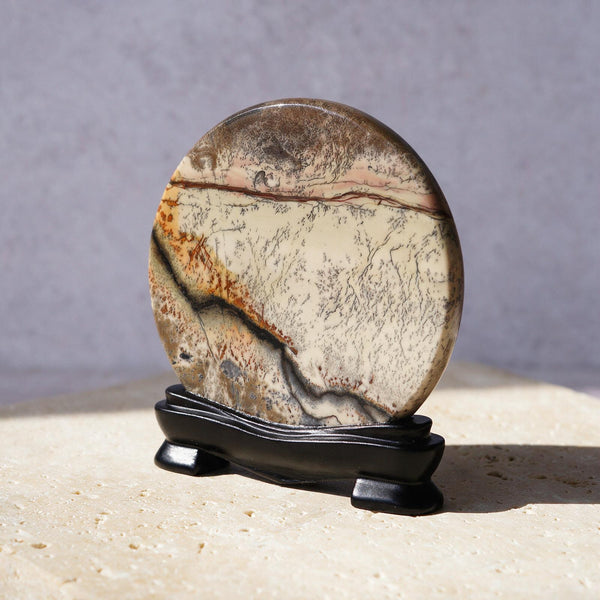
Like a small ink landscape caught inside stone, this dendritic limestone picture stone holds dark, branching mineral forms against a pale limestone ground. The arched shape gives it the feeling of a quiet window, made for a shelf, mantelpiece or contemplative corner where the eye can keep returning to it.

Dendritic Limestone Picture Stone Arch 145x110mm is backordered and will ship as soon as it is back in stock.
What it is
A Guohua picture stone, fine grained limestone from Guangxi in China. This one is an arch of about 145 by 110 mm.
Why people choose it
- Natural patterns Tree-like manganese dendrites.
- Arch About 145 by 110 mm.
- Not painted Formed over millions of years.
Care: Dust with a soft dry brush. Points and edges break easily, so lift the piece by its base. Keep coated and dyed pieces out of water and strong sun to protect the finish.
Reviews of similar pieces from this shelf
56 reviews on this shelf
This piece has no reviews of its own yet. These are from its closest neighbours, and each one names the piece it was written about.
-
★★★★★ B.Stunning stone. So happy!!
This is so gorgeous! It arrived yesterday within a day of ordering and I'm thrilled with it. It's much larger than I expected and the colour is beautiful. It is quite thick too and amazing value for money. Very well packaged without having too much packaging. Really beautiful and so happy. Great…
About: Amethyst Crystal Standing Cluster Natural Medium 350-450g → -
★★★★★ D.Perfect raw crystal
A perfect item, nice and huge piece, which was worth the price for it. Safely packaged, which arrived 2 days earlier than I expected. It was a gift to my wife, and she loves it. Purchased together with another lovely raw crystal, they were also perfect in all way. You can read a few negative…
About: Amethyst Crystal Standing Cluster Natural Medium 350-450g → -
★★★★★ P.
What can I say about these Amethyst Points that I have not said before. They are great for the use I have them for. If only a few other Companies trained their Staff so well life would be so much simpler.
About: Amethyst Rough Crystal Points 500g → -
★★★★★ P.
As rough points go these are the best I have ever come across in over 60 years ( Yes I mean 60 years). I use a lot of them. Once again 100 / 100 as 5* are just not enough.
About: Amethyst Rough Crystal Points 500g → -
★★★★★ J.Excellent service, delivery and value for money
Excellent service, delivery and value for money. My mum loves crystals and this was a great piece for her collection. Really happy!
About: Calcite Quartz Crystal Geode 15-18 cm → -
★★★★★ R.It's not too good to be true!
I ordered on the 17th and got it the next day, its beautiful, its palm sized, and sits perfectly. So happy with this purchase.
About: Calcite Quartz Crystal Geode 15-18 cm → -
★★★★★ Z.
Beautiful large raw quartz crystal, exactly what I wrote. Unbeatable in terms of value for money.
About: Smoky Quartz Raw Crystals, 500g → -
★★★★★ L.B.Perfect pocket size
I have crystals all over the place and this one can be carried in a pocket or purse I love it
About: Clear Quartz Crystal Cluster, Man-Made, 8 cm → -
★★★★★ J.
These were better than I expected for the price. They are interesting & sparkly.
About: White Apophyllite Crystal Clusters 20-30 mm, Set of 6 → -
★★★★★ D.
Didnt stick around very long, were snapped up as soon as we unpacked them
About: Calcite Geode Painted Turquoise or Purple Crystal → -
★★★★★ M.
First time I’ve ordeeed these and look to be very good quality. .
About: Smoky Quartz Raw Crystals, 500g → -
★★★★★ J.
Better than I expected! Good quality & great value for money.
About: Angel Aura Quartz Crystal Man Made →
Bought this piece? Be the first to review it.
Other choices
Complete your ritual
A few things often kept alongside this piece.
About this product
The natural artwork in the stone
- The dark dendritic markings spread like fine branches, river deltas or distant trees seen through mist.
- Soft tonal shifts in the limestone give the surface a painterly depth, closer to an abstract landscape than a simple pattern.
- The arch shape frames the markings gently, so the stone reads as a small natural scene rather than a flat specimen.
- Because the image is formed inside the stone, not applied to it, every line belongs to the mineral structure itself.
- It rewards slow looking. A different angle of light brings out different parts of the surface and changes what you notice first.
Dendrites in fine-grained limestone
This Guohua picture stone is dendritic limestone, with manganese dendrites held in a fine-grained limestone matrix. Iron oxide also contributes to the natural variation in tone. These branching forms are not painted or printed; they come from mineral movement through the stone over deep geological time, then appear when the stone is cut to reveal them.
How to display and care for it
Place it where the arched outline has room to breathe: on a bookshelf, console, mantelpiece or quiet desk. A plain background will let the natural markings do the work.
Limestone is softer than quartz, so handle it with care and keep it away from abrasive surfaces. Dust with a soft, dry cloth and avoid prolonged damp or soaking.
Guohua and the art of looking
Guohua means ‘national painting’ in Chinese, and these stones are named for the way their mineral patterns can resemble the brushwork and open space of Chinese ink painting. They also sit comfortably beside the wider East Asian appreciation of viewing stones, where naturally formed rocks are valued for suggestion rather than literal likeness. A good picture stone does not need to show one fixed scene. Part of its appeal is the quiet practice of reading the surface, finding mountains, trees, figures or weather in marks that were made by stone, water and time.
Size and details
This arch-shaped stone measures approximately 145 x 110 mm and weighs around 479 g. It is part of the Guohua Picture Stones range and originates from Guangxi Province, China.