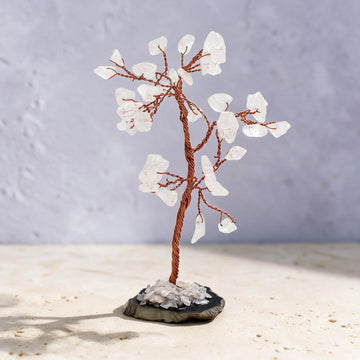
Long before crystals had anything to do with altars, cleansing rituals or set intentions, one plain, colourless stone had already found its way into almost every pocket and wrist on the planet. Clear quartz is the least showy member of a spectacular family, and that might be exactly why so many beginners are pointed towards it first. Understanding why starts with a fact most crystal guides leave out entirely.
The stone already keeping time
Somewhere inside almost every quartz watch, and inside most mobile phones, sits a sliver of clear quartz cut and shaped with real precision. Squeeze quartz and it produces a tiny, measurable electric charge. Run a current through it instead and the crystal vibrates, not randomly, but at a stable, repeatable rate, over and over, for as long as the current runs. This behaviour is called the piezoelectric effect, and it is what a quartz watch actually uses to keep time: a small quartz element inside the movement is typically cut to vibrate at 32,768 Hz, a figure chosen because it halves down neatly to one second through a simple binary counting circuit, not because quartz itself is somehow bound to that number. A circuit counts those vibrations and moves a second hand forward, tick by even tick.
 Clear Quartz97 pieces
Open →
In this guide 5
It's an odd thought to sit with. The stone so many beginners are handed as their first piece of energy work is, at this very moment, quietly doing verifiable, measurable work inside the device on your wrist.
What clear quartz actually is
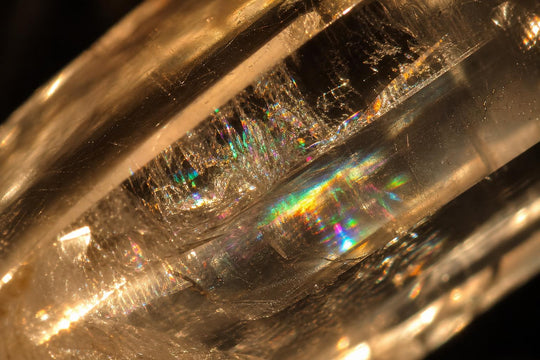
Strip away the mysticism and clear quartz is a mineral with a formula as plain as its appearance: silicon dioxide, arranged in a trigonal crystal structure, hard enough to scratch glass and most other common stones. It's one of the more abundant minerals in the rock beneath our feet, worked and shaped from riverbeds and mountain veins on more than one continent, and it turns up more often, in more places, than almost anything else people call a crystal.

Clear quartz is also, in a sense, the plain sibling of a colourful family. Amethyst's purple, citrine's yellow and rose quartz's soft pink all come from the same underlying mineral; what changes is a trace element or a tiny structural quirk, never the substance itself. Clear quartz is simply quartz without those additions, as close as the mineral gets to its own unmodified self.
The word "quartz" entering scientific vocabulary is often credited to the German scholar Georgius Agricola, writing in the sixteenth century, who is said to have adapted a term already circulating among miners working underground. Exactly where that older mining term first came from is similarly not settled with any certainty, both ends of the word's history rest on tradition more than on a single, documented origin.
The oldest belief about it
The word "crystal" has an older story, and a more poetic one. It comes from the Greek word for ice, and for a long stretch of the ancient world that link wasn't treated as a metaphor. Clear quartz was described, quite literally, as water frozen so hard by extreme cold that it could never thaw again, not a resemblance to ice but a genuinely different, more permanent state of the same substance.
 Next: Five First Crystals, Arranged by ColourCrystals & Jewellery · 4 min read
That belief was written down by more than one observer of the natural world in antiquity, and it travelled. Across the many cultures that have valued clear stone, from lapidary work to talismans to divination, its exact use and standing shifted a great deal from one place and one period to the next. There's no single, tidy history to give here, and any account that offers one is smoothing over a much messier, more interesting truth.

Why it's the one beginners reach for
None of this explains, on its own, why clear quartz sits at the top of almost every beginner's shelf. That answer lives less in geology than in a living, present-day tradition. Among many contemporary crystal practitioners, clear quartz is spoken of as a kind of master stone, one thought capable of holding and amplifying whatever intention a person sets with it, and it's commonly associated with the crown chakra, the point where focus and clarity are said to gather. These are ideas carried by people practising today, not settled facts, and they are not empty for being unsettled. They give a plain stone a job to do in a room, and a reason to keep it close.
Part of the appeal is structural rather than symbolic. Amethyst, citrine and rose quartz are all built from the same underlying mineral as clear quartz, so whatever a person later feels drawn towards, they will still be working, at bottom, with the stone they started on.

A way to begin
Buying a first piece of quartz from a photograph rewards the wrong instinct: hunting for the clearest, most flawless-looking image. In hand, quartz behaves differently, catching light unevenly, holding a faint milkiness in one corner, feeling heavier or lighter than its size suggests. Choosing by handling, where that's possible, teaches more about the mineral in a minute than any listing ever will.
Once it's chosen, tradition offers a few quiet ways to mark a fresh start with it: holding it under running water, or leaving it out overnight under open sky, both long-standing habits among people who keep crystals, more a way of marking the beginning of a relationship with the stone than a claim about what the water or the night air actually does to it.
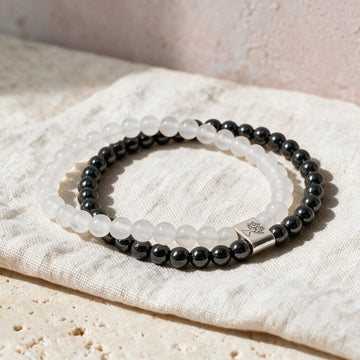
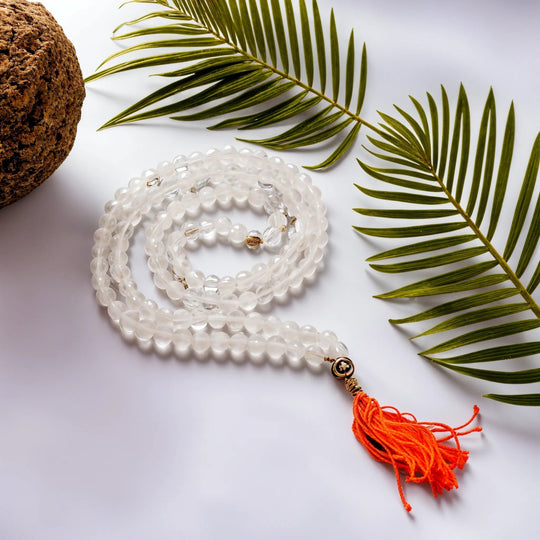
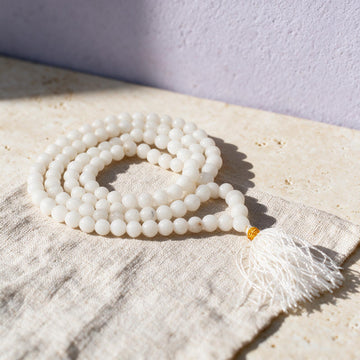
What matters more in the first weeks of owning a piece is smaller and far less dramatic than any of that. Hold it for a minute, properly, once a day: not scrolling, not talking, just registering its weight and temperature in your palm. Some people begin with a single pointed piece to hold this way; a hexagonal quartz wand keeps the mineral's natural six-sided growth visible even after cutting, which gives the hand something specific to notice rather than a generic lump to grip. Others prefer the habit worn rather than held, folding it into a repeated, counted practice: a mala for daily practice threads many small pieces of quartz into a single loop, so that same minute of attention can move, one bead at a time, into counting breaths or repeating a phrase.
None of this is the stone doing the work. The attention is. Handled daily until it stops being a novelty and starts being familiar, clear quartz teaches the habit that every stone after it will depend on. Knowing one thing well is worth more, at the start, than owning many things barely at all.




 India

 China