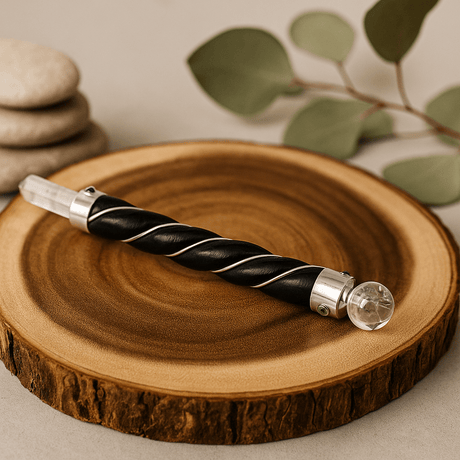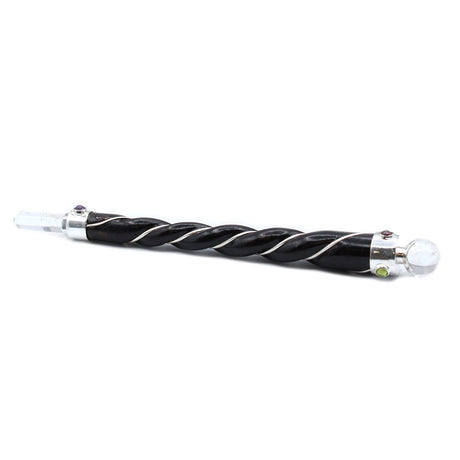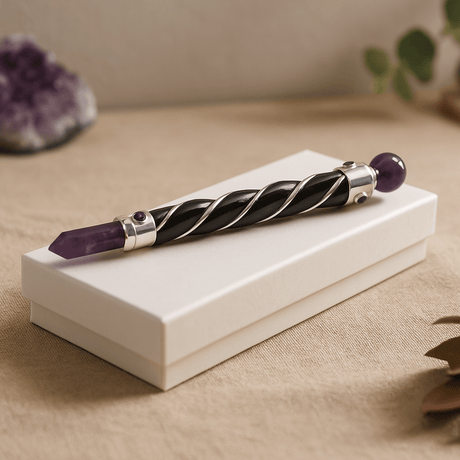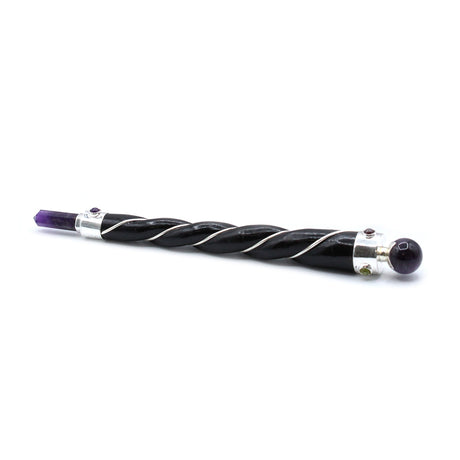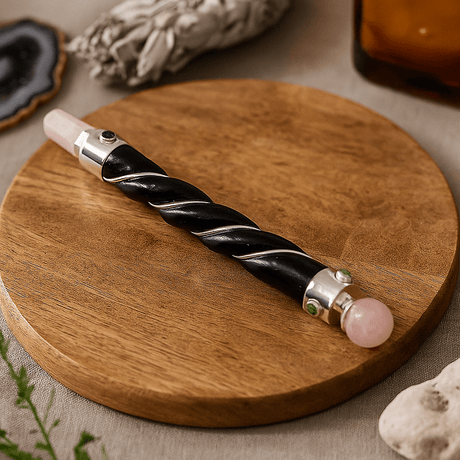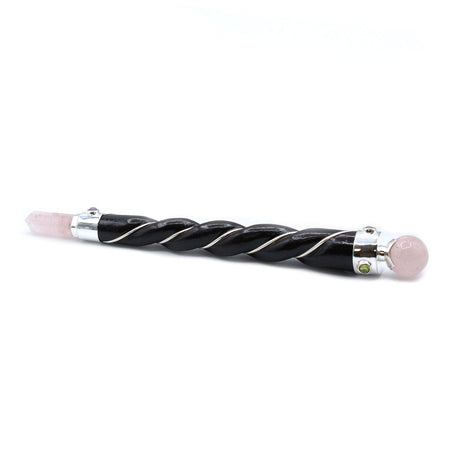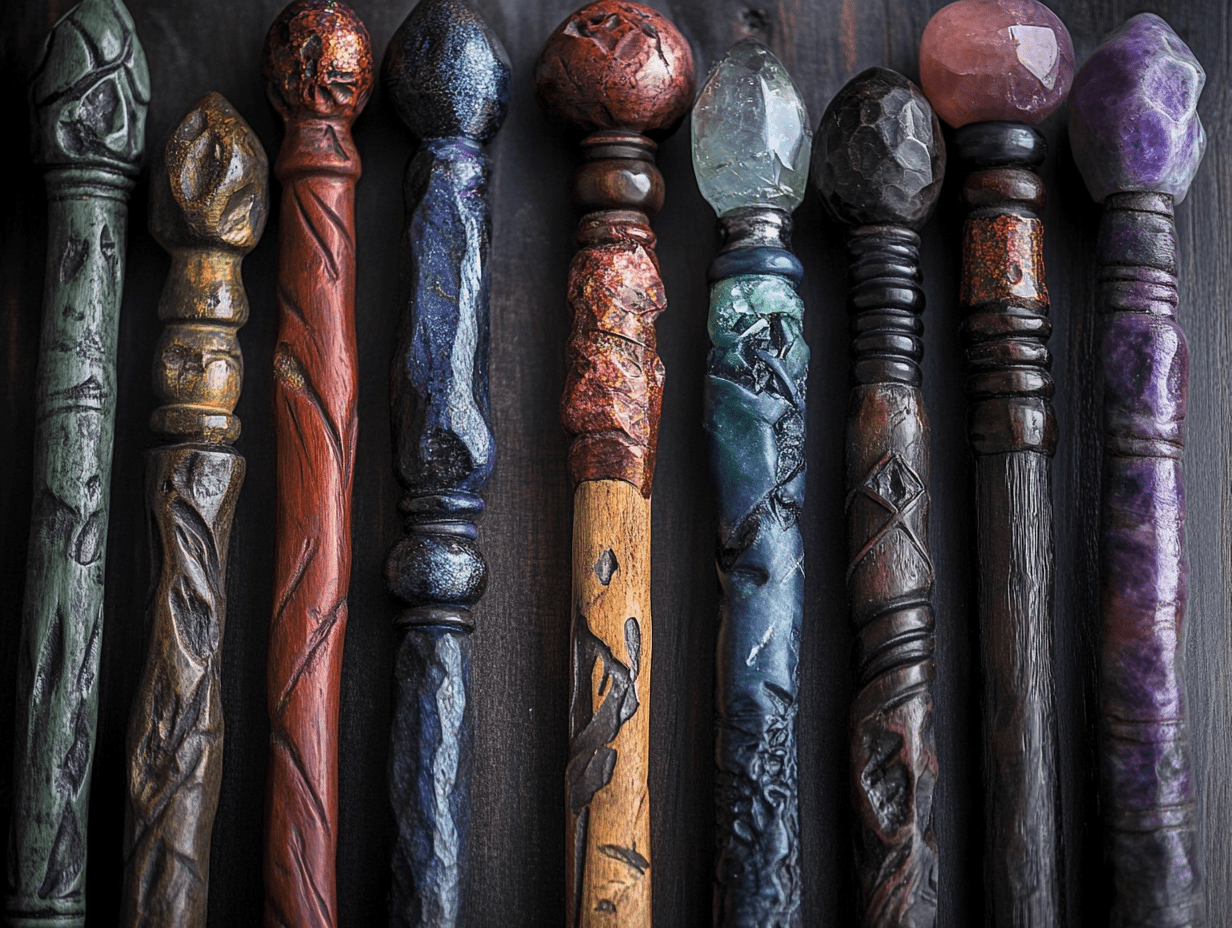
A wand does very little on its own. It is a shaped piece of crystal, or wood, or metal that fits the hand. What it offers is somewhere for your attention to rest. Hold one during a quiet moment and it gives the practice a centre, something to come back to when the mind wanders.
In many traditions these wands are used as a focus for attention and intention, a way to centre yourself during meditation or quiet practice. They have been part of ritual life, in one form or another, for a very long time. This is a slow look at where they come from, what they are made from, and how people use them today.
Understanding healing wands
A healing wand is a tool, not a remedy. People reach for one to focus the attention and settle into stillness, a tangible thing to hold while the breath slows and the day goes quiet.
Most wands take their character from the crystal set into them. Clear quartz, amethyst and others each carry their own associations in crystal lore. In that tradition, stones are valued as things to store and focus an intention, to keep the note while you sit with it.
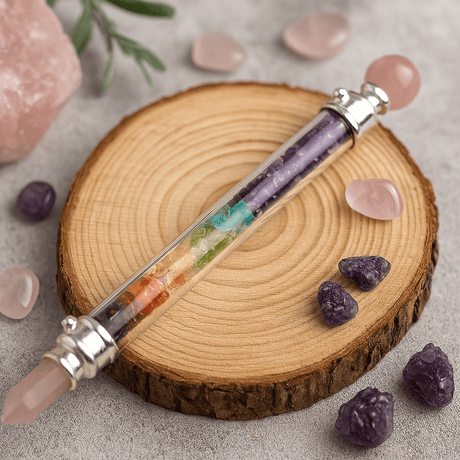
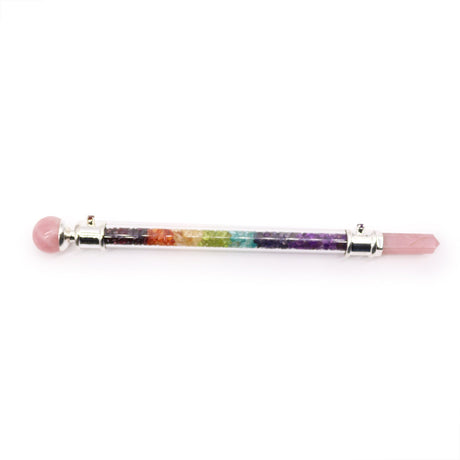
Many people use a wand as part of a practice to align the chakras, or simply to mark the start of a few quiet minutes. The work is yours. The wand keeps you company while you do it.
That is the honest heart of it: the power lies in your own intention and the practice you build around it. Name what you are working towards, return to the wand through the day, and let the practice deepen over time.
The history of healing wands
Wands and ritual staffs appear across many ancient cultures. Egyptian craftsmen carved apotropaic ivory wands for protective rites; ceremonial staffs were carried in Mesopotamia. These were objects of ritual, held by priests and shamans, rather than direct ancestors of today's crystal wands.
They were often made with great care, from stone, bone and metal, and treated as objects of meaning. That care, and the human wish for harmony, is the thread that runs through to the present, not a single unbroken "healing wand" tradition, but a long, varied history of ritual objects shaped to hold attention.
Today's wands sit within holistic and meditative practice. The fact that people still reach for them speaks to the place such objects hold in ritual life, and to a quiet, lasting wish for calm and connection.
Materials of healing wands
Wands are made from a handful of natural materials, each with its own feel in the hand. Semi-precious stone, metal and wood are the usual choices. The material shapes the character of the wand as much as it shapes how it sits in your palm.
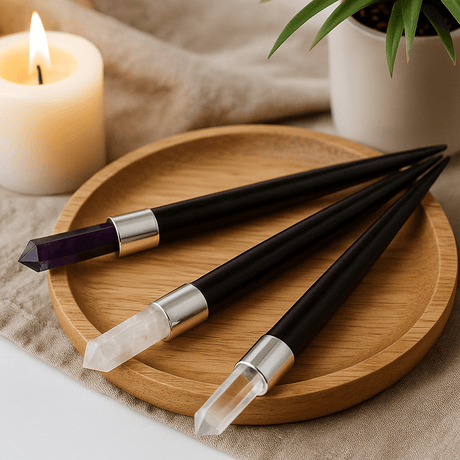
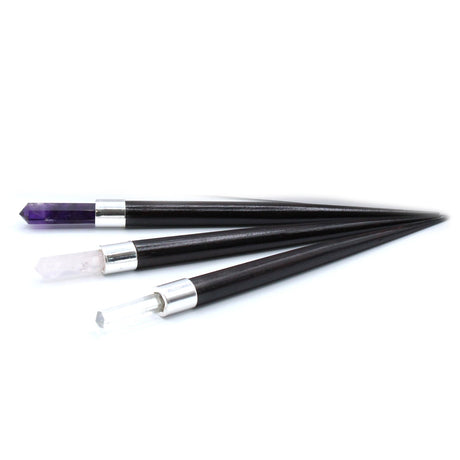
Some are a single length of polished crystal. Others set a stone into a carved wooden shaft, or a copper pipe. The choice is personal, pick the one whose weight, colour and texture you are drawn to, and the rest follows.
Crystal wands
A crystal wand is, at its simplest, a shaped piece of stone. In crystal lore, clear quartz is often called the 'master healer' and valued for amplifying intention, which is why it is such a common choice.
In crystal lore, clear quartz is valued for its association with clarity and for amplifying intention.
People use crystal wands to focus during meditation and quiet practice. The stone gives the attention somewhere to go; you bring the intention. Together they make a small, steady ritual, a way to begin, and a way to return.
Wooden wands
A wooden wand has a different warmth to it: grounded, plain, easy to hold. The appeal is in its simplicity, and in the sense of connection to the natural world that a worked piece of wood can carry.
The wood itself sets the character. Oak is associated with strength and steadiness. Willow with flexibility. In wand lore, walnut is linked with wisdom and birch with clearing and renewal, each wood carrying its own historical and cultural meaning.
Practitioners often choose the wood they feel drawn to. A wooden wand that feels right in the hand becomes a familiar, personal tool, warm, unfussy, and easy to return to.
Wood and copper
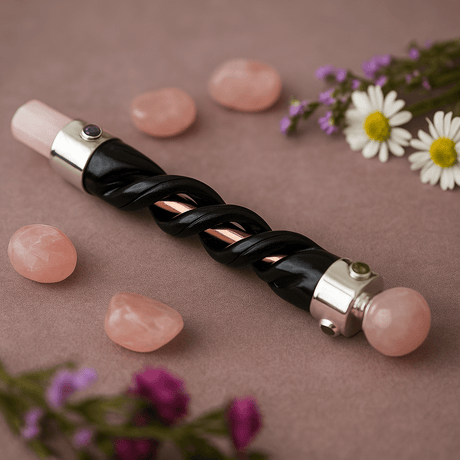
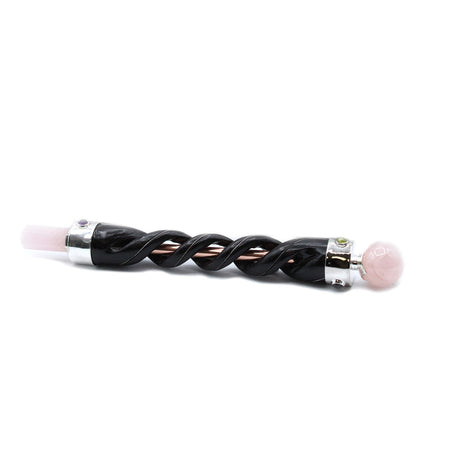
Some wands pair a wooden shaft with a copper pipe, setting an organic, grounded material against a bright, conductive metal. Copper is a genuine conductor, and the two together make a wand that is both sturdy and pleasing to hold.
- Wood brings a grounded, natural warmth.
- Copper is a conductive metal, bright and durable.
- The two together feel balanced, earthy and clear at once.
It is a practical, handsome combination: a tool that holds up to daily use and carries a little of both worlds.
Popular crystals for healing wands
A few stones turn up again and again. Amethyst is traditionally associated with calm and rest, and resonates with the crown chakra in crystal practice, a favourite for meditation. Clear quartz, the so-called 'master healer', is valued for clarity and for amplifying an intention.
There is no single right stone. Choose by the quality you are drawn to, and by the colour and feel that speak to you.
Amethyst wands
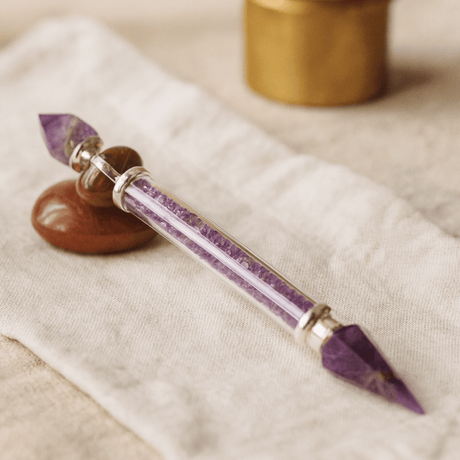
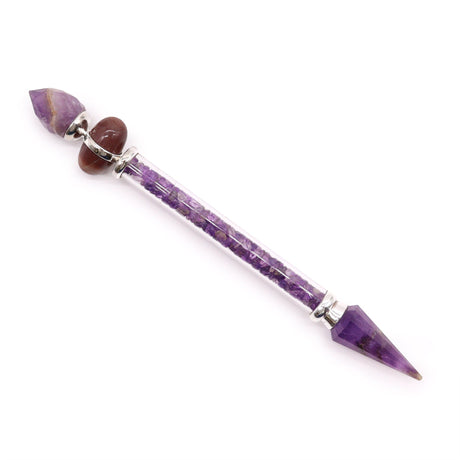
Amethyst is the quiet one, its soft violet often turned to for calm, rest and meditation. The colour ranges from pale lilac to deep purple, and it is a gentle thing to hold while you settle.
Many keep amethyst wands close for quiet practice. In crystal lore it is linked with the crown chakra and with stillness, which is why it features so often in meditation and reflective ritual.
Hold one while you breathe and name what you intend. The stone keeps you company; the calm is something you grow into.
Rose quartz wands
Rose quartz is the gentle one, long associated with warmth, compassion and self-kindness. Its soft pink hue is part of the appeal, open and unhurried.
Many people hold a rose quartz wand while reflecting on self-compassion and forgiveness. It is a stone people turn to when they want to be a little kinder to themselves, used as a focus for that intention rather than a fix for it.
Browse our rose quartz wands if the heart is what you want to sit with. Hold one during a quiet moment and let the practice do the rest.
Rock quartz wands
Rock quartz, more often called clear quartz, is one of the most familiar tools in crystal practice. Clear and bright, it is valued in the tradition for amplifying an intention and for a sense of clarity.
People use it to focus during meditation and to sharpen their attention. As a wand, it is a simple, versatile thing to keep to hand, a steady companion for a quiet practice.
In crystal lore it is paired with the idea of focus: name what you are working towards, hold the wand, and let it keep the note while you breathe.

Other wands worth knowing
Beyond the everyday quartz and amethyst, a few wands have their own following. Each is a different kind of object, carved or cast with care, and each suits a slightly different practice.
Selenite wands
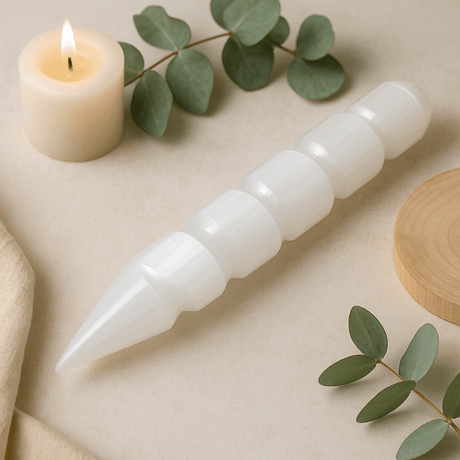
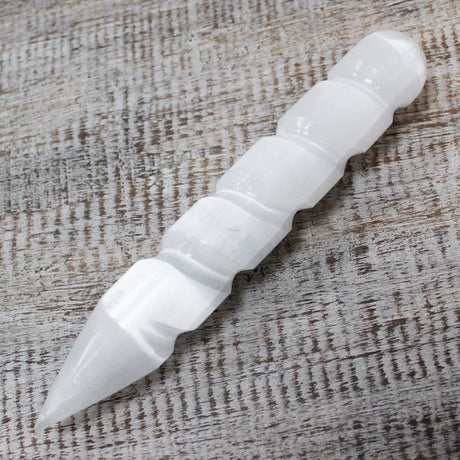
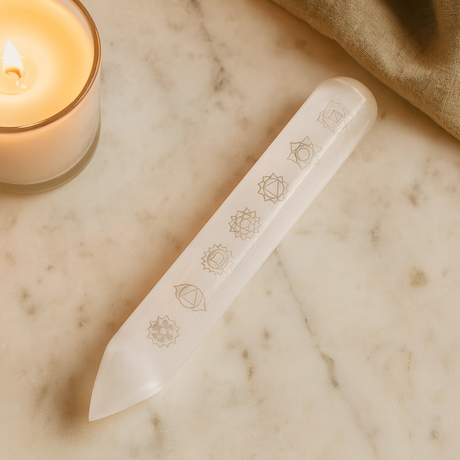
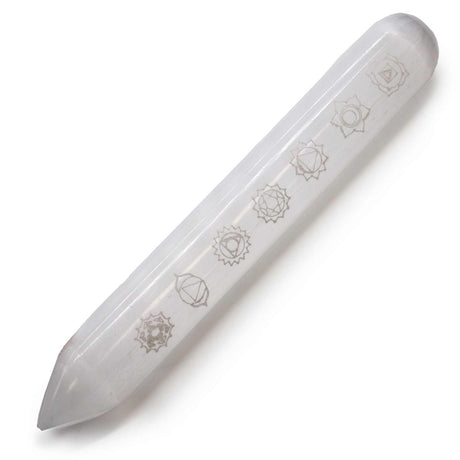
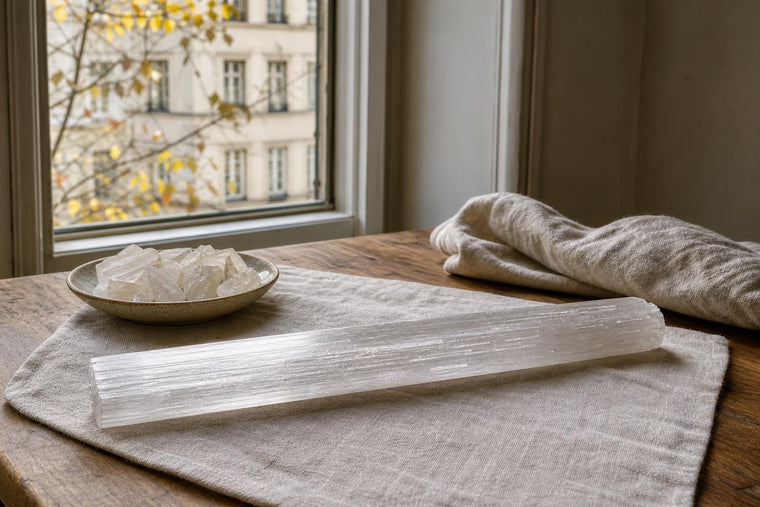
Selenite has long been valued in crystal practice for its soft glow and its association with clearing and calm. Many keep a piece in a space they want to feel settled, a meditation corner, a quiet shelf, a bedside.
It has become a favourite among crystal enthusiasts for exactly that gentle, luminous quality. People use selenite wands as part of a ritual to refresh a room or to mark the start of a quiet practice.
A word of care: selenite is soft and water-sensitive, so keep it dry. Set one where you sit, and let its quiet glow help the space feel calmer.
Shiva Lingam wands
Shiva Lingam stones are gathered from the Narmada River in Madhya Pradesh, India, where they carry deep cultural and spiritual meaning as a symbol of balance and union. Their smooth ovoid form and natural markings are part of what makes them so distinctive.
As a wand, a Shiva Lingam is used much like any crystal tool, held during meditation, returned to when you want to feel grounded. We share this as living heritage and cultural context, an invitation to learn rather than a claim about what the stone will do.
If the symbolism speaks to you, our Shiva Lingam wands carry the genuine Narmada stone. Hold one quietly and let it anchor a moment of stillness.

Orgonite wands
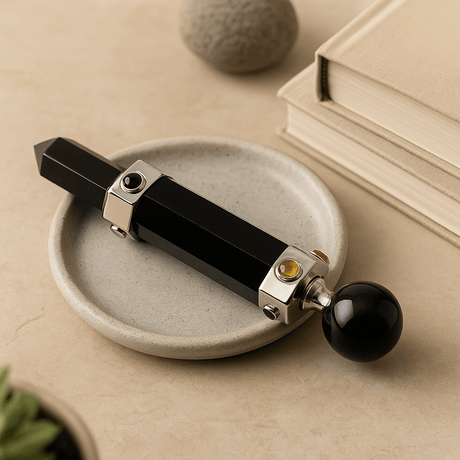
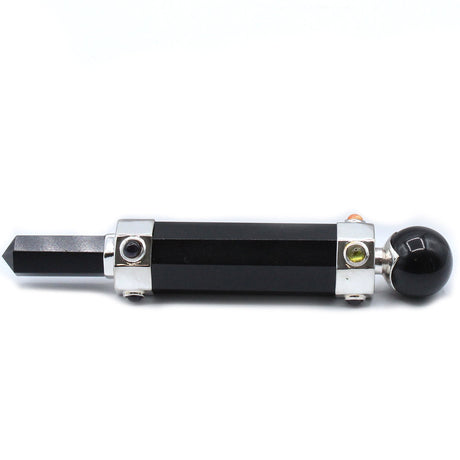
An orgonite wand is cast from resin, metal shavings and quartz, set together into a solid form. It is a striking object, and a distinctly modern one.
Orgonite was inspired by the early-twentieth-century ideas of Wilhelm Reich, who proposed a universal 'orgone' life force, a concept that sits outside mainstream science. In modern crystal practice, many people use orgonite pieces as a focus during meditation.
Treated that way, as a focal point for attention rather than a device that does something to you, an orgonite wand can find a place in a quiet practice alongside any other crystal tool.
What people find in a healing wand
For those who use them, the appeal is simple: a wand gives a practice a shape. It is something to hold, a way to mark the start of a ritual, a reminder to return to your intention through the day.
Some people move the wand slowly over the body as a way to focus their attention and settle into stillness. Others keep one in a room they want to feel calm. It supports meditation and quiet reflection; it does not replace them.
As we bring the healing wand into a modern practice, the point is the same as it ever was, a small, steady object to help you pause, breathe and return to yourself.
How to use a healing wand
There is no single correct method. A wand practice is personal, and the best one is the one you will actually keep. These steps are a starting point, take what fits and leave the rest.
Setting an intention
Begin by settling. Take a moment to centre yourself and breathe. Name one thing you are working towards, clarity, ease, rest. The intention is yours; the wand simply gives your attention somewhere to rest while you hold it.
Cleansing the wand
Many people like to refresh a wand now and then, in whatever way feels right. For crystal wands you might try:
- Smudging, pass the wand through the smoke of sacred herbs like sage or palo santo.
- Moonlight, leave it out overnight, especially under a full moon.
- Sound, let the vibration of a singing bowl or a bell wash over it.
Working with the chakras
Many people find a slow wand practice over the chakras a calming way to pause and reset. To work with one:
- Choose a focus, by intuition, settle on the chakra you want to sit with.
- Hold the wand, rest it a few inches above, picture a soft light, and let your breathing set the pace.
- Sit with it, when you are ready, lower the wand and stay quiet for a moment.
Meditation and visualisation
A wand can be a steady companion in meditation. To bring one in:
- Hold it in your dominant hand, or both hands if you prefer.
- Picture a soft white or golden light where your attention rests.
- Breathe slowly and evenly, letting the wand mark the rhythm.
Quiet rituals
If you like a little more structure, a few simple rituals work well:
- An energy grid, lay out a few stones in a pattern with the wand at the centre, as a focus for your intention.
- Sound, pair the wand with a singing bowl and let the vibration settle the room.
- Affirmations, as you hold the wand, repeat a phrase that matches your intention, such as 'I am at peace'.
Settling a space
To mark a fresh start in a room, move the wand slowly through the space, then hold it still for a moment and picture the room feeling calm and settled. It is a small ritual, more about your own attention than the wand.
Keeping it up
A wand earns its place through regular, gentle use. Five quiet minutes done often is worth far more than one long, occasional session. Now and then, pause to notice how the practice feels, that reflection is part of it.
Chakra balancing with a healing wand
Many people find a slow wand practice over the chakras a calming way to pause and reset. The idea is gentle: a few unhurried minutes, the wand as a focus, the breath setting the pace.
Move the wand slowly and without hurry, letting your attention follow it. There is nothing to force. The practice is simply a way to slow down and sit with yourself for a while.
Used regularly, it becomes a small, steady ritual, a way to pause in a full day and come back to your own breath. The benefit grows from the habit, not from any one session.

Care and maintenance
A wand asks for little, but a little care keeps it well. Handle it with clean hands, and treat it as the personal object it is.
Refresh it now and then in whatever way feels right, a night under the moon, a pass through the smoke of sage or palo santo. Choose the method you are drawn to; the ritual matters more than the rule.
Store it wrapped in a soft cloth or in a small box, away from knocks. Selenite is water-soft and should be kept dry; a quick wipe is enough. Looked after gently, a wand stays a familiar companion for years.
Choosing a healing wand
Choosing a wand is a personal thing. There is no wrong first one, start with the stone, wood or form you are drawn to, and let the rest follow.
Our crystal wands range from clear and rose quartz to amethyst, selenite and Shiva Lingam, in plain stone, carved wood and copper. Each is a tool to hold alongside your own practice, not a promise, but a companion for one.
When you find the one whose weight and colour feel right in the hand, that is the one. Begin a small, steady practice around it, and let it keep the note while you do the work.