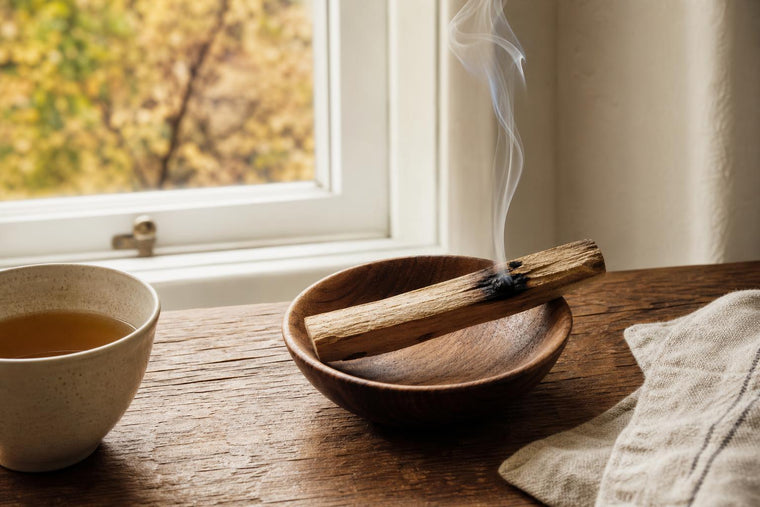
Real Mysore sandalwood means a specific wood, traceable to a specific place, processed by a specific maker, and used in two honest, ordinary ways: as an oil worn on the skin, and as a paste ground fresh on a stone. The name is not a marketing flourish. It is tied, formally, to Karnataka Soaps and Detergents Limited (KSDL), the Karnataka government enterprise that distils the oil and makes the soap the name is built around, and both its sandalwood oil and its soap carry a Geographical Indication tag, the same kind of legal mark that protects Champagne or Darjeeling tea. Most pages that cover sandalwood skip this entirely and go straight to a diffuser-and-pulse-points checklist. That checklist is not wrong, exactly. It is just incomplete, and it leaves out a use that is very common in Indian homes: sandalwood rubbed into a wet paste, not dropped from a bottle.
Keeping a chandan stone alongside a bottle of diffusing oil is an ordinary, common habit, not a contradiction. One practice is older than the other by some centuries. What follows is how to use both well.

How should you apply Mysore sandalwood oil?
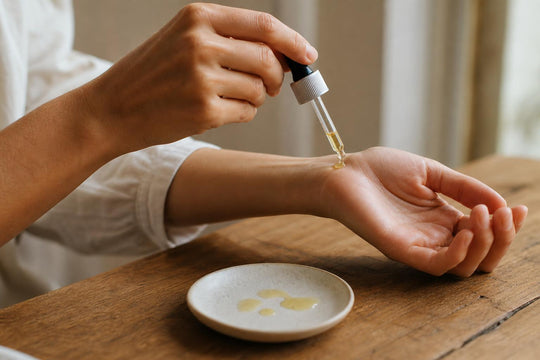
Sandalwood essential oil is strong and should not go on the skin neat. The standard guidance, followed by most sellers and aromatherapists, is to dilute it in a carrier oil before applying it to skin or using it in massage. A small amount diluted is enough for most uses; sandalwood's scent is dense and a little goes further than people expect the first time they open a bottle. For the room rather than the skin, a few drops in a diffuser is the ordinary way people bring the scent into a space, and it is worth doing in the evening rather than first thing, when the note has room to settle rather than compete with everything else happening in the morning.
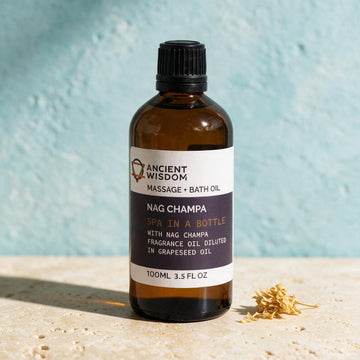
If you prefer not to measure drops into a carrier oil, massage oils and aromatherapy blends that already carry sandalwood pre-diluted take that step out of your hands, which is a reasonable thing to want on a tired evening. Sandalwood is traditionally associated with a settled, unhurried mind, the kind of quality many traditions reach for in quiet or seated practice, though what any oil can actually do is scent a room and sit on skin; the stillness is work you still have to do yourself.
What actually makes an oil "Mysore" sandalwood?
The word "Mysore" attached to sandalwood oil is not loose geography. It traces to one institution: KSDL, a public sector company owned by the Government of Karnataka. Its origin goes back further than the modern company name. In 1916, the Maharaja of Mysore, Krishna Raja Wadiyar IV, together with the engineer Sir M. Visvesvaraya, founded the Government Sandalwood Oil Factory specifically to extract and export sandalwood oil. The factory launched its now well-known soap, Mysore Sandal Soap, in 1918, and the enterprise was reorganised as a public sector company under its current name, Karnataka Soaps and Detergents Limited, in 1980. KSDL's oil is distilled from the heartwood of Santalum album trees grown in Karnataka, which is the part of the tree that carries the scent; sandalwood's outer wood is close to odourless, and it is the heartwood that takes decades to develop its oil content.
Because the name carries real weight, both Mysore Sandalwood Oil and Mysore Sandal Soap now hold a Geographical Indication tag, a formal protection comparable to the one that stops any sparkling wine from calling itself Champagne. That matters for a buyer mostly as a piece of honesty: a bottle labelled "Mysore sandalwood" is making a specific, checkable claim about where the wood came from and who processed it, not just describing a scent family. Much of today's genuine Mysore-type oil now comes from registered private and government-managed cultivation in Karnataka, following regulatory reforms in recent decades that eased the colonial-era state monopoly and allowed private planting, though the felling, transport and sale of sandalwood remain tightly regulated by the forest department. When you are shopping more generally rather than hunting a single named bottle, the full sandalwood collection is a reasonable way to see the range, oils through to incense and body products, without assuming every item on a shelf anywhere is entitled to the Mysore name.
How is sandalwood paste used in daily practice?
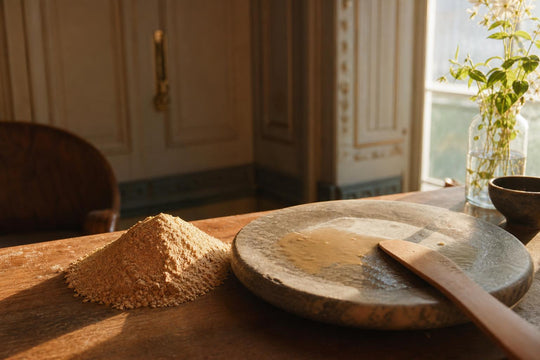
Before there was an oil industry at all, there was a stone. In many Indian households, a flat sandalwood stone, often just called a chandan stone, sits near the puja space, and a short length of sandalwood log is rubbed against it with a little water until a wet, fragrant paste forms. That paste, chandan, is applied as a mark on the forehead or offered to a deity as part of daily worship; it is also simply dabbed on the skin for its cooling, grounding scent, independent of any ritual at all. This is not a historical curiosity kept alive for tourists. It is still how many households use sandalwood day to day, quietly, before the oil ever enters the picture.
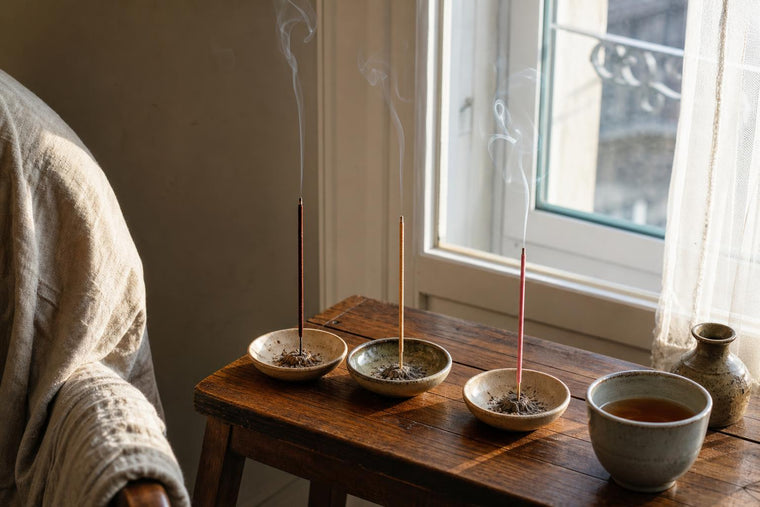
Grinding paste by hand takes a minute or two and gives a texture and strength many bottled extracts don't match, because you are making something fresh rather than storing something concentrated. If a stone and a raw log feel like more than you want to take on, sandalwood incense sticks carry a related, gentler version of the same scent into a room with far less preparation, which is why incense tends to be where most people new to sandalwood actually start.
Sandalwood oil or powder: which do you need?
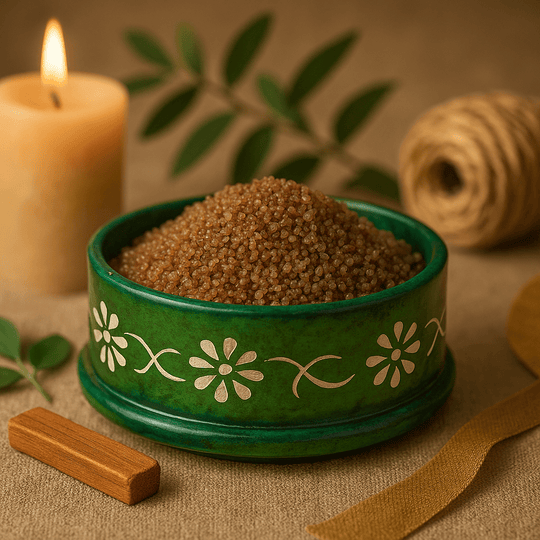
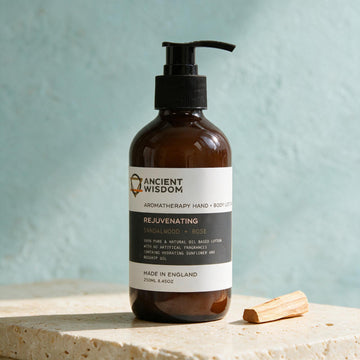
The honest answer depends on what you are trying to do, not on which form is "more authentic". Oil is concentrated, long-lasting on skin once diluted, and suited to massage or a diffuser where you want a sustained background note over an evening. Powder (the same material a chandan stone produces when it is bought ready-ground rather than rubbed fresh) is better suited to a paste you mix yourself in small batches, and it is generally gentler and easier to control on skin than neat oil, since you decide the water-to-powder ratio each time. Neither is a substitute for the other; they are different tools doing different jobs, in the same way a diffuser and incense are not competing for the same moment of your day. If you want the scent on your skin without either grinding or diluting, a rose and sandalwood hand and body lotion sidesteps both decisions, and for a warmer, slower-release version of the scent in a room, sandalwood simmering granules for an oil burner work closer to how incense behaves than how a diffuser does, releasing scent as they heat rather than all at once.
Living with sandalwood, not just buying it
What ties the oil, the paste and the incense together is not a shared origin story so much as a shared demand: sandalwood rewards attention and gives little back to someone rushing through it. The scent is quiet by nature, not loud like citrus or spice, so it asks you to actually be in the room with it rather than half-notice it on your way somewhere else. That is true whether you have bought a GI-tagged bottle traceable to a Karnataka enterprise a century old, or a stick of incense you picked up without thinking much about where the wood began. The practice that makes sandalwood mean something is not the certificate behind it; it is the five minutes you give it, however you choose to use it.

 India


 United Kingdom
 China

 Spain