


 £15.25 off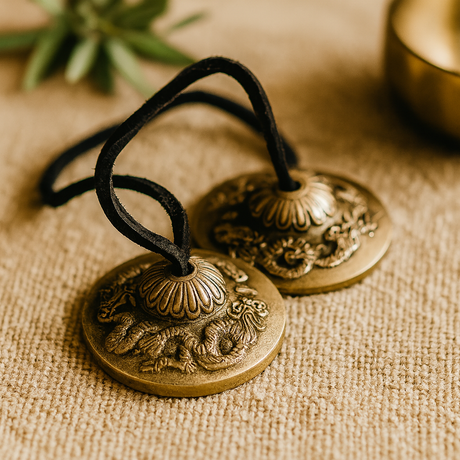


Tingsha cymbals have been at the heart of Tibetan Buddhist practice for centuries — small hand-held instruments that a practitioner holds between thumb and finger, striking them together to produce a clear, sustained tone that marks transitions in ritual, anchors breathwork, and brings attention into the present moment. This collection brings together authentic pairs for meditation, sound healing, and ceremonial use.
What you will find here
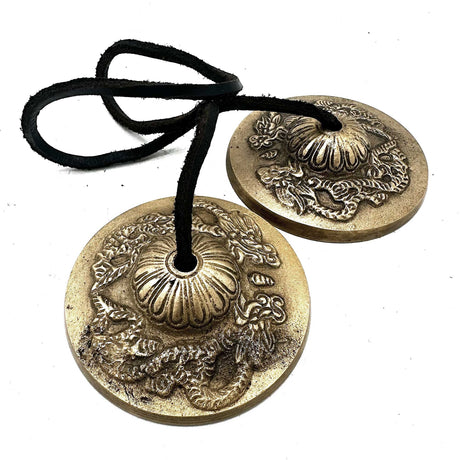
Our tingsha cymbals are handmade using traditional bronze alloys, each pair producing its own individual character of tone. Within this collection you will find small hand-held cymbals ranging from compact 6 cm designs — ideal for personal practice or travel — through to larger 9.5 cm pairs that carry a deeper, more resonant voice for group sessions or energetic clearing. Designs include the Five Buddha, Dragon, Lucky Symbols, and Seven Chakra configurations, each carrying traditional Tibetan iconography.
Choosing your size and tone
The size of a tingsha directly influences its voice. Smaller pairs (6–7 cm) produce a higher, more focused tone that suits quiet meditation and intimate settings. Larger pairs (7.5 cm and above) generate a richer, longer-sustaining resonance that fills a room more easily — well suited to sound healing sessions or group practice. If you are new to Tibetan Buddhist instruments, the 7–7.5 cm range is a versatile starting point: substantial enough to feel the vibration clearly, yet compact enough to hold comfortably in one hand while striking with the other.
How to use your tingshas
The technique is simple and meditative in itself. Hold one cymbal steady between thumb and finger of your non-dominant hand, and strike it with the other cymbal held in your dominant hand — a controlled, intentional motion rather than a hard strike. Allow the tone to ring out fully before sounding again. The clean attack and gradual fade make tingshas excellent for marking transitions in yoga practice, punctuating guided meditation, or simply sounding a moment of pause in daily life. They pair naturally with a singing bowl for layered sound work, or alongside other sound healing instruments in a ritual collection.
Frequently asked questions
What are tingsha cymbals made from?
Tingshas are traditionally cast from bronze-based alloys. Each pair is handmade, which means no two sets are exactly alike — you may notice subtle variations in finish, weight, and tone between pairs. These differences are a natural quality of handcrafted instruments, not a flaw.
How do I play tingsha cymbals?
Hold one cymbal between your thumb and a finger of your non-dominant hand, keeping it fairly still. Strike it gently with the other cymbal held in your dominant hand, then let the tone ring out naturally. The technique is intuitive and develops with practice — start slowly and pay attention to the quality of each strike rather than the speed.
Are tingshas suitable for beginners?
Yes. Tingshas are among the most accessible of Tibetan Buddhist instruments — they require no musical training and are straightforward to play. They make an excellent introduction to sound work and are often chosen as a first instrument alongside a singing bowl. If you are building a sound practice from scratch, a pair of tingshas is a focused and rewarding starting point.
Do tingshas come as a pair?
Yes — each listing in this collection is for a matched pair of cymbals, ready to play. The cymbals are not attached to each other; they are separate pieces that you hold and strike together.
How should I care for my tingshas?
Keep them dry and store them safely when not in use. Wipe them with a dry cloth after playing to remove any moisture or residue from your hands. For occasional polishing, a soft cloth is sufficient — avoid harsh chemicals. If you are exploring other Tibetan bells and tingshas, the same care principles apply across the range.