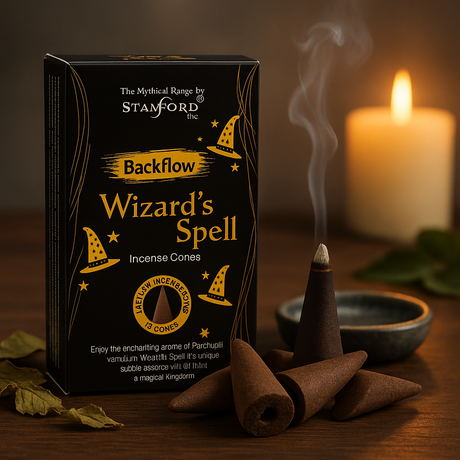
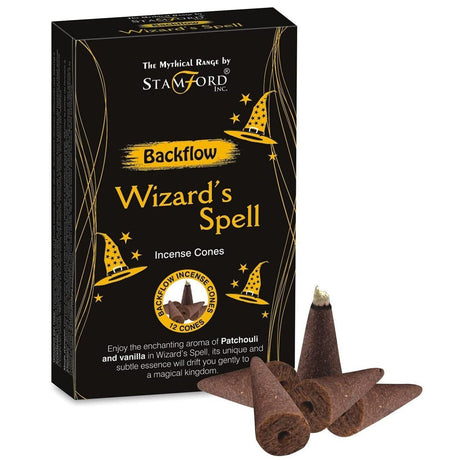
A backflow incense cone looks unremarkable on the shelf: a small grey or brown pyramid, no different from any other cone until you turn it over and find a narrow tunnel bored straight through its middle. Light it, set it on the right burner, and within a minute or two the smoke stops climbing and starts falling, pooling downward around the base like a miniature waterfall. It is a genuinely strange thing to watch the first time. It is also, underneath the strangeness, a piece of ordinary physics wearing a costume borrowed from a much older idea about where smoke is supposed to go.
A mountain built to send smoke up
Long before anyone built a cone to make smoke fall, Chinese metalworkers were building censers to make it rise more beautifully. The boshan censer, found in tombs from the Western Han dynasty of the 2nd century BCE, took the shape of a mountain: a bronze vessel with a conical lid carved into jagged peaks, meant to recall the mythical ranges where Daoist immortals were believed to live. The lid was pierced with small openings so that smoke from the incense burning inside would escape through the mountain's slopes and gaps, drifting up and around the peaks like cloud clinging to a real summit. It was, in effect, an engineering project in service of an image: use the smoke's natural instinct to rise, and shape that rise into something that looked like weather on a sacred mountain.
A tunnel that changes the smoke's mind
A backflow cone does the opposite, and physics alone accounts for it. Ordinary smoke rises because the hot gases produced by burning are lighter than the cooler air around them, the same convection that lifts warm air out of a chimney. A backflow cone interrupts that on purpose: instead of burning openly at the tip, the smoke is drawn down through a hollow channel running through the cone's centre before it ever reaches open air. By the time it exits through a small hole at the base, it has lost enough heat to become denser than the air around it, so gravity, not any hidden mechanism, pulls it downward and lets it pool rather than climb. There is no trick hidden in the burner and none in the cone; only cooler, heavier air finding its way down, the same rule that settles a cold draught along a floorboard. The cone needs a burner made for this, a stand with its own matching hole beneath it, because an ordinary solid cone has no tunnel to cool the smoke and will simply rise the way incense has risen for as long as people have burned it.
The stillness the room asks of you
Every account of backflow incense agrees on one fragile condition: it only works in a still room. A draught from an open window, a fan, a vent from the air conditioning, even a person walking briskly past, and the falling smoke scatters and rises like any other smoke. Most guides file this under troubleshooting, a line to fix before the ritual can properly begin. In practice, the disturbance is rarely the room itself. It is the person in it: reaching for a phone, shifting in a chair, standing to check something halfway through. Smoke this light and this cool answers to exactly that small a movement, the same way it answers to gravity once it has lost its heat. A backflow cone burns for roughly fifteen minutes before it tapers and goes out, which gives the sitting a real edge rather than a vague intention to "be present". Light the tip, wait for the ember to catch properly, then do nothing else until the cone finishes; there is no further step. I keep a daily habit of lighting incense, usually to mark the start or the close of the day rather than to fill the middle of it, and what years of it have taught me has nothing to do with backflow cones specifically and everything to do with this: the smoke behaves the way the room behaves, and the room behaves the way I do. A cone that pours smoke down for its full quarter hour is reporting something plain and physical: nobody, including me, disturbed the air for that long.
What is left
When the fifteen minutes end, the cone has burned down to a small pale husk of ash, the tunnel through its centre finally hollowed all the way through, and the smoke stops falling because there is nothing left to produce it. What remains on the burner afterward is unremarkable: ash, a cooling ceramic mountain or waterfall shape, a faint smell in the room. There is no artefact to keep. That is simply the nature of a cone built to last a quarter of an hour and then be finished, and it is worth letting it be exactly that small and exactly that ordinary.