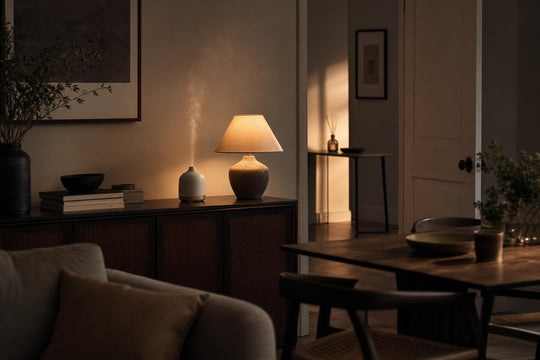
A reed diffuser contains no moving part: no motor, no heat, no switch. Only a bottle of scented oil and a handful of thin sticks, drawing liquid upward by nothing more complicated than the force that pulls damp up the corner of a tea towel. An electric diffuser, by contrast, is a small machine: it hums, mists or warms, and it has a button. Most guides to choosing between them talk about room size and settings. The better question is simpler and closer to home: how do you want a room to smell across a day, as a constant you never decided on, or as something you switch on when you want it?
Three Machines and One Piece of Physics
The reed diffuser works by capillary action. Rattan or fibre reeds are threaded with tiny internal channels, and the fragrance-oil mixture climbs through them the way water climbs a wick, reaching the exposed top of each reed and evaporating quietly into the air. Nothing is powered. Nothing is heated. The bottle does the whole job on its own, for as long as there is oil left to draw.
Electric diffusers do a related job in three different ways, and the differences matter more than the marketing usually admits. An ultrasonic diffuser vibrates a small ceramic disc at a frequency high enough to break a mix of water and oil into a fine, cool mist, which is why its scent tends to read as gentle. A nebulising diffuser skips the water entirely: pressurised air atomises the pure oil, so the result is stronger and more concentrated, oil for oil, than an ultrasonic mist. A heat-based diffuser is the oldest idea of the three, close cousin to the classic oil burner: a small element gently warms the oil until it releases its scent, with no fan and no mist involved.
How the Reed Diffuser Reached the High Street

It is tempting to reach for antiquity when writing about home fragrance, and several accounts of the reed diffuser do exactly that, tracing it back to Egypt or Greece without much to stand on. A more traceable account suggests it began somewhere far more ordinary: a house, not a laboratory. Mei Xu and David Wang reportedly founded Chesapeake Bay Candle in 1994, working from the basement of their home in Annapolis, Maryland. The company is often cited as an early populariser of the reed diffuser format in mainstream American retail, carrying an object with no moving parts from a basement start to a fixture of the home-fragrance aisle.
What strikes me about that story is how little invention it needed. A reed diffuser has no motor and no circuitry to patent; capillary action is the whole of the mechanism, and it was already sitting in nature waiting to be bottled. The format's rise looks more like a retail achievement than a technological one: a husband-and-wife team, working from their own basement, worked out how to turn a very simple physical process into a shelf-ready object, and much of the industry that followed took a similar path.
The Habits Each One Asks For
A reed diffuser rewards a small weekly act: flipping the reeds. Turning each stick over exposes a fresher section of the wood to the air and noticeably lifts the scent, which otherwise fades as the exposed tips dry out. How long any one bottle lasts is not fixed: it depends on the number of reeds left in, the thickness of the oil itself, and the room's own temperature and draught, so the same bottle can run down within a matter of weeks in a warm, breezy spot and last considerably longer in a cool, still one. When the sticks themselves need replacing, a fresh set of reed diffuser sticks starts the whole process again from an absorbent surface, rather than one already saturated with the old blend.
An electric diffuser rewards the opposite discipline: a bounded session rather than a machine left running out of habit. An ultrasonic model needs its water tank cleaned now and then, particularly with hard water, to stop mineral or oil residue building up. A nebulising model needs its oil path kept clear for the same reason. Both formats avoid flame, which removes one whole category of risk, though a heat-based diffuser should only be trusted unattended overnight if it carries an automatic shut-off, and any electric model deserves a sensible, stable spot rather than a precarious one.
Room Enough, Time Enough
A single reed diffuser suits a smaller or more enclosed room: a bedroom, a bathroom, a hallway, a study, somewhere a light, steady presence is welcome and nobody is asking it to fill a large volume of air. The scent has little air to travel through before it reaches you, which is exactly the condition it needs. An electric diffuser's adjustable strength and stronger throw make more sense in an open-plan living space, ahead of guests arriving, or in a kitchen once cooking is done and a change of atmosphere is actually wanted. Turned up for a larger room, down for a small one, switched off the moment the mood has served its purpose, its flexibility is the real advantage, more than any figure printed on a box.
None of that is really the choice, though. A reed diffuser is passive and continuous: once it is set up it releases scent for as long as there is oil in the bottle, with no on/off control and no timer, because there is nothing electrical to time. An electric diffuser is active and intermittent: switched on for a chosen session, run for twenty minutes or two hours, turned up or down at will. One gives you fragrance that simply is there, in the background of a life you are mostly not paying attention to; the other marks a stretch of time you have chosen to notice.
I keep incense to a chosen stretch of the day, lit and put out on purpose rather than left to burn its own course. A reed diffuser asks for none of that discipline: once it is filled, it works without any further decision from me, running down at its own pace until the oil is gone. That is roughly what Mei Xu and David Wang are reported to have worked out in their basement in 1994, not a new fragrance, not a new mechanism, but a shelf-ready object that could do exactly that, quietly, for weeks at a stretch. Some accounts place the company's founding a little differently, or credit other early manufacturers with getting there first, but the shift from a basement start to a fixture of the home-fragrance aisle is the part every version agrees on. Which habit suits a given room has less to do with the room than with how much of your own attention you want a scent to ask for.