Ganesha is among the most recognised forms in the world's visual vocabulary, yet the story behind that elephant head is stranger, older, and more layered than the image alone suggests. This is the myth told in full, and what it has carried across centuries of practice.
On Kailash, Before the Door
Parvati, consort of Shiva and daughter of the mountains, wanted a guardian she could trust entirely. Not one of Shiva's ganas, his attendants, loyal first to him. Her own. Someone who would stand at the threshold of her private chambers and answer to no one else.
In the account given in the Shiva Purana's Rudra Samhita (the Kumara Khanda section, compiled by scholars to roughly the 7th–10th century CE and among the earliest Sanskrit sources to tell this story in full), she fashioned a boy from the sandalwood paste and ubtan she had applied to her own body. She shaped him, breathed life into him, and placed him at her door with a single instruction: let no one pass.
Shiva returned. The boy, knowing nothing of him, refused entry. A confrontation followed; Shiva's ganas fought the child and lost. Shiva himself intervened, and in the battle the boy was beheaded.
What happened next is the part the story is remembered for, though it is rarely told with the detail the text supplies. Shiva, moved by Parvati's grief, instructed his ganas to go north and bring back the head of the first living creature they found sleeping with its head pointing in that direction. They returned with the head of an elephant. Shiva placed it on the boy's body and restored him to life. He named him Ganapati, lord of the ganas, and declared that he would be honoured first, before any other deity, at the opening of every rite and every undertaking.
The Story the Popular Accounts Skip
The Brahma Vaivarta Purana offers a different telling, and it changes the story's centre of gravity entirely.
Here, Parvati forms the child not during a moment of need but as an act of pure creative will. She takes the ubtan, the turmeric-and-oil paste used in bathing, scrubs it from her own body, and from it shapes a son. She breathes life into him herself. The child exists, fully, before Shiva arrives. The origin is hers: not a response to conflict, not a consequence of divine politics, but a mother's deliberate act of making.
This variant does not contradict the Shiva Purana account so much as it reframes it. In one telling, the story is about a boundary violated and restored. In the other, it begins with a woman's creative sovereignty. Both traditions are alive in practice; neither cancels the other. The mythology of Ganesha has always held this kind of productive multiplicity: regional retellings, sectarian emphases, textual layers that sit alongside one another without demanding resolution.
The elephant identified in some retellings as the source of the head is Airavata, the white elephant of Indra. This identification is not universal across traditions, and it is worth naming as one thread among several rather than the single authoritative version.
What the Form Carries
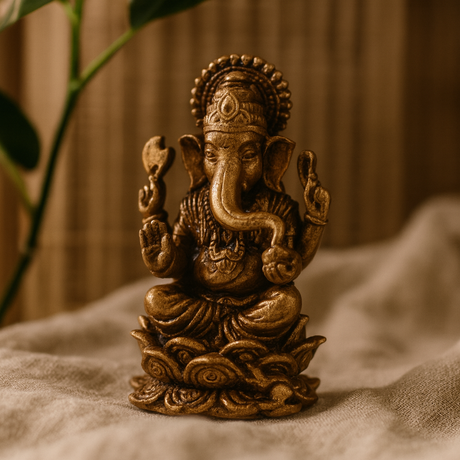
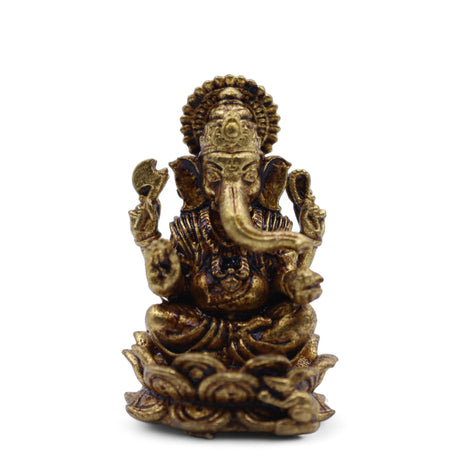
Each element of the four-armed form holds a specific meaning in the Agamic tradition, and the meanings have been consistent enough across centuries to function almost as a visual grammar.
The broken tusk, the epithet Ekadanta meaning one-tusked, is associated in the Mahabharata tradition with the story of Ganesha serving as scribe to the sage Vyasa. When his pen broke mid-dictation, he snapped off his own tusk and continued writing rather than interrupt the flow of the text. The gesture is read as a statement about the value of sustained effort: the work matters more than the instrument.
The modaka, the sweet dumpling of rice flour and jaggery or coconut that Ganesha holds and is offered in worship, carries a parallel reading in devotional commentary. It represents the sweetness of inner realisation, not given freely, but earned through practice and attention. The reward is real; the path to it is the point.
The pasha (noose) and ankusha (goad) in his other hands are the tools of a mahout translated into cosmic register: the noose catches what wanders, the goad directs what is caught. His vehicle, the mushika, a mouse or rat, is the creature that gnaws through obstacles unseen, working in the dark where the large cannot go. The contrast of the vast elephant-headed deity riding a small mouse is itself a deliberate iconographic statement, one that the tradition has never felt the need to explain away.
The elephant head itself is read in devotional commentary as the union of cosmic intelligence with human embodiment. The elephant in Indian thought carries associations of wisdom, patience, and the capacity to move through what blocks the path. Ganesha's title Vighneshvara, lord of obstacles, names both his power to place them and his power to clear them.
Where the Symbol Lives in Stone
The Ashtavinayak, eight Ganeshas, is a pilgrimage circuit of eight temples in Maharashtra, each enshrining a swayambhu murti: a form held to be self-manifested rather than carved by human hands. The circuit is not a single narrative but a set of distinct iconographic episodes, each site enshrining a different aspect or episode from the mythology.
Morgaon, in Pune district, is traditionally counted the first and most senior shrine of the eight. Its presiding deity is Mayureshwar, Ganesha mounted on a peacock, a form associated with the defeat of a particular demon in the Mudgala Purana tradition. Pilgrims who complete the Ashtavinayak circuit begin and end at Morgaon; the sequence is understood as a complete reading of the deity's forms rather than a simple accumulation of merit.
What the circuit makes visible is something the mythology already implies: Ganesha is not one story but many, held together by a consistent set of attributes and a consistent role. The broken tusk at one shrine, the modaka at another, the mushika at a third. Each site asks the pilgrim to attend to a different facet of the same form. The iconography is a language, and the pilgrimage is a way of learning to read it slowly, in place.
The Practice of Beginning
Ganesha holds the title Prathamapujya, the first to be worshipped. Across Shaiva, Vaishnava, and Shakta contexts, he is invoked at the opening of any ritual, any journey, any significant undertaking. This is not a sectarian preference but a structural principle: every beginning has a threshold, and the threshold deserves attention.
The practice of invoking Ganesha first is, at its most practical, a reminder that how something starts shapes what it becomes. A journey begun with intention is a different journey from one begun on autopilot. A ritual opened with attention is a different ritual from one performed by rote. The deity at the threshold is not a gatekeeper demanding tribute; he is a prompt to pause, to mark the moment, to bring the mind to what the hands are about to do.
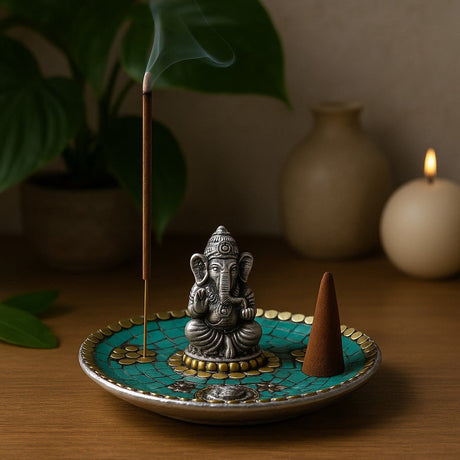
In many households, a small Ganesha murti sits near the entrance or at the altar, not as decoration but as a daily reminder of this principle. Lighting incense at the start of the day, or before beginning work that matters, is one way the tradition travels into ordinary life without requiring the full architecture of a temple. The invitation the mythology has always carried is the same: mark the beginning. The rest follows from there.
The Threshold You Already Keep
Most of us already practise some version of this, without the name for it. The pause before a difficult conversation. The moment of stillness before opening a document that matters. The breath taken at the kitchen counter before the day properly begins. These are not superstitions or habits borrowed from anywhere — they are the mind's own recognition that transitions deserve attention, that moving from one state to another is not nothing. What the Ganesha tradition offers is simply a form for what the mind already knows it needs: a mark, a beat, a conscious crossing.
The transformation the myth describes — a boy remade as something neither parent could have foreseen — is not a story about loss recovered. It is a story about what becomes possible when a beginning is taken seriously. The head that returns is larger, more patient, capable of holding more. That is what a real beginning does, when it is met with full attention rather than hurried through.
You do not need a temple, or even a murti, to carry this forward. You need only the habit of pausing at the threshold — of whatever room, whatever task, whatever day — long enough to bring the mind to where the hands already are. The tradition has kept that invitation alive for a very long time. What you do with it, on the other side of the door, is entirely yours.