Bali is often described as a place of extraordinary beauty. What is less often said is that the beauty is maintained deliberately, daily, by millions of people who understand it as an obligation rather than an accident of geography.
An Island Oriented Toward the Sacred
Gunung Agung rises to 3,031 metres at Bali's eastern edge, and almost everything on the island is oriented in relation to it. The direction kaja, toward the mountain, carries sacred weight; kelod, toward the sea, is the profane direction. Shrines, sleeping positions, the placement of a household altar: all are arranged along this axis. The volcanic spine running roughly north to south is not scenery. It is a coordinate system.
This spatial logic is one expression of a larger philosophy. Tri Hita Karana, which translates roughly as "three causes of well-being", holds that a good life depends on harmony in three directions at once: with the divine (parahyangan), with other people (pawongan), and with the natural environment (palemahan). The relationships it names are old; the phrase itself gained its public, institutional prominence in Balinese discourse over the twentieth century. It has since shaped regional governance and was central to the UNESCO inscription of the Balinese Cultural Landscape in 2012. It is not a tourist slogan. It is a working doctrine.
The Offering Economy

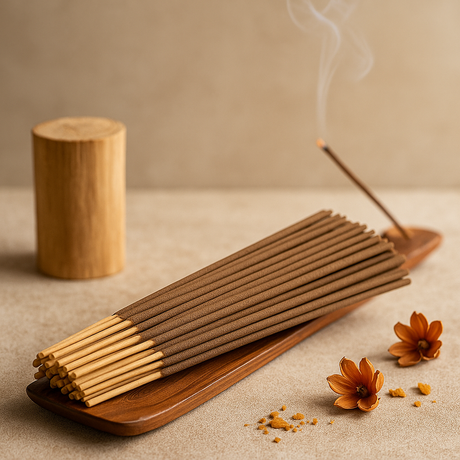
Every morning, and often again at midday and dusk, small palm-leaf trays appear on doorsteps, shop fronts, road junctions, and temple gates across the island. These are canang sari: a woven tray (canang) filled with flowers laid out, in one widely used arrangement, by colour and direction (white to the east, red to the south, yellow to the west, blue or green to the north), topped with a stick of incense and sometimes a small portion of food. They are placed, a brief prayer is offered, and the day continues.
The scale is difficult to hold in mind. Estimates suggest millions of offerings are made daily across Bali. Each one is prepared by hand, and much of that preparation falls to women. Ethnographic research, including work by anthropologist Linda Connor and sociologist Graeme MacRae, consistently records that during high-ceremony periods, the preparation of banten (the broader category of ritual offerings, of which canang sari is the simplest daily form) can occupy two to four hours of a woman's day. This is not a charming morning habit. It is skilled, sustained labour, carried out alongside everything else.
Tourism has introduced a tension worth naming honestly. Pre-made canang sari are now sold in markets across the island, and many households buy them rather than weave and arrange their own. Convenience and devotion pull in different directions, and Balinese communities hold varying views on where the line sits. The offering is not only the object; it is also the act of making. When that act is outsourced, something in the intention shifts, though what exactly is lost, and whether it matters, is a question each family answers for itself.
The 210-Day Calendar
One reason Bali feels ceremonially dense to visitors is structural. The Balinese Pawukon calendar runs 210 days — thirty 7-day weeks (210 days) — cycling continuously without the intercalation that keeps the Gregorian calendar aligned to the solar year. It runs concurrently with the Saka lunar calendar, and the intersection of multiple week-cycles (three-day, five-day, seven-day weeks all running simultaneously) produces a complex grid of auspicious and inauspicious days that recurs every 210 days.
Galungan, the festival celebrating the victory of dharma over adharma, falls every 210 days. Kuningan follows ten days later. Neither has a fixed Gregorian date; both move through the Western calendar year by year. Between these poles, the Pawukon cycle generates a near-constant rhythm of smaller observances, each tied to a specific day-combination. An "auspicious day" in Bali is not a vague feeling. It is a calculated intersection, consulted before planting, building, marrying, or beginning anything of consequence.
This is why the island never quite settles into ordinary time. The calendar does not allow it.
Water as Shared Obligation

In the rice terraces of Jatiluwih in Tabanan regency, part of the UNESCO-listed landscape, the water does not simply flow downhill. It is managed. The subak is a traditional Balinese cooperative system for irrigating rice paddies, organised around a network of water temples (pura subak). Independent farming families coordinate their planting schedules not through a central authority but through ritual consensus at these temples. The system is, in practice, a living application of Tri Hita Karana: the water is shared, the timing is agreed communally, and the temples that govern the process are understood as sacred, not merely administrative.
The UNESCO inscription in 2012 specifically cited the subak as a demonstration of this philosophy in working agricultural practice. Documented for over a millennium, with roots scholars trace further still, what makes it remarkable is not its antiquity alone but its continued function. The terraces at Jatiluwih are not a museum exhibit. Families still plant by the water-temple calendar. That said, tourism development has placed documented pressure on subak land in several areas, and researchers have noted the encroachment of villa and resort construction on irrigated fields as a genuine tension the system now navigates.
Pura Tirta Empul, near Tampaksiring, is a water temple fed by a natural spring, used for ritual purification (melukat). A copper-plate inscription (prasasti) dates the site to 962 CE, attributed to the Warmadewa dynasty, though the current structure has been rebuilt and extended many times since. The spring itself is the constant.
What Travels Home
The Balinese concept of taksu describes a quality of spiritual presence or vitality believed to inhabit places, people, and objects when properly tended. It is not guaranteed by location or lineage. It must be maintained through repeated, attentive acts. Stop the practice, and the quality fades.
This is perhaps the most transferable idea Bali offers: not a mood, not an aesthetic, but a discipline. Small acts, repeated. Attention given before the day accelerates. A moment of reorientation, toward what you value, toward the people around you, toward the ground beneath your feet, practised not once on a retreat but daily, in ordinary circumstances, without ceremony making it easy.
The island's beauty is the accumulated result of millions of people doing this work, every day, because they understand it as their part of a larger balance. You do not need to be Balinese, or Hindu, or on a volcanic island, to recognise that logic and find something in it worth carrying.
Taksu does not accumulate in a single visit or a single gesture. It accrues through repetition, through the ten-thousandth offering made with the same attention as the first. That is what the island demonstrates, quietly, every morning before the tourists are awake.