Some patterns in a life feel too consistent to be chance. The kind word that comes back round when you least expect it. The short temper that keeps landing you in the same argument. It is tempting to call this karma and leave it there, as if an invisible ledger were keeping score on your behalf. We would like to offer a gentler, more useful reading — one where the responsibility, and the freedom, stay with you.
Karma is one of the oldest ideas in human thought, and one of the most misread. Treated as a cosmic scoreboard, it becomes a way to explain away misfortune or wait for the universe to settle the bill. Held more honestly, it is something better: a framework for paying attention to your own intentions and actions, and for noticing how they shape the person you are becoming. Not a law that decides your fate — a mirror that helps you choose your next step.
This is a piece about that quieter version. We will look at what karma has meant across the traditions that carry it, what the idea asks of us in ordinary days, and a few simple, unhurried practices that go with it. No promises, no proof of an unseen force — just an idea worth sitting with, and a way to make it your own.
What karma actually means
The Sanskrit word karma (कर्म) means, very simply, action. Long before it became shorthand for fate, it pointed to something close to home: that what we do, say and intend carries consequences, and those consequences ripple forward into who we become.
An idea carried by many traditions
The concept took shape in ancient India and runs through several living traditions — Hinduism, Buddhism, Jainism and Sikhism among them. Each holds it a little differently. Buddhist teachers often describe karma less as cosmic justice and more as a psychological process: what we repeatedly do shapes the mind we then have to live inside. Many Hindu traditions read it as a natural unfolding of cause and consequence rather than a reward handed down from above.
Georgetown’s Berkley Center describes karma in the Hindu tradition as the view that good thoughts and deeds may lead to beneficial effects, and harmful ones to harm — a definition, offered here as cultural and philosophical context, not a verdict on how the universe runs. We share these traditions with respect and curiosity, never as a single truth to be adopted. If the idea is useful to you, that is enough.
If you are drawn to the contemplative side of these traditions, prayer beads across cultures are one of the oldest tools for carrying an intention through the day — a thread that turns up in many of the same lineages.
Cause and consequence, not cosmic accounting
It helps to strip the idea back to its plainest form. We act; our actions land; something follows. Some of what follows is obvious and immediate — speak harshly and the room cools. Some of it is slower and harder to trace — a habit of generosity that, over years, quietly shapes the people who gather around you.
You will sometimes hear karma described in the language of energy and frequencies, as though it were a measurable force passing between bodies. We would rather keep that language plainly metaphorical: the mood you put into a day tends to colour it. That is a familiar, human observation, not physics. The honest version of karma needs no invisible machinery to be worth living by.
A learning frame, held consciously
Read this way, karma becomes less a sentence passed on you and more a way of learning. Your past choices set part of the scene you wake up to. What you do next, though, is open. Buddhist thought is clear on this: the past conditions the present, but it does not author the future. That authorship is yours.
This is the line we care about most. Karma is easy to misuse as a way of offloading responsibility — “this was meant to be”, “the universe will sort it out”. Held consciously, it does the opposite. It keeps returning the pen to your hand.
Living with the idea
An idea earns its keep in ordinary days, not grand theories. Here is where a karmic outlook tends to show up, gently, if you let it.
In our relationships
Some connections seem to teach us something. A friendship that keeps circling the same tender subject; a relationship that surfaces a fear you would rather not look at. People often reach for the word “karmic” to describe a bond that feels unusually charged, full of pull and lesson.
We would gently steer away from the language of destiny here — the sense that two people were fated to collide. It is kinder, and truer, to say that close relationships act as mirrors. They show us the parts of ourselves we have not yet met. What we do with that reflection is a choice, repeated daily, and it is where any growth actually happens.
If a relationship matters to you, a small shared token can be a quiet way to mark the intention you bring to it — something as simple as a thoughtful spiritual gift that says, in its own way, I am paying attention to this.
In our work and dealings
The idea also has a plain, practical face at work. Keep your word, give credit, do the unglamorous task properly when no one is watching — and, over time, you tend to become someone others want to work with. There is nothing mystical in that. It is simply what a steady stream of small, considered choices builds.
Many people find the idea of karma a useful prompt here: a quiet reminder, before a reactive email or a sharp word, that today’s action becomes tomorrow’s pattern. The reminder does the work, not a cosmic referee.
A note on wellbeing
We want to be careful and honest here, because this is exactly where the idea is most often oversold. Karma does not heal the body, and no serious research suggests it does — anyone telling you otherwise is overreaching, and we will not.
What is fairer to say is gentler and well within reach: people who lean towards kindness and honesty tend to report feeling a little more settled in themselves. That is a point about the quiet satisfaction of living in line with your own values — not a claim about illness, and certainly not a cure. If a karmic outlook supports your sense of wellbeing, it does so through attention and intention, the same way a steadying routine does.
What the idea asks of us
It is worth being clear about what an honest reading of karma does and does not claim, because the gap between the two is where most of the trouble lives.
Belief is not proof
Karma as a cosmic force has never been measured in a laboratory, and any article promising you that science has “proven” it is selling certainty it does not have. What researchers have looked at is more modest and rather more interesting: how holding a karmic outlook tends to shape how people behave.
A 2019 YouGov survey, for instance, found that around a third of people asked said they believed strongly in karma. That is a finding about belief, not about an unseen law — and the two should never be quietly swapped for one another. The honest takeaway is small but real: many people find the idea of karma a useful prompt to act well, and that prompt can nudge behaviour in kinder, more far-sighted directions.
Stories that move us
You will have read stories told as proof of karma — the honest stranger rewarded, the good turn returned years later. They are worth keeping, but for what they really are: stories about human kindness, and how it tends to call out kindness in others.
One often-told example is the man in the United States who, some years ago, returned a lost ring worth about three thousand pounds to its owner. Moved by his honesty, the owner set up a fundraiser, and strangers gave over a hundred and forty thousand pounds towards helping him rebuild his life. It is a genuinely lovely story — but the money came from people choosing to respond, not from a cosmic ledger settling up. That distinction matters. The mechanism here is us, at our better moments, and that is more hopeful than fate, not less.
Agency, not fate
So the idea asks something specific of us. It asks us to notice the link between intention and action, and to lean towards the kinder choice a little more often than we did yesterday. It does not ask us to wait for the universe to balance the books. Read as fate, karma quietly takes the pen out of your hand. Read as a tool, it puts it back.
Noticing your own patterns
The most useful place to bring this idea is inward — to the loops we run without quite seeing them.
The reactions that repeat
There is no measurable karmic clock, no cycle that turns on a schedule. What there is, in every life, is repetition — the reaction we reach for on autopilot, the dynamic that keeps reappearing in different clothes. Recognising one of these is the whole of the work, and the start of any change.
You might notice a pattern as:
- A strong, familiar pull towards certain people or situations.
- A challenge that seems to arrive again and again.
- A relationship dynamic that keeps replaying.
- An intense reaction that feels larger than the moment deserves.
None of this is fated. It is simply learned — and what is learned can, slowly, be unlearned.
Tools for paying attention
A few unhurried practices help widen the gap between feeling something and acting on it. We offer them as invitation, not prescription — take what is useful, leave the rest.
One is the old idea of karma yoga — selfless action, the work in front of you done with care and without grasping at the reward. You need no mat for it. Cooking a meal for someone, helping a neighbour, finishing a task properly: the tradition treats this kind of unattached service as its own quiet discipline.
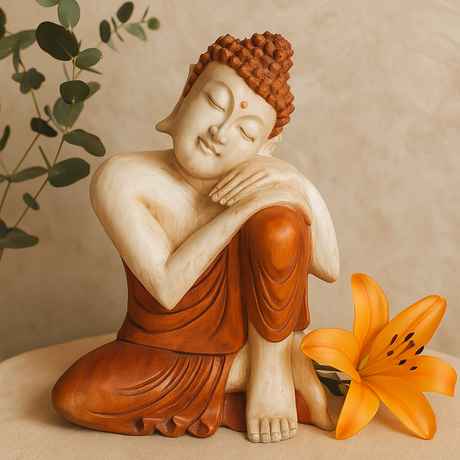
Another is meditation. A few minutes of stillness builds the self-awareness that lets you catch a pattern mid-flight rather than after the fact. Some people anchor the practice with a set of japa mala beads, moving bead by bead through a breath or a single intention; others simply sit. If you are starting out, a quiet meditation practice can give the early days a little structure. A Buddha statue for a quiet corner can serve as a plain visual cue — a reminder to come back and practise, nothing more.
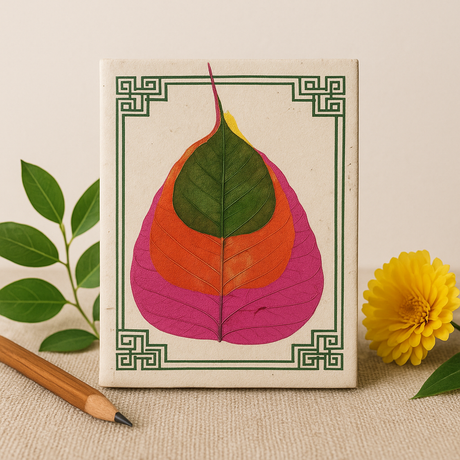
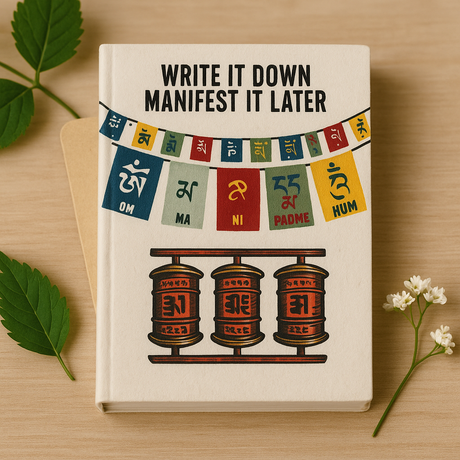
Forgiveness is a third — for others, and just as often for yourself. Held as a practice rather than a single grand gesture, it loosens the grip of an old reaction over time. So does honest self-reflection. A handmade journal gives you somewhere to track the situations that keep returning and the intentions you want to bring to them; over weeks, the patterns become legible.
What change looks like
Real change here is slow and undramatic — that is the honest version. You will not wake transformed. You will, more likely, notice one day that a remark that used to provoke you simply passed; that a conversation you would once have lost went differently. Better emotional balance, clearer decisions, a little more harmony where there used to be friction. These are quiet markers, and they come from consistency rather than intensity. Showing up to the practice, on the ordinary days, is what does it.
Small, honest practices to live by
If you would like to make this concrete, here are gentle, non-prescriptive ways to put a karmic outlook into daily life. None of them is magic. Each is simply attention, turned into a small habit.
- Practise everyday generosity — giving without keeping score.
- Cultivate genuine gratitude, noticing what is already good.
- Make room for regular stillness and a little self-reflection.
- Keep your relationships honest and your word reliable.
- Contribute something, however small, to the people around you.
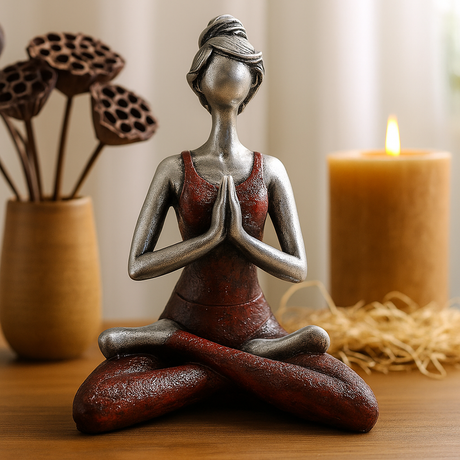
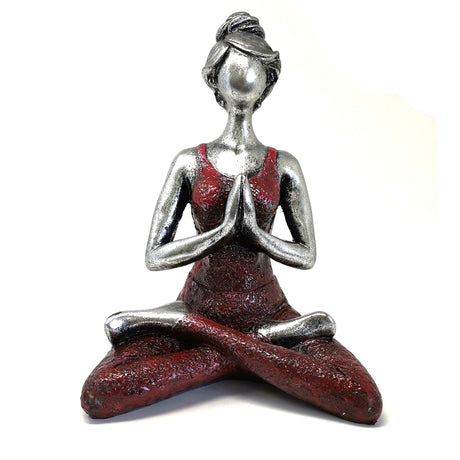
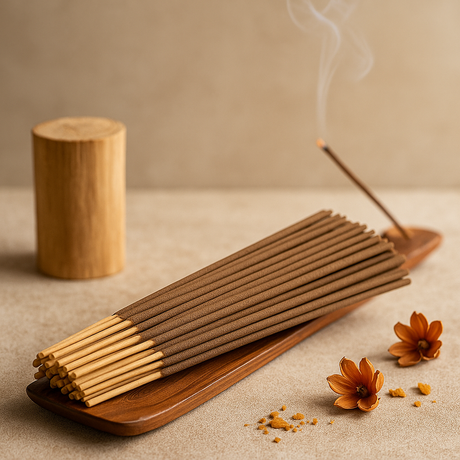
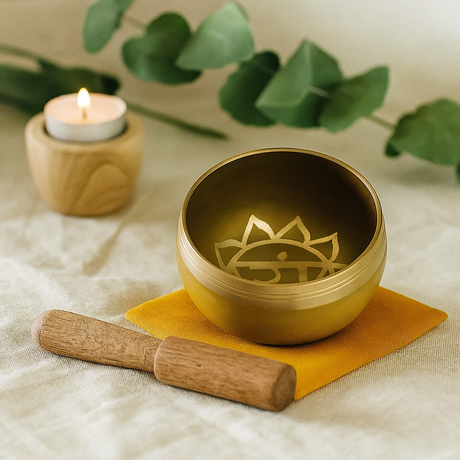
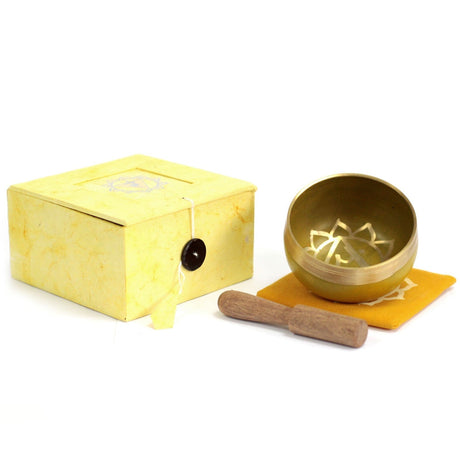
Many people find a simple sensory ritual helps these intentions stick. Lighting a stick of incense to mark the moment before a few minutes of reflection turns a vague resolution into a real, repeatable cue. The gentle ring of a Tibetan singing bowl — or other sound healing instruments — can mark a clear beginning and end to a sit. For some, a slow tea ritual in the morning is reflection enough; for others, a yoga figure for the shelf is a small daily nod to the idea of action done with care. The object holds the note. You do the practice.
A closing thought
So: is karma real, proven, a law of the universe? We would not claim that, and we would be wary of anyone who does. What we can say with a clear conscience is gentler and, we think, more useful. Karma is one of the oldest ways humans have found to take their own actions seriously — to notice that intention shapes consequence, and that the next choice is always, quietly, ours.
Held that way, it asks nothing supernatural of you. It asks only attention: to your patterns, your intentions, the small turns of an ordinary day. The traditions that carry the idea offer it as a mirror, not a fortune. Look into it now and then, choose your next step a little more consciously, and let the rest be. That is the whole of it — and it is plenty.
Questions about karma
Is karma really ‘proven by science’?
No — and it is worth being honest about that. There is no laboratory proof of karma as a cosmic force, and any article promising one is overreaching. What researchers have looked at is gentler and more interesting: people who hold a karmic outlook tend to act a little more honestly, think further ahead, and report feeling more settled in themselves. That is a finding about how a belief shapes behaviour, not a measurement of an invisible law. Read karma as a framework for living with intention, not a verdict handed down by a study.
What does karma actually mean in Hinduism and Buddhism?
The Sanskrit word karma simply means ‘action’. In the Hindu and Buddhist traditions it points to the idea that our actions, words and intentions carry consequences that ripple forward into who we become. Buddhist teachers often describe it less as cosmic punishment and more as a psychological process — what we repeatedly do shapes the mind we live inside. We share this as cultural and philosophical context, not as a religious truth claim. The thread that matters for daily life is that responsibility stays with you: the past sets the scene, but your next response is yours to choose.
Does believing in karma mean my life is already decided?
Quite the opposite, when it is held consciously. Karma is easy to misuse as fatalism — ‘this was meant to happen’, ‘the universe will sort it out’ — and that quietly hands away your agency. A more grounded reading keeps you in the driving seat: your circumstances are partly the wake of past choices, but how you meet them now is open. Karma is best understood as a tool for self-awareness, never a prediction. It asks you to pay attention to your patterns, not to wait for fate.
How can I bring a karmic outlook into ordinary days?
Start small and concrete. Notice the gap between an impulse and an action, and choose the kinder one more often than not. Keep your word when it would be easier not to. Give without keeping score. Many people anchor this with a simple practice — a few minutes of stillness in the morning, a line in a journal at night, beads run through the fingers while repeating an intention. The object holds the note; you do the practice. None of it is magic. It is attention, made into a habit.
What is karma yoga, and do I need to be a yogi to practise it?
Karma yoga is the path of selfless action — doing the work in front of you with care, without grasping at the reward. You do not need a mat or a single posture for it. It can be as plain as cooking a meal for someone, helping a neighbour, or finishing a task properly when no one is watching. The tradition treats this kind of unattached service as its own quiet discipline. If you would like a thread back to it, the eight limbs of yoga set this within a wider practice of living attentively.
Can I change a pattern I keep repeating?
Yes — patterns are precisely the part within reach. The first move is recognition: noticing the relationship dynamic, the reaction, the choice you make on autopilot. From there, small interventions help — a pause before reacting, a forgiveness practice (for yourself as much as others), a few minutes of meditation to widen the gap between feeling and doing. Change here is slow and undramatic, and that is the honest version. Consistency, not intensity, is what shifts a habit over time.