Janmashtami does not begin with a date on a calendar. It begins with the sky, a specific convergence of lunar day and star that traditional pandits calculate each year, and that sometimes splits the festival across two consecutive nights. Understanding why is the first step toward understanding what the vigil is actually for.
A Birth Fixed by the Sky
The word Janmashtami joins janma (birth) and ashtami (the eighth day of the lunar fortnight). But the eighth day of which fortnight, and measured how? Traditional reckoning requires two conditions to coincide: the eighth day of the dark, waning half of the lunar month, the fortnight when the moon moves from full toward new, must overlap with Rohini, the fourth of the twenty-seven lunar constellations in the Hindu sky-map, and ideally that overlap must fall at midnight, the hour the tradition considers the birth moment.
Rohini is associated with the moon, and it is recorded in the Bhagavata Purana, the ancient Sanskrit text that tells Krishna's story at greatest length, as Krishna's birth star. When the eighth lunar day and Rohini fall cleanly on the same night, the calculation is settled. When they straddle two calendar dates, different communities observe the festival on different nights. This is why certain Vaishnava institutions and more broadly Hindu households have historically celebrated Janmashtami a day apart, and why, across India, the question "which night?" is answered differently depending on the lineage. Neither is wrong; they are reading the same sky by different rules of precedence.
This astronomical precision is not pedantry. It is a statement about what the tradition considers real: not a commemorative date but a living recurrence, the same configuration of time and sky that, according to the Bhagavata Purana, attended the birth itself.
The Prison Cell, the River, the Child
The birth narrative, told in the tenth book of the Bhagavata Purana, is spare and strange in the way the best mythological accounts are. Devaki and Vasudeva are imprisoned in Mathura by King Kamsa, Devaki's own cousin, who has been warned by a prophecy that her eighth child will be his end. Six children have already been killed. The seventh escapes by miraculous transfer. On the night of the eighth birth, the prison falls silent: the guards sleep, the chains fall away, the doors open.
Vasudeva carries the newborn across the Yamuna, which is said to have risen in flood and then parted to let him pass. He reaches Gokul, exchanges the child with the infant daughter of Yashoda, and returns before dawn. Kamsa, arriving to destroy the eighth child, finds a girl, who slips from his hands and rises into the sky. The child he sought is already safe across the river, in a cowherd's home, under a different name.
Mathura, in present-day Uttar Pradesh, marks the site of that prison cell. Vrindavan, some fifteen kilometres away, is where the child grew up. Both cities draw hundreds of thousands of pilgrims each Janmashtami, not to witness a re-enactment, but to be present at a place where, in the devotional understanding, the event is not entirely past. The geography is the argument: these are not symbolic locations but specific ones, and the tradition has always known the difference.
The Vigil

Staying awake until midnight is the central discipline of Janmashtami, and it is worth sitting with what that means before reaching for the obvious explanation. The night-long wakefulness is not simply waiting for a ceremony. It is the ceremony. Devotees keep the hours through communal singing, repetition of the divine name, and the reading of the Bhagavata Purana's tenth book. The fast, observed through the day, is broken only after the ritual bathing of the Krishna image at the moment the eighth lunar day and Rohini are deemed to coincide, an act performed with five traditional offerings: milk, curd, ghee, honey and sugar.
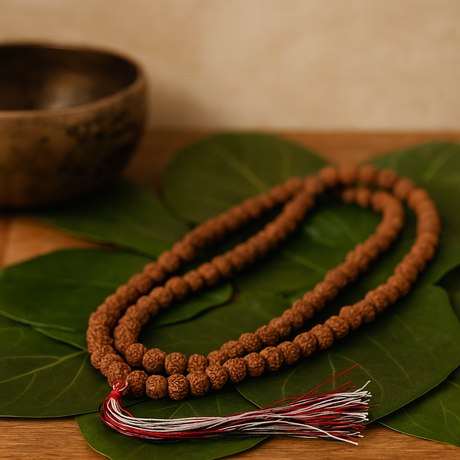
My own japa practice has taught me something about what a mala does in the dark hours: it gives the mind a structure when the body wants to drift. The beads are not a shortcut to wakefulness; they are a way of choosing, one count at a time, to remain present. That is precisely what the midnight ceremony asks of the person keeping vigil, not spectacle, but sustained attention across the hours that precede it.
One night of chosen wakefulness, held with intention, is a direct counter to the autopilot of ordinary sleep, not because sleep is wrong, but because this particular night asks something different. The tradition has always understood that what you do with your attention in the dark hours shapes what you carry into the day. The vigil is the act of choosing, repeatedly, not to drift, and the mala is simply the tool that makes that choosing countable.
Arjuna's Collapse and the Gita's Midnight
The Bhagavad Gita is set on the battlefield of Kurukshetra, not in a prison cell in Mathura. And yet the structural parallel between the two is precise enough to be worth naming.
Chapter 1 of the Gita, verses 28 through 47, describes Arjuna's crisis: he sees his kinsmen arrayed against him, his bow slips from his hands, and he refuses to fight. This is not cowardice in the ordinary sense. It is a collapse of the frameworks by which he has understood his life, duty, identity, the meaning of action. His bow falls. He sits down in his chariot. He cannot move.
This is the Gita's inciting darkness, and it mirrors the darkness before Krishna's birth with a structural logic that the tradition does not always make explicit. In Mathura, the night is at its deepest before the prison doors open. On Kurukshetra, the teaching cannot begin until Arjuna has reached the bottom of his paralysis. Krishna's first substantive response, in Chapter 2 verse 11, is direct: "You grieve for those who should not be grieved for." The dawn of the teaching follows the midnight of the crisis.
Janmashtami, read this way, is not only a birth anniversary. It is an annual reminder that the wisdom arrives after the darkness, not instead of it. The vigil enacts this: you sit with the dark hours, you hold the mala, you wait, and the ceremony at midnight, when it comes, is the arrival of something that the waiting made possible.
What the Night Leaves Behind
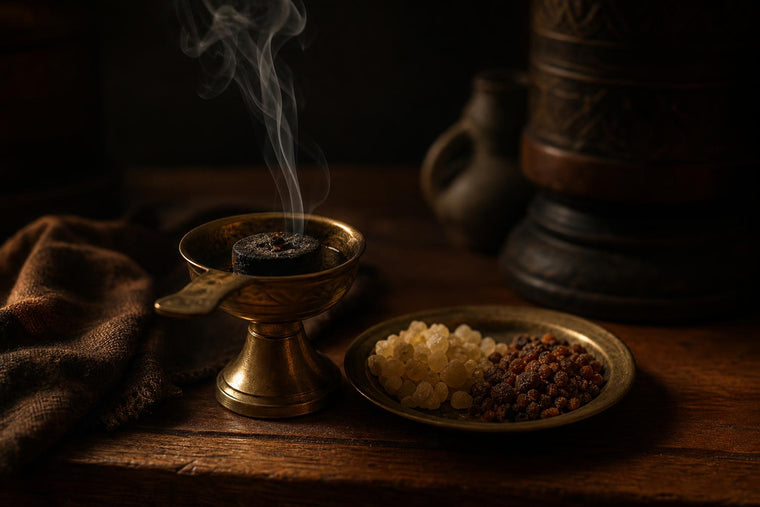
The tradition offers a clear answer to what a practitioner actually does: fast through the day, keep the evening through communal singing or quiet reading, hold a single lamp and the mala as a way to hold the hours, and be present at midnight. The form can be as elaborate as a full temple ceremony or as simple as a lamp, a mala, and the tenth book of the Bhagavata Purana open on a table.
The point is the choosing. Sleep is the default; wakefulness on this night is an act. The Gita's first instruction to Arjuna, once the teaching begins, is essentially the same: stand up. Not because standing is easy, but because the alternative, remaining collapsed in the chariot, is the one thing that forecloses everything else.
The vigil ends. The fast breaks. The day begins. And the question the night leaves behind is not theological but practical: what did you notice, in those hours, that you would otherwise have slept through?