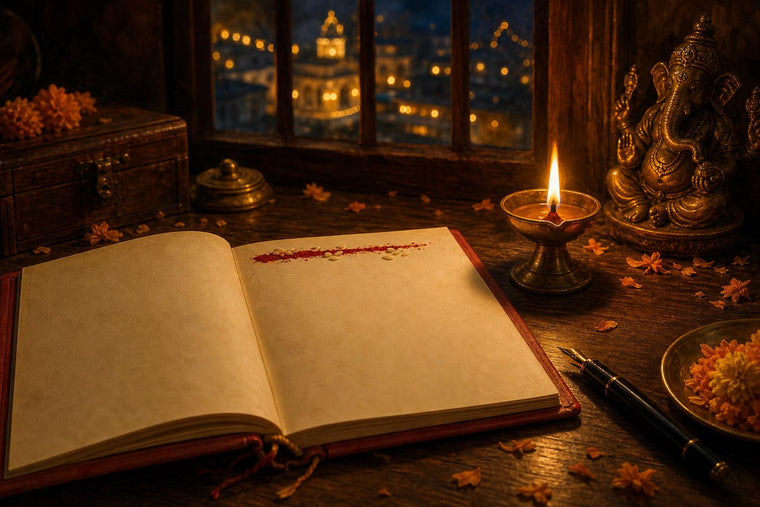
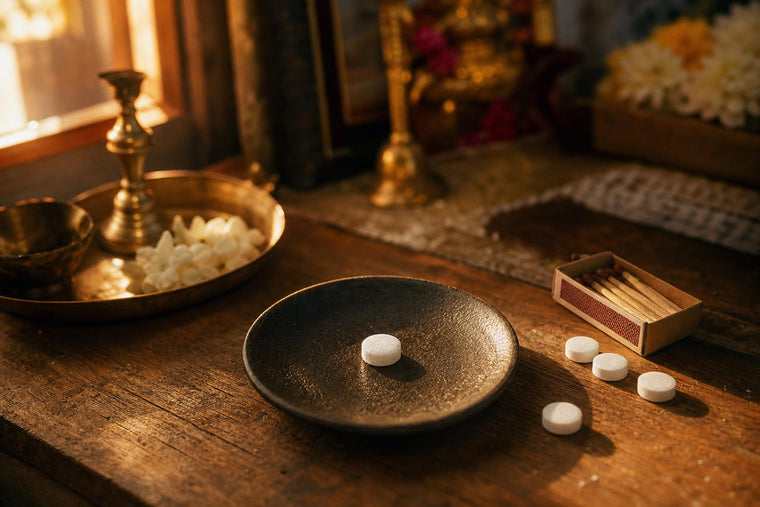
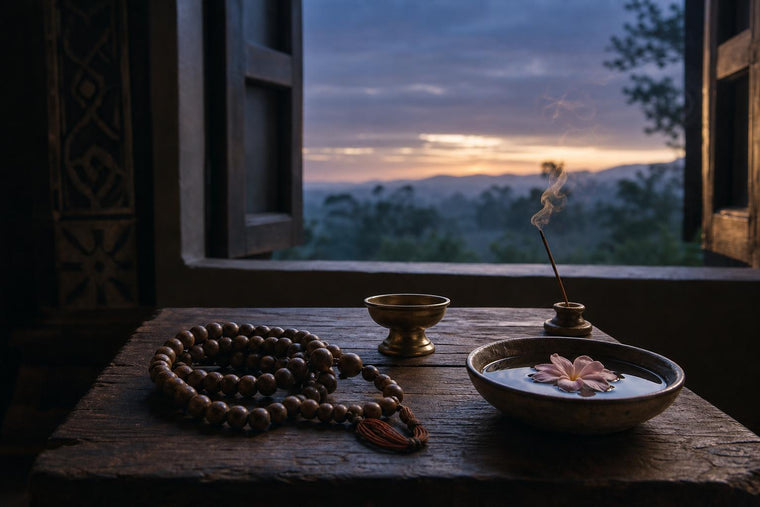
A small brass Durga, no taller than the palm of a hand, spends eleven months of the year wrapped in a cotton cloth at the back of a cupboard. Navaratri is the one time she comes out. Someone unwraps her, wipes the tarnish from her shoulders and the folds of her sari, sets her on the altar, and for nine nights she is looked at, lit, and spoken to. Then she goes back into the cloth until next year. The statue does not change. The cloth gets a little softer. The metal, if you look closely, is a shade darker than it was a decade ago.
Nine Nights, Two Calendars, Many Forms
Navaratri is Sanskrit for nine nights: nava, nine, and ratri, night. It is easy to assume there is a single Navaratri, the one that fills the autumn calendar with garba dancers and Durga Puja pandals. There are in fact two marked in the Hindu calendar: Vasanta Navaratri in the spring month of Chaitra, and Sharad Navaratri in autumn, in the month of Ashvin, usually September or October. The autumn observance is the one most widely kept across India and among the diaspora, and it is the one this piece follows.
The nine nights themselves are traditionally linked to Navadurga, nine forms of the goddess. One commonly cited sequence runs Shailaputri, Brahmacharini, Chandraghanta, Kushmanda, Skandamata, Katyayani, Kalaratri, Mahagauri and Siddhidatri, one form given to each night. Many households instead divide the nine nights into three sets of three, given in turn to Kali, Lakshmi and Saraswati: the goddess met first in her fierce aspect, then as abundance, then as knowledge. Both patterns are real and neither cancels the other. Regional practice across India, and the very different names the festival wears (Durga Puja in Bengal, Golu doll displays further south, Bathukamma in Telangana, Dashain across the border in Nepal), makes a single tidy rule impossible to write honestly.
The Nights as They Are Kept
Whichever pattern a household follows, the nine nights usually open the same way: Ghatasthapana on the first morning, when a kalash, a pot, is installed on the altar, often with a lamp kept burning beside it for the length of the festival, done before midday, not after. The lamp lit each evening beside that kalash is a small, repeated act, the kind that asks nothing dramatic of anyone, only that someone remembers to do it again tomorrow.
Later in the nine nights, on Ashtami or Navami, many households perform Kanya Puja, sometimes called Kanjak: nine young girls are invited, honoured as living representations of the Navadurga, and served a meal, often including items such as puri, chana and halwa. It is one of the festival's more tender customs, and it says something the statue on the altar cannot say by itself: that the goddess, in this tradition, is not only bronze or brass or clay. She is also, for one afternoon, nine children sitting down to eat.
Why Brass Doesn't Go Into the River
Here is the fact that most guides to the festival skip past. The murtis carried through the streets on Vijayadashami, the large clay figures built for public Durga Puja pandals, are made to be immersed in a river or tank on that tenth day. Visarjan, the immersion, is not an afterthought; it is understood as part of a clay murti's intended life, one festival, then a return to the water and the earth it came from. A brass Durga kept for worship at home is treated altogether differently. She is cleaned, not dissolved. She is put back into her cloth, not into the river. There is no visarjan for her, this year or any year, and that single difference changes what the object is. A clay murti is made for one Navaratri. A brass one is made, quietly, for all of them: this year's nine nights, and the ones a family has not yet reached.
Brass itself is an alloy of copper and zinc, chosen across Indian temple and household ritual for two related reasons: it survives handling for decades, and it takes a shine when someone bothers to polish it. Moradabad, in Uttar Pradesh, is one well-known centre of India's brass trade, recognised within the country for well over a century, and murtis very like this one are among the pieces commonly cast there. Many of these figures are made by casting, sometimes by the lost-wax method also known from South Indian bronze icon-making, where a wax model is built, coated, and burned away so molten metal can take its exact place. I think of this whenever a small brass or bronze piece goes onto an altar: someone, somewhere, once held this exact shape in wax before it existed in metal at all.
Vijayadashami and What Stays
The story behind all nine nights comes to its point on the tenth day, Vijayadashami, also known as Dussehra. Durga's battle with the buffalo demon Mahishasura, who had driven the gods from their own heaven, is said to end here, on her victory. It is the day the clay murtis go to the water. For the household with a brass Durga, it is an ordinary day: she is wiped down once more, wrapped again in her cloth, and put away, not because the festival means less to that household but because the object was never going to be given back to the river in the first place.
What stays odd, in a culture that rebuilds so much of its ritual imagery every year, is that one small object is simply allowed to age. She tarnishes a little further each year; someone polishes some of that away, and some of it stays. Whether incense is lit beside her on any of the nine nights is a matter of personal habit, not something the ritual itself requires. What the ritual does ask for is simpler: notice what another year has done to her, and to you, and let that be the measure of the season, rather than the calendar alone.