A slow-living note on stone, patience, and the towns that first taught us to smooth what nature left rough.
The Gulf and the Stone

On the eastern edge of the Arabian Sea, where the Gulf of Khambhat cuts into Gujarat, sits a port town that has spent centuries turning rock into something a hand wants to hold. Khambhat, once known to European traders as Cambay, no longer handles the sea traffic it once did; the gulf has silted, and the old harbour trade has largely moved elsewhere. What remains is the stone.
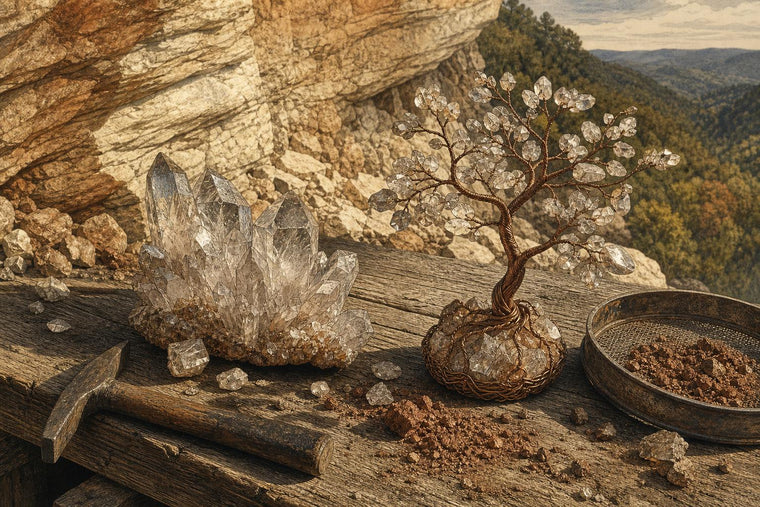
The material itself does not come from the town. Rough agate and carnelian are traditionally brought in from hills at some distance from Khambhat, then worked in the workshops closer to the coast. Agate is a banded form of chalcedony, itself a microcrystalline variety of quartz; carnelian is chalcedony's reddish-orange cousin, coloured by traces of iron oxide. Neither is rare in the geological sense. What is rare, and what has made Khambhat's name travel further than its harbour ever did, is what its people learned to do with it. Anyone who has weighed a piece of rough quartz in the hand, the kind sold whole and unpolished as Amethyst Raw Crystals 500g, will recognise the starting point: a stone with edges, waiting for someone patient enough to wear them down.
Hands That Learned to Shape It

An ethnoarchaeological study of the region places Khambhat as one of the largest known stone bead-working centres in the world, its craft a tradition researchers trace back several millennia, though contested. Some researchers push the origin further back still, pointing to finds at the nearby Harappan-era site of Lothal as evidence of an older lineage; the record here is genuinely debated, and the honest version is that Khambhat's stonework has a deep, if not perfectly continuous, ancestry rather than a single fixed founding date.
The tool most associated with the craft is the shingadi, a hammer headed with buffalo horn, used to chip and shape rough stone before it ever reaches a wheel. Finishing has traditionally happened on an emery wheel known locally as a kurund or samado, the abrasive surface doing slowly by friction what the shingadi did by force. The Irish geologist Valentine Ball, who served in India and later held the chair of mineralogy in Dublin, wrote a detailed account of the Khambhat agate trade in 1881; earlier travellers, in accounts attributed to Herodotus and to the Portuguese writer Duarte de Barbosa, had already noted the region's trade in agate and carnelian centuries before Ball ever set foot there. Muslim artisan families have long been closely associated with this work, local tradition tracing the community's settlement in the area to a sixteenth-century merchant remembered as Baba Ghor, though this is a remembered history rather than a single verified record. Much of the stone is also heat-treated, a step that intensifies agate's natural colour before it is cut and set.
The Cost of a Polished Stone
It would be tidy to end the story there, with old hammers and older trade routes. It would also be incomplete. Grinding agate on a wheel throws fine silica dust into the air, and occupational health research, including studies by India's National Institute of Occupational Health, has documented silicosis among Khambhat's agate workers, a lung disease caused by inhaling that dust over years of work. This is not a footnote to the craft; it is part of what the craft has cost the people who kept it alive.
In 2008, the Agates of Cambay received Geographical Indication status from the Government of India, formally recognising the region as the origin of this particular tradition. A GI tag protects a name and, in theory, the livelihoods attached to it, but it does not by itself solve a labour problem decades old, nor does it guarantee that recognition reaches the hands actually doing the grinding. Khambhat's stonework survives under real pressure: from cheaper machine-cut imitations, from the health cost of the traditional method, and from the ordinary difficulty of keeping a slow craft alive in a fast market. None of this cancels what the town has made. It simply means the polish on a piece of Cambay agate carries a labour history worth knowing, not only a shine worth admiring.
What Travels Home

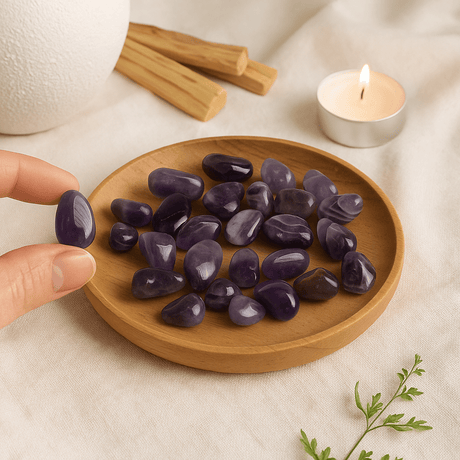
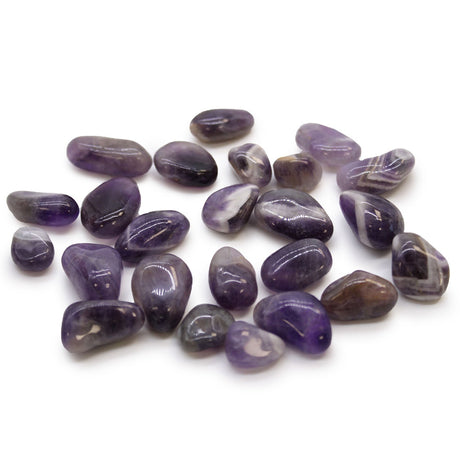
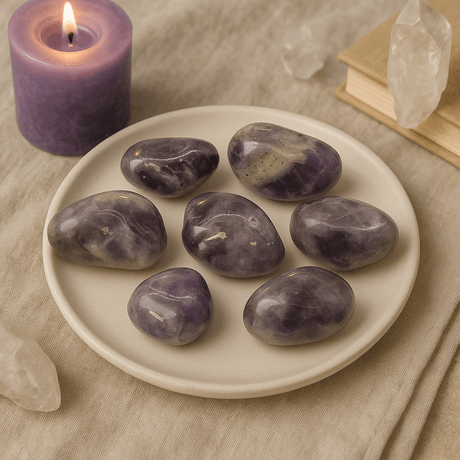
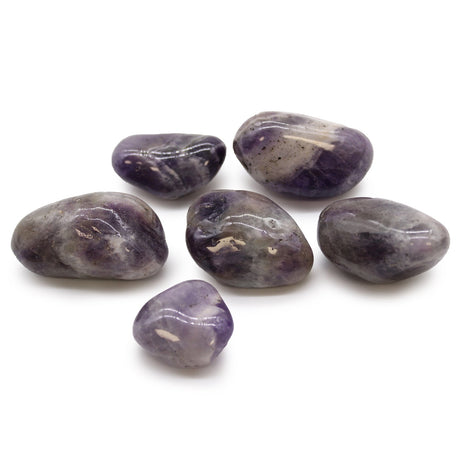
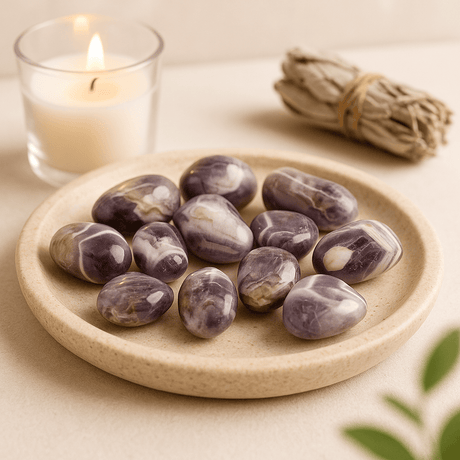
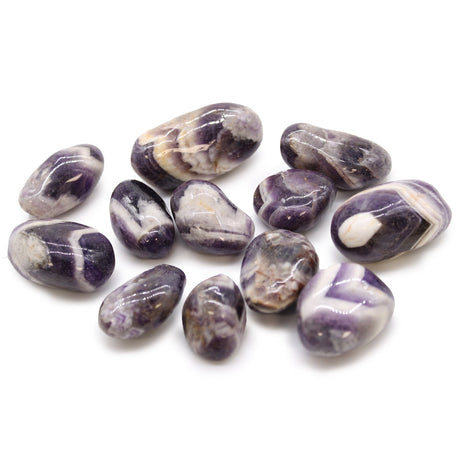
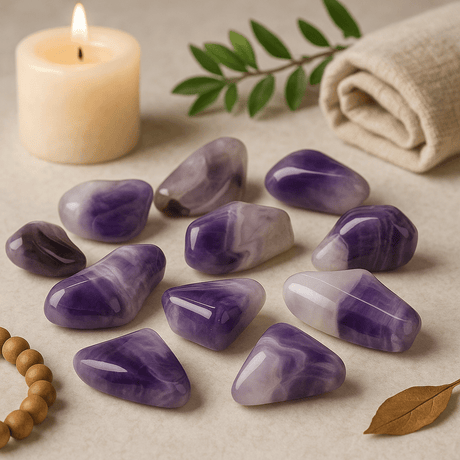
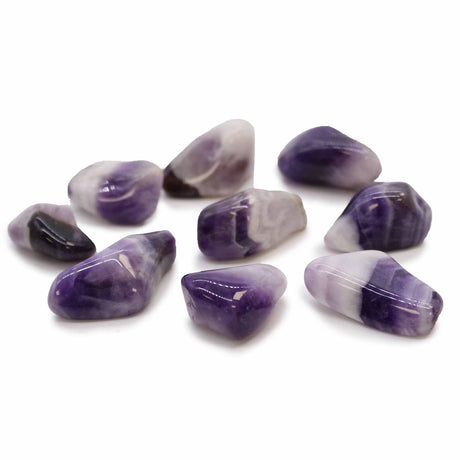
The impulse behind Khambhat's work is older than any single technique: take a stone with rough, unfriendly edges, and spend time until it becomes something pleasant to hold. A modern rock tumbler does the same thing by different means. Rough stone is rotated in a barrel with water and abrasive grit, moving through coarse, medium and fine grinding stages before a final polish, a process that commonly takes three to five weeks from start to finish. Chalcedony varieties such as agate, jasper and carnelian, and quartz varieties such as amethyst, citrine and rose quartz, are chosen for the process largely because they are hard enough to survive it without cracking or wearing away entirely.
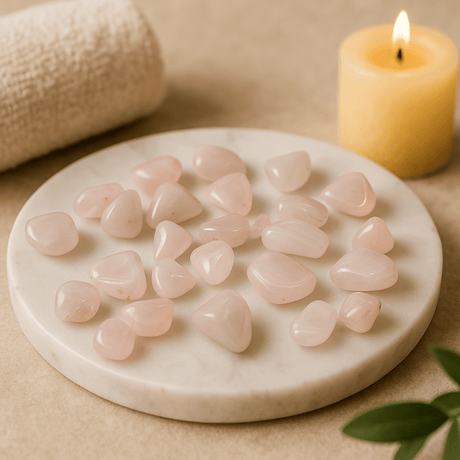
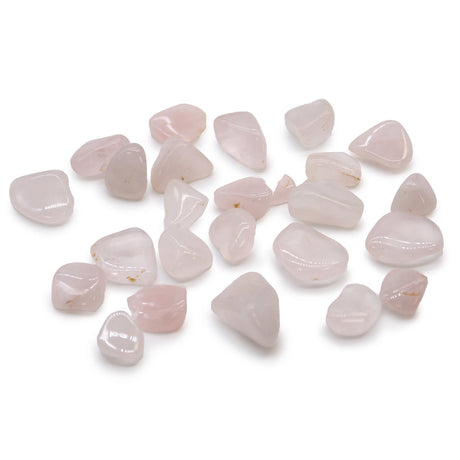
A hand-shaped Khambhat bead and a barrel-tumbled stone are not really different in kind. One is shaped by a shingadi and years of a craftsperson's judgement, the other by grit and rotation and time; both take something rough and give it back smooth enough to be carried. A set like Rose Quartz Tumbled Stones, 24 Pieces owes its finish to that same patient logic, even if the hands involved are mostly the machine's. My own practice runs on a mala rather than loose stones, but the principle sitting behind both is identical: something you can hold in one palm, worked on until it settles there without protest. For anyone who would rather not choose a single stone and instead let a handful arrive as they come, a Lucky Dip mix of tumbled stones keeps a little of that unpredictability, the same unpredictability that once decided which rough piece a Khambhat artisan picked up first.
Choosing, Not Collecting
A tumbled stone is a small, unglamorous object by most measures: no setting, no chain, nothing that asks to be looked at twice. Its whole value sits in the fact that someone, somewhere, spent real time reducing a rough edge to nothing. Whether that someone worked an emery wheel in Khambhat or ran a barrel of grit for three weeks in a shed, the stone in your pocket is evidence of patience applied to something that did not ask for it. Traditional associations, a colour said to answer to a particular chakra, a quality long reached for in carnelian or rose quartz, are worth carrying alongside the stone if they mean something to you; they were never the reason the polishing happened in the first place. The reason was simpler, and older: rough things can be made gentle, given enough hours and enough hands willing to give them.