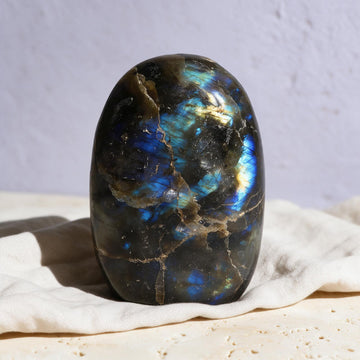
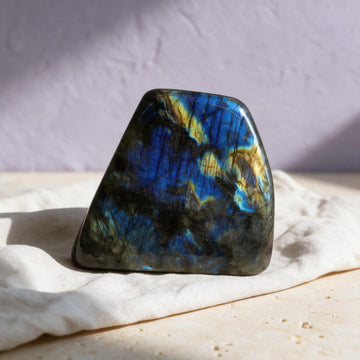
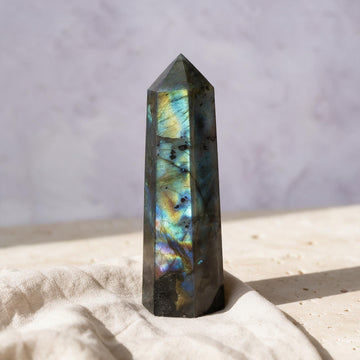
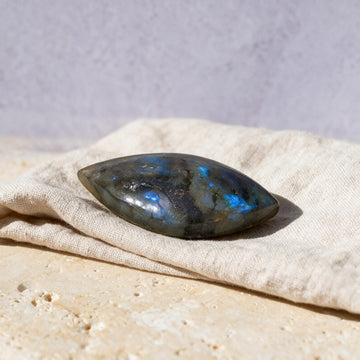
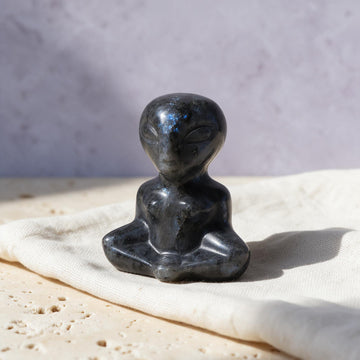
The best crystal for intuition is labradorite. If you want one stone that does this job well, that is the answer: a dark grey feldspar that looks ordinary until it catches the light, and then flares into blue, green or gold across its surface. That flash, called labradorescence, is produced by thin layers inside the stone's structure that scatter and reflect light as it turns in your hand. It is not a metaphor. It is optics, and it happens to look exactly like the thing people mean when they talk about inner sight switching on.
Labradorite is not the only answer, though, and which stone earns its place depends on what you actually need: something to meditate with, something to wear every day, something to give someone for under £25. Below is a short, honest list, each pick with a real reason it is there and a line on who it is wrong for. I keep a labradorite on my desk, and I'll say plainly where the others serve better.
 Intuition641 pieces
Open →
In this guide 6
What is the best crystal for intuition overall?
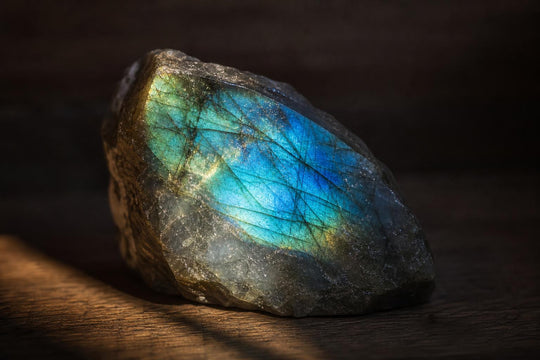
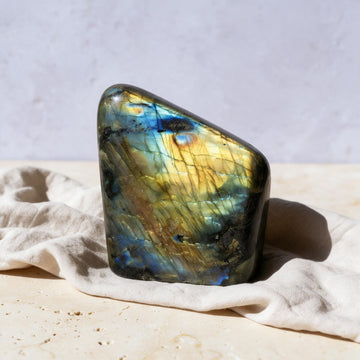
Labradorite. In crystal practice it is most often linked to the third eye, the point between the brows associated with inner vision and perception, and the stone's own behaviour makes that association easy to feel: still and grey in flat light, then suddenly alive the moment it turns toward a window or a candle. People describe it as a stone for acting on what they sense rather than simply feeling it, which is a slightly different job from the softer, more receptive stones further down this list. A piece like the Labradorite Stone Medium 250 To 300g Madagascar is heavy enough to sit on a desk or an altar shelf and be turned rather than carried, which suits its character: it rewards a slow look, not a quick glance in a pocket.
It is wrong for someone who wants a quiet, uniform-looking stone they can set down and forget. Labradorite is a performer. If movement and changeability feel distracting rather than useful to you, this is not your stone, and that is a fair thing to know before you buy it.

What is the best crystal for a beginner?
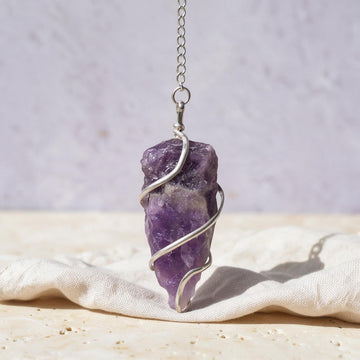
Amethyst. It is widely available, gentle in colour and handling, and has a long association in meditation practice as what older writing calls "the stone of spirituality": calm, inward, tied to the crown rather than the third eye, which for many beginners is the easier place to start. There is no flash to learn to read, no particular angle of light required. You simply hold it. A small Amethyst Crystal Tree works well on a shelf near where you sit each morning, somewhere your eye lands before the day gets busy.
It is wrong for someone who has already chosen labradorite's flash and movement as the thing they are actually drawn to. Amethyst will not give you that. It gives you steadiness instead, which is its own kind of use, but the two stones are answering slightly different questions, and swapping one in hoping for the other's effect will only disappoint you.
 Next: What Crystal Should You Sleep With?Crystals & Jewellery · 6 min read
What is the best crystal for daily wear?

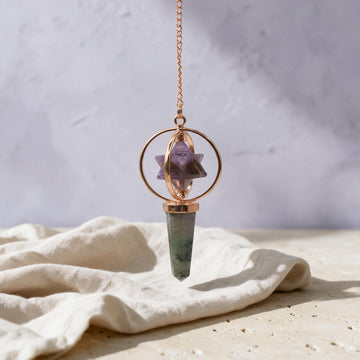
Moonstone. Its glow, called adularescence, comes from the same family of light-scattering behaviour as labradorite but reads very differently: soft, milky, close to the surface rather than a sudden flash across it. True moonstone is usually an orthoclase feldspar, while the rainbow moonstone often sold alongside it is technically a labradorite variety; both glow, but they do it in their own way, which is worth knowing if you are choosing between two stones that look similar on a shelf. The finest blue-sheen moonstone has long been associated with Sri Lanka, particularly a deposit at Meetiyagoda in the island's south, a place that gave the stone much of its reputation for that pale, moving light. In practice it carries associations with feminine energy, emotional openness and intuition, a quieter, more receptive counterpart to labradorite's instinct to act. A Rainbow Moonstone Crystal Dowsing Pendulum is small enough to wear or carry daily and suits that quieter use: something close to the body rather than set apart for ceremony.
It is wrong for someone after a large statement piece. Moonstone's best qualities show in a small, well-cut stone held close, not in size. If what you want is something substantial to anchor a room, look elsewhere on this list.

What is the best crystal for a small gift under £25?
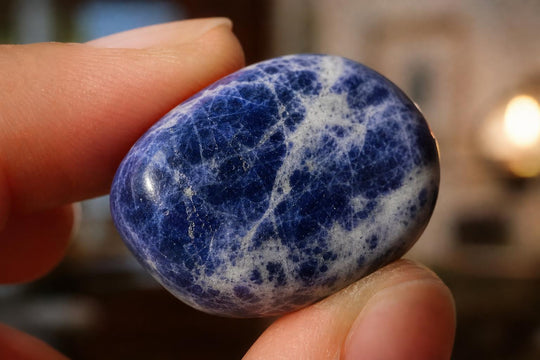
Sodalite. It is an affordable, deep blue stone usually sold tumbled, small enough to post in a card, and it carries its own long association with communication, focus and intuition, distinct from labradorite's flash or moonstone's glow but genuinely in the same family of intent. For a gift where budget matters more than ceremony, this is the sound, honest choice: a real stone with a real tradition behind it, at a price that does not ask the giver to make a statement they cannot afford.
It is wrong for someone expecting one of the "classic" named intuition stones as a centrepiece gift, the kind a person half-expects after a bit of reading: labradorite, moonstone, amethyst. Sodalite is a supporting player, not a headline act, and a gift that leans on it should be given as what it is: small, considered, blue.
How do you actually use these stones for intuition?
The stone does the least interesting part of the work. What matters is what you do while it is in your hand. I keep mine on the table where I sit for japa each morning, and the habit that has stuck with me is simple: hold the stone through the first few minutes of meditation, before the mind has settled, when attention is still loose and easy to lose. A moonstone pendulum or a sodalite tumble works the same way carried in a pocket through an ordinary day, something your thumb finds without you deciding to reach for it.
Cleansing is a matter of habit more than ritual: running water, a few minutes in sunlight, a wipe with a soft cloth when a stone has been handled a great deal. Rotating which one you carry, swapping labradorite for amethyst for a week, keeps the practice from going stale, which it can, like anything repeated without attention. For the fuller range beyond these five, there is a dedicated Intuition collection, and labradorite specifically has its own shelf in the labradorite range if that is the stone you have settled on.
Choosing one and living with it
None of this works as a substitute for paying attention. A stone does not tell you anything; it simply gives you a reason to sit still long enough to notice what you already half-know. That is the actual use of the whole category, labradorite included: not a shortcut to insight, but a small, physical cue that returns you to a moment of quiet often enough that noticing becomes a habit rather than an accident. Choose the one whose character suits the attention you are trying to build, wear it or keep it close, and let the rest be ordinary.




 Madagascar
 China
 India