
Gemstone
Lapis Lazuli
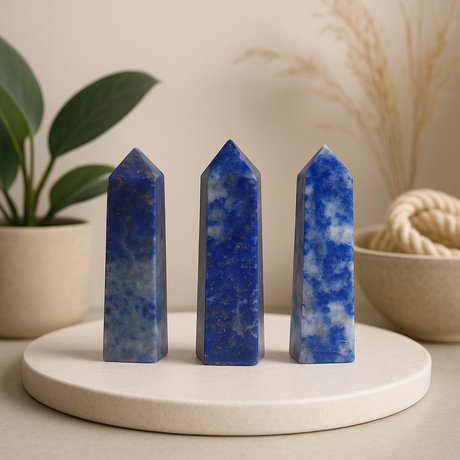
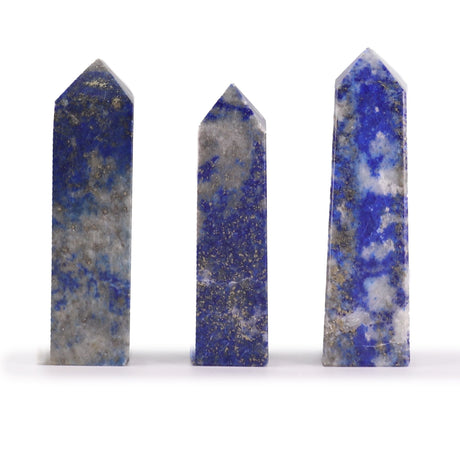
Deep royal blue threaded with gold pyrite — lapis lazuli has been prized since ancient Egypt, where it was carved into seals and ground as the costliest pigment in the world.
Royal blue, gold
Lapis lazuli is a metamorphic rock whose famous deep blue comes from lazurite, with gold flecks of pyrite scattered through it and occasional veins of white calcite. The name arrives from two sources: Latin lapis, stone, and Persian lazaward, blue. The finest material has come from a single valley in Afghanistan's Badakhshan province for six thousand years.
The history is long and specific. Ancient Egyptians carved it into seals, amulets and the famous death mask of Tutankhamun. Medieval Europe reserved it for the wealthiest patrons. Renaissance painters ground it into ultramarine — the most expensive pigment in the world, worth more than its weight in gold. The colour that looks almost black in poor light and luminous in sunlit water has been chasing painters and jewellers ever since.
The crystal tradition places lapis lazuli with the third eye and throat chakras, giving it a bridge between seeing and speaking. The zodiac associates it with Sagittarius and Libra; the elements with Air and Water. The intentions gathered around it — intuition, communication, focus, clarity — follow naturally from that position between sight and voice.
The tradition's quiet suggestion is to give the stone a role in a practice: hold it for a moment while you name a question or an intention in plain words, and let it keep the note. A stone on the desk is a physical bookmark for the wish to speak more carefully, or to listen before answering. It works the way a physical reminder always works — it doesn't do the work, but it keeps the work in view.
Below: our catalogue's lapis lazuli — tumbled stones, pendulums, jewellery and objects for the space between seeing and speaking.
Shop Lapis Lazuli
 £3.05 off
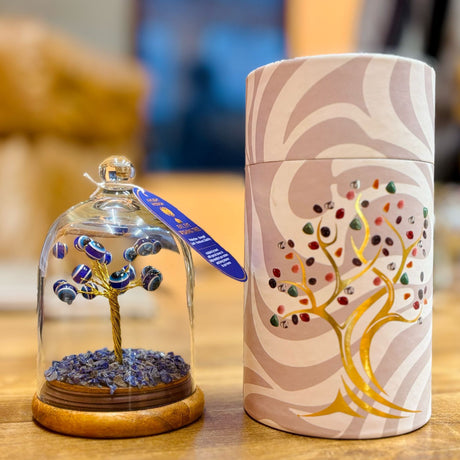
Lapis Lazuli Evil Eye Dome Beads 20-Bead Set
In stockSale price £2095 Regular price £2400Unit price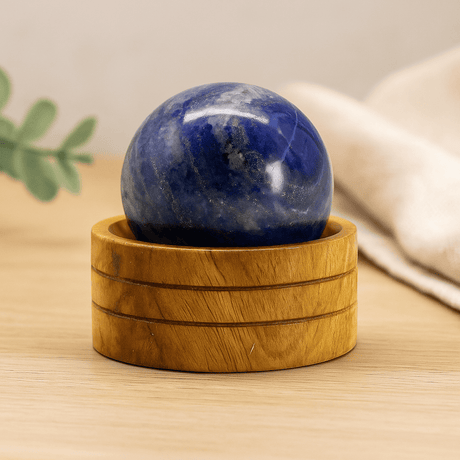
 £3.25 off
 £2.61 off



 £6.04 off


