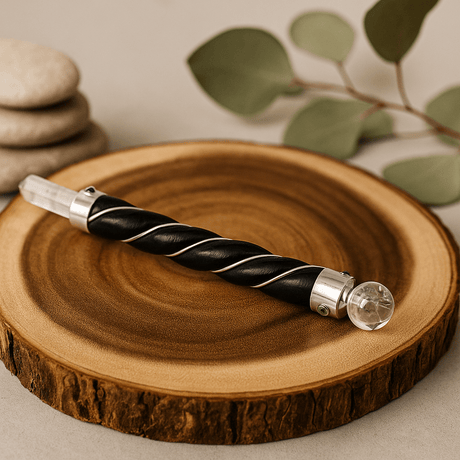
One object, chosen deliberately, held to. A letter on the oldest focus practice at the writing desk.
Roman natural philosophers believed clear quartz was water frozen permanently solid by extreme cold. They named it krystallos — ice — and the word has sat at the centre of every crystal conversation since. That is where this letter begins: not with wellness culture, but with two thousand years of human curiosity about a stone that catches light in ways that still reward attention.
A single stone on the desk can be a focus anchor. Not a collection. Not a rotation of seven, each assigned a property. One stone, placed where the eye finds it naturally, held to across weeks and months. The practice is older than wellness culture by several centuries, and it is worth understanding on its own terms.
Why one, not several
Scholars of the 16th-century humanist tradition understood something particular about objects at the writing surface. Their lapidaries — illustrated manuscripts cataloguing stones by physical and symbolic properties — were consulted alongside books, and there is good evidence that individual stones were kept close to hand as working objects rather than decorative ones. Whether a single stone served as a deliberate focus anchor in the way we might now frame it is harder to verify; what is clear is that the relationship between the scholar and the material world of the desk was an active, considered one. The practice was not mystical in the way we might now frame it. It was practical, in the way that all good humanist thinking was practical.
The Stoics called the discipline of returning attention prosoche — a continuous, deliberate coming back to the present moment. Marcus Aurelius practised it in writing, in the private journal we now call the Meditations. The Zen tradition holds a parallel idea in its aesthetics: the single stone in a dry garden, the empty bowl, the ensō circle. The point is not the object itself but the act of return it makes possible. One object, chosen and stayed with, trains something that seven objects, rotated, cannot.
Clear quartz, specifically

If you are going to choose one stone for a desk, clear quartz has a particular claim on the role — and not for the reasons most pages will give you.
Pliny the Elder recorded in Naturalis Historia (77 CE), Book 37, that Roman and Greek natural philosophers believed quartz was water frozen permanently solid by extreme cold, so hard it could never thaw. The belief was not superstition; it was the best natural philosophy available, and it persisted through the medieval period in European thought. The stone's name carries that history in every syllable.
What quartz actually does on a desk is real and observable. Clear quartz is optically transparent and exhibits double refraction: it splits a single ray of light into two. Place a clear quartz point where morning light crosses the surface and it will redistribute that light in ways that are genuinely worth watching. Not magic — physics. But physics that rewards attention, which is precisely what the desk requires.
In Sanatana Dharma, the same stone is known as sphatika (Sanskrit: स्फटिक) and is used in japa malas and as a material for Shivalinga. It is considered particularly suited to practice because it is held to be neutral: not amplifying a specific energy but reflecting the practitioner's own intention back. Whether or not that framing speaks to you, the underlying idea is consistent with what the humanists and the Stoics were reaching for — an object that does not impose itself, but waits for you to bring something to it. It is worth noting that associations vary across traditions: in some Tantric lineages, sphatika carries specific ritual meanings that go well beyond neutrality, and the stone's symbolic range is wider than any single account suggests.
Among the stones most consistently associated with clarity of thought across European, Indian and East Asian traditions, clear quartz appears with unusual frequency — in lapidaries, in contemplative practice manuals, in the material culture of scholars and monastics alike. That consistency is not proof of anything metaphysical, but it is a fact worth sitting with.
The practice, then, is not programming the stone or charging it under a full moon. It is simpler and more demanding than that. Place it where the eye finds it. When the mind drifts, let the stone be the thing you return to. The person returns. The stone waits.
What stays on the desk
I keep returning to this idea because it runs against the grain of how focus is usually sold to us. Focus, in most accounts, is something you achieve through the right system, the right app, the right sequence of habits. The humanist desk tradition suggests something quieter: that a single object, chosen deliberately and held to, can itself become a practice of attention — not because the object does the work, but because the act of choosing one thing and staying with it is already a form of discipline.
The desk anchor you choose matters less than the choosing. But if you want a place to start, a clear quartz point is an honest beginning: a stone with a long history in scholarly and contemplative traditions, a name that carries two thousand years of human curiosity about what it is, and an optical quality that gives the eye something genuinely worth finding.
Place it. Return to it. See what the practice asks of you over time.
With warmth,
Alex
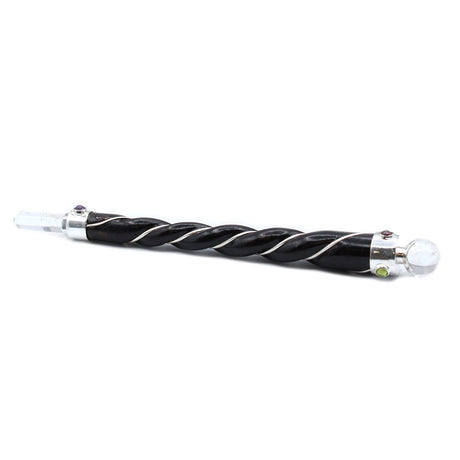
If you are looking for a clear quartz point to begin with, or something to anchor a wider working surface, the desk anchor at SHAMTAM is a quiet option worth considering.