The word is older than the practice that made it famous. It was already in use when the forests of the Upanishadic age were still the centre of Indian philosophical life, centuries before anyone had codified a single asana, centuries before Patanjali set down his sutras. To understand ahimsa is to follow it backward, past the yoga studio, past the wellness shelf, into the world where it first appeared.
In the forest of the Upanishads

The Chandogya Upanishad, composed somewhere around the eighth to sixth century BCE, contains one of the earliest recorded uses of the word. The passage (Chandogya Upanishad 3.17.4) is not addressed to a monk or a forest renunciant. It is addressed to a householder. Ahimsa appears in a list of ethical duties alongside tapas (austerity), arjava (straightforwardness), and dana (generosity). Non-harm, in its first datable appearance, is a domestic and social ethic: something you practise at the table, in speech, in the ordinary texture of a life lived among other people.
The word itself is a compound. The prefix a- negates; himsa means injury, harm, the desire to strike. The root is han, to kill. Ahimsa is therefore not a passive word. It names the active refusal of something that is always possible. The Rigveda does not contain it; its emergence in the Upanishadic literature marks a philosophical turn in the late Vedic period, away from sacrificial ritual and toward inward ethics. By the fourth century BCE, the grammarian Panini was treating himsa as an established root in the Ashtadhyayi, his foundational Sanskrit grammar. The concept was already in common philosophical use well before it became a technical term of any single tradition.
Mahavira's absolute

If the Upanishads gave ahimsa its first clear articulation, it was Jain philosophy that made it unconditional. Mahavira, the twenty-fourth Tirthankara of Jainism, elevated ahimsa to the supreme ethical principle (paramovdharma) and transformed what had been a relative guideline into an absolute vow. For Jain monks and nuns, the commitment extends to all living beings, including insects and micro-organisms. Monks of the Digambara and Shvetambara traditions carry a small broom to sweep the path before walking, to avoid harming small creatures. Some wear a mouth-cloth, the muhapatti, to prevent inadvertent harm to airborne organisms.
This is not symbolic gesture. It is a worked-out philosophical position: that harm is harm regardless of scale, and that the practitioner's intention does not cancel the injury caused. The radicalism of this position changed the wider Indian philosophical conversation. It forced every subsequent tradition that engaged with ethics, including the schools that would eventually produce the Yoga Sutras, to take a position on where the boundary of moral consideration lay.
Patanjali receives the word
When Patanjali compiled the Yoga Sutras (estimated by many scholars at around the fourth century CE), he placed ahimsa first among the five yamas, the ethical restraints that form the outermost layer of the eightfold path. The ordering is deliberate. The commentarial tradition, including Vyasa's Yogabhashya, reads the placement as foundational: without non-harm, no further practice rests on solid ground.
Sutra II.35 states it plainly: ahimsa-pratishthayam tat-vaira-tyagah — when non-harm is established, enmity is abandoned in the presence of that person. This is a relational claim, not merely a personal one. Ahimsa, in Patanjali's framing, does not only change the practitioner; it changes the field around them. The Bhagavad Gita lists ahimsa among the divine qualities in Chapter 16, placing it in a catalogue of virtues rather than as a technical term, which suggests how widely the concept had already travelled by the time the Gita took its final form.
It is worth noting what the Gita does not do: it does not resolve Arjuna's dilemma by simply invoking ahimsa. The text's meditation on dharmic action, on when duty may require what looks like harm, is precisely a recognition that the principle is not self-applying. Ahimsa, across its traditional contexts, has never been synonymous with simple pacifism.
One principle, three scales
Gandhi understood this. He drew explicitly on Jain and Vaishnava interpretations of ahimsa to develop satyagraha (truth-force) as a political method, and he was careful to distinguish it from passive non-resistance. Ahimsa, in his reading, required active courage; it was, in his words, the greatest force at the disposal of mankind. He credited part of his understanding to his correspondence with Raychandbhai, the Jain poet-philosopher Shrimad Rajchandra, whose letters shaped Gandhi's thinking during his years in South Africa.
Buddhist ethics approaches the same territory from a different angle. The first precept, the Pali training rule to abstain from taking life, is ahimsa in practice, and its positive counterpart is metta, loving-kindness: the active cultivation of goodwill toward all beings. Where Jainism emphasises the absolute vow and yoga emphasises the relational field, Buddhism tends to emphasise the quality of mind that makes harm unthinkable. Three traditions, one word, three genuinely different emphases; none of them reducible to a lifestyle tip.
How it lives at home

The commentarial literature, both Jain and yogic, describes ahimsa as operating at three levels: manasa (thought), vacha (speech), and kaya (body). This tripartite framework is useful precisely because it refuses to let the principle settle at the easiest level. It is straightforward to avoid physical harm. It is considerably harder to notice the small violences of speech: the impatient reply, the dismissive tone, the word chosen to win rather than to clarify. Harder still to attend to thought, to the habitual judgements that precede speech and action and that, left unexamined, shape both.
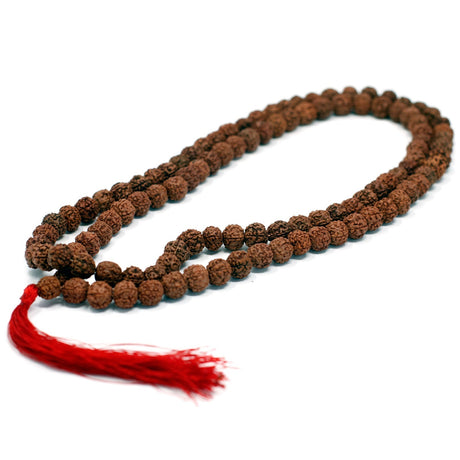
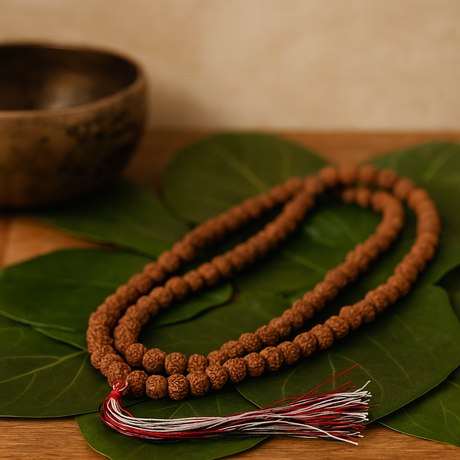
My own practice has taught me that ahimsa is less a rule than a direction of attention. I keep japa with a mala as part of a daily rhythm that includes puja and incense every day: not because these objects perform the work, but because they mark the moment when attention turns inward. The question ahimsa asks is not "did I cause harm today?" as a checklist item. It is closer to: where was I on autopilot? Where did I act from habit or irritation rather than from awareness? The practice is the noticing, repeated.
There is a mala sometimes called the Forgiveness Warrior, a name that captures something the tradition has always known: that non-harm directed outward begins with something much harder directed inward. The vow is not primarily about the world. It is about the quality of attention you bring to it.
The foundation before the practice
Patanjali placed ahimsa first for a reason that holds across traditions: every other ethical and contemplative practice is built on top of it. Concentration without non-harm becomes manipulation. Discipline without non-harm becomes rigidity. Even generosity, without the underlying orientation of ahimsa, can become a transaction.
What the Chandogya Upanishad understood, and what the Jain, yogic, Buddhist and Gandhian traditions each elaborated in their own way, is that non-harm is not a constraint on life. It is a quality of attention that makes a certain kind of life possible. The householder in the forest text was not being asked to become a monk. He was being asked to notice what he was doing, and to whom, and to choose accordingly.