A daily practice does not begin when you sit down. It begins the night before, when you place the object where it will be waiting for you.
The Mala on the Tray
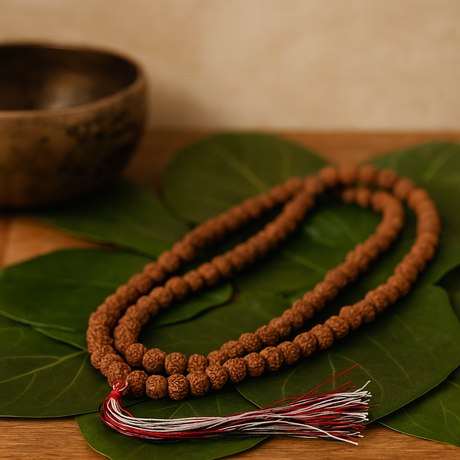
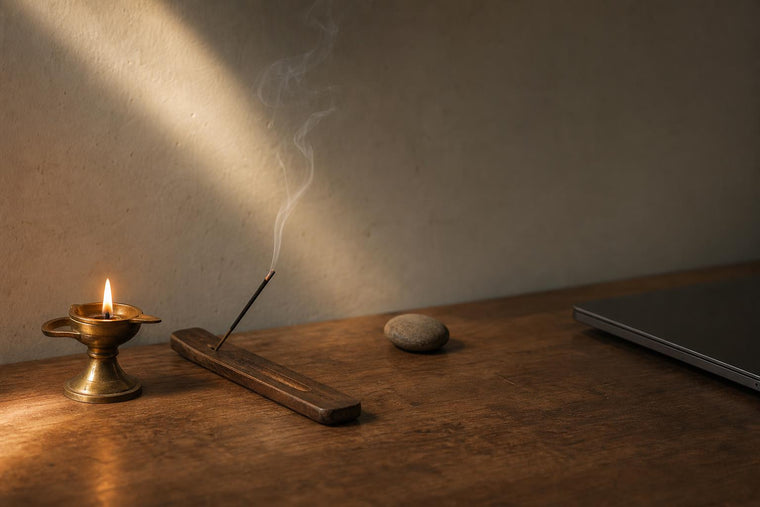
On a small wooden tray, beside an unlit stick of incense, rests a Rudraksha Japa Mala, 108 Beads on a cotton cord. The practice has not begun. That is precisely the point. The mala is already in position, which means the decision was made last night, not this morning when resistance is highest and the bed is warm and the mind has not yet found its footing.
This is the first and least-discussed architecture of a daily practice: the preparation that removes the moment of choice. You cannot negotiate with yourself at six in the morning. You can only meet what is already there. A fixed cue — a time, a place, an object — gradually reduces the effort of beginning. The decision cost drops. The groove, once cut, holds.
Benedict of Nursia, writing his Rule around 516 CE at Monte Cassino in Italy, structured the entire monastic day around seven fixed prayer times, spaced so that no more than a few hours passed without one. He was not building on inspiration or mood. He understood that the feeling of wanting to pray is not a reliable guide to when prayer is needed. Fixed times remove the question. The mala on the tray is the same logic at a smaller scale: the object is already there, so the question of whether to begin has already been answered.
The Oldest Word for It
Sanskrit has a word for daily personal observance: niyama — from ni- (inward, down) and yama (rein) — a rule turned inward, as distinct from the rules that govern how we move through the world with others. It appears in Patanjali's Yoga Sutras, compiled around 400 CE, as the second of eight steps on the path toward a settled mind. The first step is how you treat others; the second is how you tend yourself; the third is physical posture — what most people today simply call yoga. The postures that fill contemporary studios are the third step. The daily inner disciplines come first.
Patanjali lists five personal observances. The first is cleanliness — clearing what is unnecessary. The second is contentment — the practice of sufficiency. What is striking, and what most modern guides to daily routine entirely miss, is that Patanjali's architecture is not a morning-routine upgrade. It is a complete account of what a human life in practice looks like, and it places regularity at its foundation.
My own japa practice began not with a full understanding of this framework but with a simpler instinct: that doing the same thing at the same time, in the same place, with the same object, produced something that doing it differently never did. The Sutras gave that instinct a name and a lineage.
Why 108, and What the Practice Asks For

The japa mala has 108 beads, plus one — the guru bead, a larger or differently shaped bead that marks the beginning and end of a round. The practitioner does not cross it; at the end of a round, they reverse direction and begin again. It is a pause, not a finish line.
The number 108 is not arbitrary, and understanding why it is not changes the quality of holding the mala. Ancient Vedic astronomers calculated that the Sun's diameter is approximately 108 times Earth's diameter, and that the distance from Earth to the Sun is approximately 108 times the Sun's diameter. These ratios appear in classical Sanskrit astronomical texts, and the number recurs across Hindu, Buddhist and Jain traditions in bead counts, temple measurements and sacred lists. Modern measurements put the ratios closer to 109:1 and 107:1 — close enough that the ancient figure was not a guess but a genuine astronomical observation.
What this means for the person holding the mala is that the count carries a cosmological weight that no productivity exercise can give it. Each bead is not a unit of time managed; it is a repetition inside a number that someone, long ago, found written in the sky. A standard round takes roughly ten to fifteen minutes at a calm, unhurried pace. The "I have no time" objection dissolves quickly when the actual duration is tested rather than imagined.
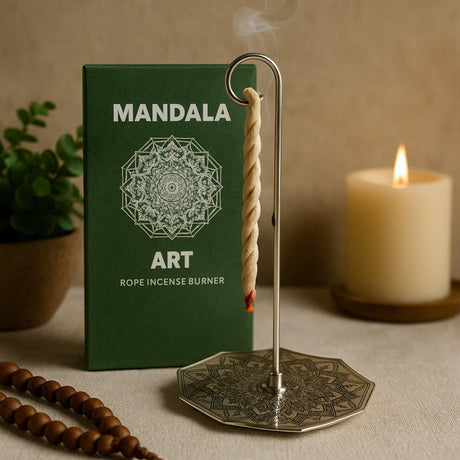
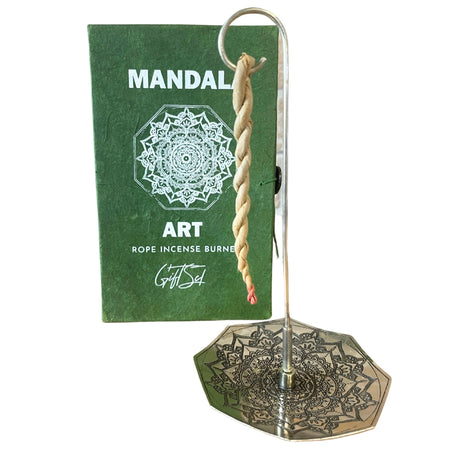
A daily practice does not primarily ask for time. It asks for three things, and they are more structural than spiritual. First, a physical anchor: one object, in one place. The mala on the tray. A stick of Sandalwood Incense Sticks 15g Satya beside it, unlit until the practice begins. The object does not perform the practice; it marks the territory where the practice lives. Second, a fixed time — not "when I feel ready", but a time chosen in advance, held as a commitment rather than a preference. Third, a threshold low enough that tiredness is not an excuse. If the practice requires optimal conditions, it will not survive a difficult week. For japa, that might be one round instead of three. The practice continues; the volume adjusts.
A Velvet Area Rug, 128 x 75 cm placed consistently in the same spot can serve this anchoring function — a defined physical space that the body begins to associate with stillness before the mind has caught up. The body learns faster than the will.
The Thing the Guides Leave Out
Here is what almost no guide to daily practice will tell you: on most days, it will feel like nothing. The mind will wander. The mantra will be mechanical. The incense will burn and the round will end and you will stand up feeling more or less as you sat down. This is not a sign that the practice is failing. It is the practice.
The Bhagavad Gita addresses this directly, in what is perhaps its most cited verse. Chapter 2, verse 47: "You have a right to perform your prescribed duties, but you are not entitled to the fruits of your actions." The daily practice is the duty. The transformation, if it comes, is not the point of entry. You do not sit down because you expect to feel different afterward. You sit down because it is the time, and the mala is there, and this is what you do.
In my own practice, the days that felt empty were often the ones that mattered most — not because something hidden was happening, but because showing up without expectation is itself the discipline. The Gita's instruction is not consolation for a practice that isn't working. It is the description of what a practice actually is.
The mala will be on the tray tomorrow morning before you decide whether you feel like it. That is the whole architecture.