Some things are worth doing slowly. Grinding sandalwood on stone is one of them, not because the result demands it, but because the doing is the point.
Twenty Minutes, a Stone, a Stick
Take a sandalwood stick. Wet the surface of a flat granite stone with a few drops of water. Press the stick down and begin to move it in slow circles. Nothing happens at first, just the soft scrape of wood on stone, a faint warmth under your palm. Then, gradually, a pale cream paste begins to appear at the edges of the motion. The scent arrives before you notice it consciously: cool, woody, faintly sweet, rising from the friction like something the wood has been holding in reserve.
This is ghisnā, the traditional preparation of chandana, sandalwood paste. It takes fifteen to twenty-five minutes of unhurried, continuous motion. There is no shortcut that preserves the result. The paste is used fresh; once ground, the aromatic compounds begin to dissipate, so it is never stored. The impermanence is not a flaw. It is the instruction: do this now, use it now, begin again tomorrow.
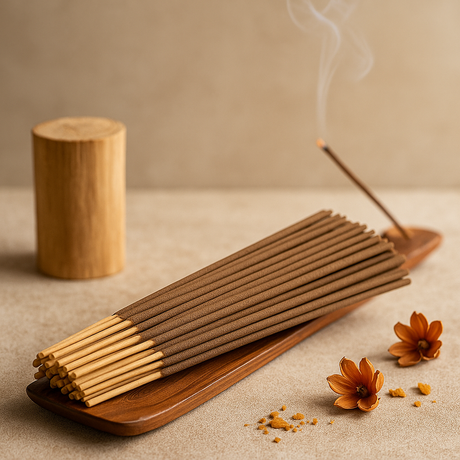
The preparation is the practice. Not a prelude to something more important, the act itself, the circular motion, the attention it asks for, the scent that builds as you work. If you find yourself reaching for sandalwood incense sticks as a quicker way into the same stillness, that is a reasonable choice, but it is worth knowing what the longer version feels like at least once.
Where the Wood Comes From
Santalum album — Indian sandalwood, grows across peninsular India, but Karnataka, formerly Mysore state, holds some of the most significant natural stands and has declared it the state tree. The tree is not in a hurry. The heartwood, where the fragrant oil lives, does not develop until the tree is at least fifteen years old. Full quality, the deep, lasting scent that comes from the highest concentration of alpha- and beta-santalol, is typically reached between twenty-five and thirty years of growth. The sapwood has almost none of it. Patience is not a virtue the tree performs; it is simply how the wood is made.
The Government Soap Factory in Bangalore, which its successor Karnataka Soaps and Detergents Ltd traces to 1916 and the initiative of Krishnaraja Wadiyar IV, Maharaja of Mysore, was established partly to channel sandalwood offcuts into soap rather than waste, slowing the depletion of a resource the state had regulated since the nineteenth century. The factory still runs. It remains among a small number of manufacturers still using genuine Santalum album oil. The wood it processes today was planted decades ago by someone who would not live to smell it.
Santalum album is listed as Vulnerable on the IUCN Red List. Slowness, here, is not aesthetic preference; it is the condition of the material's survival. When you hold a sandalwood bracelet and catch the scent warming against your skin, you are holding something that took thirty years to become itself.
Chandana: Ritual and Application

In Shaiva and Vaishnava Hindu traditions, chandana paste is applied to the forehead, throat, and chest before or during puja. It is associated with cooling, purity, and the quieting of the mind before prayer. The application is not decoration. It is a mark of readiness to be still.
Sandalwood's place in Indian ritual is old. It is referenced across Sanskrit literature and the Agamic tradition, and it is counted among the shodashopachara — the sixteen traditional offerings in formal puja. The paste is prepared fresh, applied with the fingertips or a small spatula, and the scent has been part of this preparation for a very long time, reached for as a way of marking the transition from ordinary time into something quieter. The grinding itself is part of the ritual: the stone, the water, the slow circles, the moment the scent rises.
Action Without Grasping
The Bhagavad Gita, in its third chapter on Karma Yoga, introduces the idea of niṣkāma karma — action without desire for its fruits. Doing something fully, without grasping at what it will produce. The grinding of chandana sits quietly inside this idea: twenty minutes of circular motion that yields a paste used once and not kept, a scent that dissipates by evening. Nothing accumulates. The attention given to the stone is not banked anywhere.
A rudraksha mala kept nearby during the preparation gives the hands something to return to between strokes — 108 beads, one breath per bead, a quiet count that holds the attention without directing it anywhere in particular.
A Felt Shelf

These are the objects that accompany the practice — not tools that do the work, but things that make the conditions for it.
- Light one at the start of a quiet hour; the scent arrives before thought does.
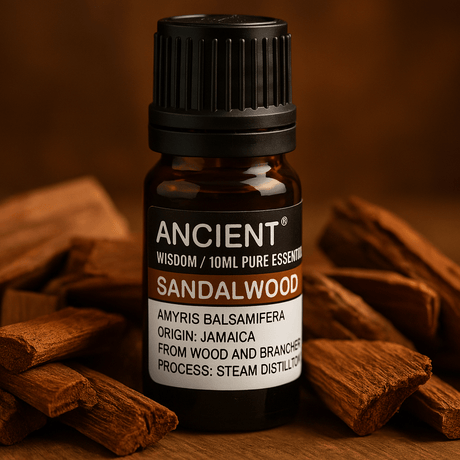
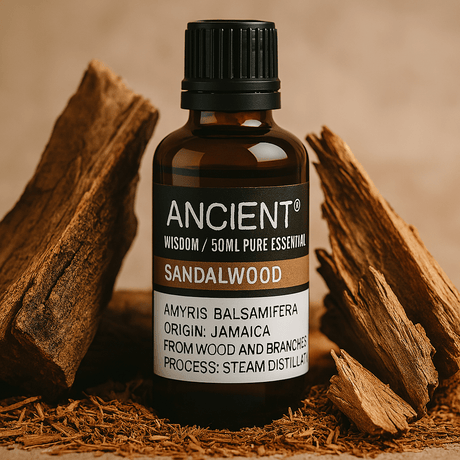
- Sandalwood fragrance oil — a few drops warmed in a diffuser or added to an unscented carrier for anointing.
- A rudraksha mala — held during the grind or used for breath-counting in the stillness after. Traditional in both Hindu and Buddhist meditative practice; the beads are tactile in a way that anchors the hands when the mind wants to wander.

None of these objects will do the stillness for you. They are the conditions you set, the way you might clear a surface before sitting down to write. The doing — the twenty minutes, the circular motion, the attention — remains yours.