Tea prompts more reader questions than most subjects we cover — not about which tea, but about the gap between meaning to stop and actually stopping. These are the questions that keep arriving, answered as honestly as we can.
The real obstacle is not the kettle
I keep meaning to have a proper tea moment but I never actually stop. What's going on?
The obstacle is rarely equipment. It is permission: the deeply embedded cultural habit of treating a pause as something earned rather than something necessary. We finish the task, then we rest. We clear the inbox, then we breathe. Tea gets folded into that logic and becomes a reward deferred until the conditions are right, which means it almost never happens.
There is a Japanese phrase that reframes this entirely: ichigo ichie (一期一会), meaning "one time, one meeting." It was recorded in the circle of the tea master Sen no Rikyū in the sixteenth century and later attributed to the Edo-period official Ii Naosuke, c. 1858, in a text on the way of tea. The idea is precise: each gathering around tea is unrepeatable, and therefore deserves full attention. Not because it has been perfected, but because it will not come again.
Read that way, the cup in front of you is not a reward for finishing. It is its own complete event. Not "I will stop when I deserve it" but "this particular cup, at this particular hour, will not exist again." The permission was always yours to give.
On vessels, trays, and the minimum viable moment
Do I need special equipment? I just have a mug and a kettle.
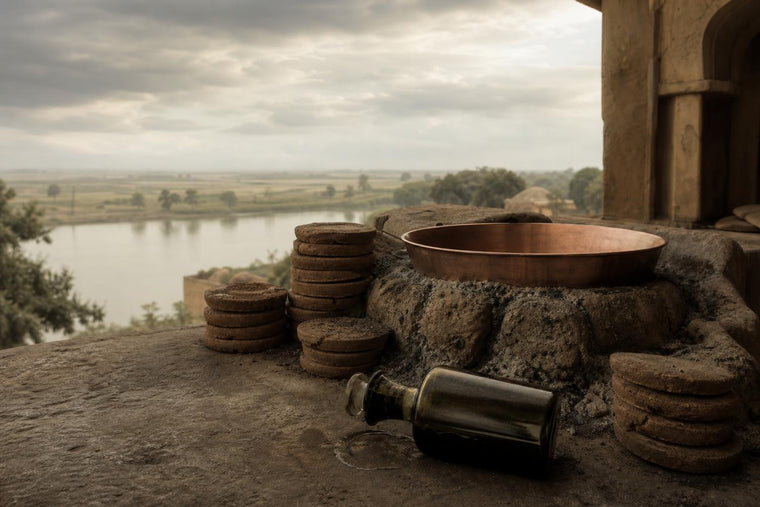
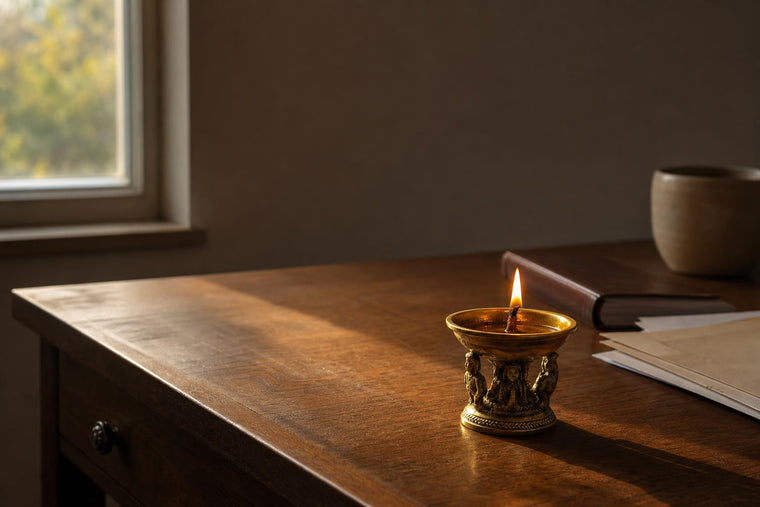
No. The Chinese literati tradition of desk tea, known as wenren cha, is associated with Song-dynasty literati culture — scholars who kept a small brazier and a single bowl at the writing desk as part of daily intellectual life. Not a dedicated room. Not a curated tray. A bowl, a source of heat, and the decision to be present for the duration of the cup.
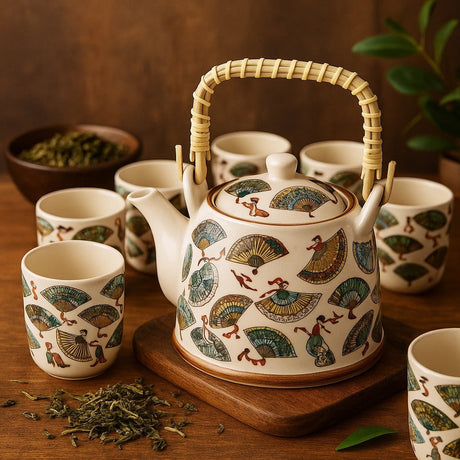
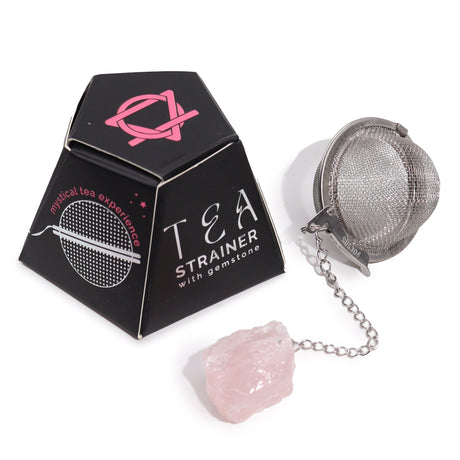
The minimum viable moment is: one vessel, one tea, no screen for as long as the cup lasts. That is the whole structure. A rose quartz tea infuser or a handthrown pot can accompany the practice beautifully, but neither is the practice. The object accompanies; the person decides to stop.
One practical note worth knowing: water temperature does affect what ends up in the cup. Green teas are generally brewed cooler, around 70–80 °C; black and pu-erh teas closer to boiling; white teas somewhere between. These are not rules requiring a thermometer. A kettle left to rest for two or three minutes after boiling will drop into a useful range for most teas. The point is not precision; it is attention. Noticing the steam is already a form of presence.
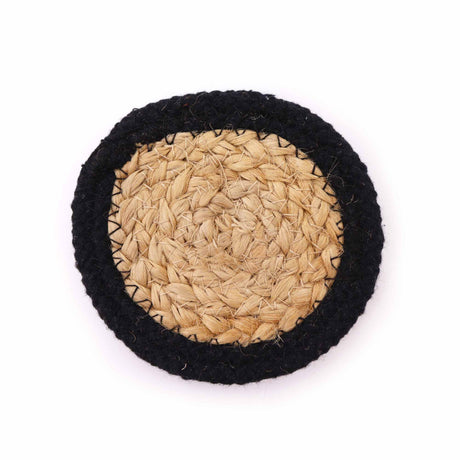
If you want to extend the surface a little, a vetiver placemat beneath the cup marks the spot as intentional. But it is an addition, not a prerequisite.
When the practice becomes another performance
How do I stop it from becoming one more thing I have to do correctly?
The moment a tea moment becomes a performance, it has already failed its purpose. This is the trap that gear-led approaches quietly set: once you have the right kettle, the right temperature, the right steeping time logged in a notebook, you have replaced one form of striving with another. The autopilot has simply changed costume.
Ichigo ichie is useful here again, because it removes the category of "correct." There is no replicable ideal version of this cup to aim for. There is only this cup, now. If the tea is slightly too strong, that is what this particular meeting tastes like.
A practical anchor: let the cup be the timer. When it is empty, the pause is complete. No log, no photograph, no assessment of whether you did it well. The practice self-selects honestly. Either something shifted in the quality of your attention, or it did not, and both are information worth having.
It is worth noting one honest complexity here: the traditions that gave us cha dao were not monolithic. Chinese and Japanese tea culture developed along distinct lines, sometimes in dialogue, sometimes in parallel — and within each, there were always practitioners who treated the form as an end in itself, and others who treated it as a means. The question of which approach is "correct" was never settled, which is perhaps the point.
A bowl of ceremonial matcha prepared with care carries that history lightly; it does not require you to know the history for the attention to be real.
Some traditions survive not because they are spectacular, but because someone quietly repeats them every morning. The room changes almost imperceptibly. Not because the ritual performs some hidden work, but because you have stopped rushing through it.
That is enough. That is, in fact, the whole thing.