Each month, readers write in with questions about their practice. This column answers the ones that keep arriving: the honest, specific, sometimes uncomfortable ones that deserve a real reply.
On beginning, and on going stale
Q: I've set up an altar but I don't know what to do when I stand in front of it.
This is the right question to start with, because it names the gap that no arrangement guide addresses. You have the shelf, the objects, perhaps a candle. You stand there. Nothing happens.
The oldest surviving textual record of the domestic sacred space, the Grihyasutras (Vedic household manuals composed roughly between 800 and 200 BCE, though estimates vary), does not specify which objects to place. It specifies which actions to repeat. The lighting. The offering. The moment of directed attention. The altar, in that tradition, is defined by the practice given to it, not by the things arranged upon it. The Sanskrit words sthana (place) and puja (worship or offering) together describe the principle: the place becomes sacred through the regularity of the act, not through the quality of the furniture.
Three entry points, none of which require anything beyond presence: light something, a candle or a stick of incense, and watch it for a moment before you do anything else. Stand still long enough to notice you have arrived. Speak one intention aloud, or silently, that is specific to this day. That is enough. The Grihyasutra texts distinguish between the daily obligatory rite (the nitya karma, the thing you simply do) and the occasional or aspirational rite. The daily practice is not supposed to be elaborate. It is supposed to be repeated.
Q: My altar has stopped meaning anything to me. I walk past it without seeing it.
This is an honest altar question, and one rarely addressed in most setup guides. It is also entirely normal, and it has a name in perceptual psychology: habituation. The nervous system reduces its response to stimuli that do not change. A permanent, unvarying altar can become, quite literally, invisible to the person who arranged it.
Traditions have answered this problem practically, not philosophically. In Vaishnava puja, fresh flowers are offered daily: not as decoration, but because wilted flowers signal inattention, and the act of replacing them requires you to actually look. In Tibetan and some East Asian Buddhist traditions, water offerings are changed each morning for the same reason. The altar is a living thing maintained by small acts of change, not a permanent installation that maintains itself.
It is worth noting that traditions differ on how much deliberate novelty is welcome, some lineages emphasise strict consistency of form as itself a discipline, and the monotony is the point. Both approaches are real. The question is which one you are actually practising, and which one you are simply defaulting to.
Practical responses that do not require rebuilding everything: rotate one object seasonally, or when something in your life shifts. Bring in a leaf, a stone from a walk, a flower from the market. Change the direction you approach from. These are not superstitions; they are ways of interrupting the autopilot that turns a meaningful space into wallpaper.
On objects, and on temporary spaces
Q: Does it matter what objects I put on it, or is any meaningful object fine?
Both are real, and they are not in competition.
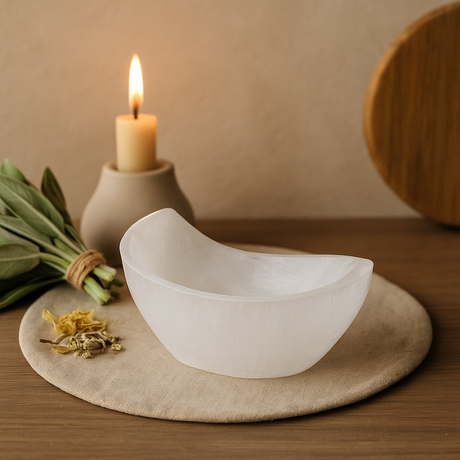
Objects chosen for traditional association, a murti, a yantra, a specific stone, carry the weight of a practice that has been repeated by many people over a long time. That accumulated intention is not nothing, even if you hold it lightly. A piece of selenite, for instance, has been reached for across traditions as a stone associated with clarity and with the quality of light; whether you understand that as energetic, symbolic, or simply aesthetic, the association is there and you can work with it consciously.
Objects chosen for personal resonance, a photograph, a stone from a place that changed you, a gift from someone whose steadiness you want to remember, carry a different kind of weight. The altar holds both. The only criterion worth applying is whether you can say, honestly, why each object is there. An altar that has accumulated things without that question being asked tends to become a shelf. The question is the practice.
Q: I share a flat and can't have a permanent altar. Is a temporary one valid?
Yes, and historically the temporary altar is arguably more common than the permanent shelf. The Vedic domestic ritual was performed at a freshly prepared space each morning, not at a fixed installation. The folded cloth or mat (the asana) appears in both Vedic and Tantric sources as a portable sacred boundary: the space is consecrated by the act of preparation, not by its permanence. You set it up; that act is the beginning of the practice.
A folded cloth, a single candle, a mala: the practice is portable. Japa, repetitive mantra recitation, is explicitly described in practice literature as valid whether performed at a fixed altar or in transit. What makes a space an altar is the repeated act of arriving at it with intention. The five minutes you take to set it up each morning may, in fact, be more honest than a permanent shelf you have stopped seeing.
What the altar is actually for
The question that arrives most often, in different forms, is really one question: how do I make this real? The answer the Grihyasutra tradition gives, and that my own japa practice has confirmed, slowly, over years, is that the altar becomes real through the repetition of small, specific actions. Not through the right objects, not through the right arrangement, not through the right amount of time spent standing in front of it.
Two minutes of full attention outweighs twenty of distraction. The texts specify actions, not durations. The altar is not waiting for you to get it right. It is waiting for you to arrive.
The room changes almost imperceptibly when you do. Not because the space performs some hidden work, but because you have stopped moving through it without noticing.